




AIDEVI Wellness Guide
What Is TMG Supplement? Trimethylglycine Explained
TMG, short for trimethylglycine, is a methyl donor also known as betaine. People use TMG supplements because methyl groups are involved in normal methylation processes, including homocysteine-to-methionine metabolism and broader cellular wellness routines. The simplest way to understand TMG is this: it is not a stimulant or an NAD+ precursor, but it often appears beside NAD+, nmn, and B-vitamin conversations because methylation helps the body manage many biochemical pathways.
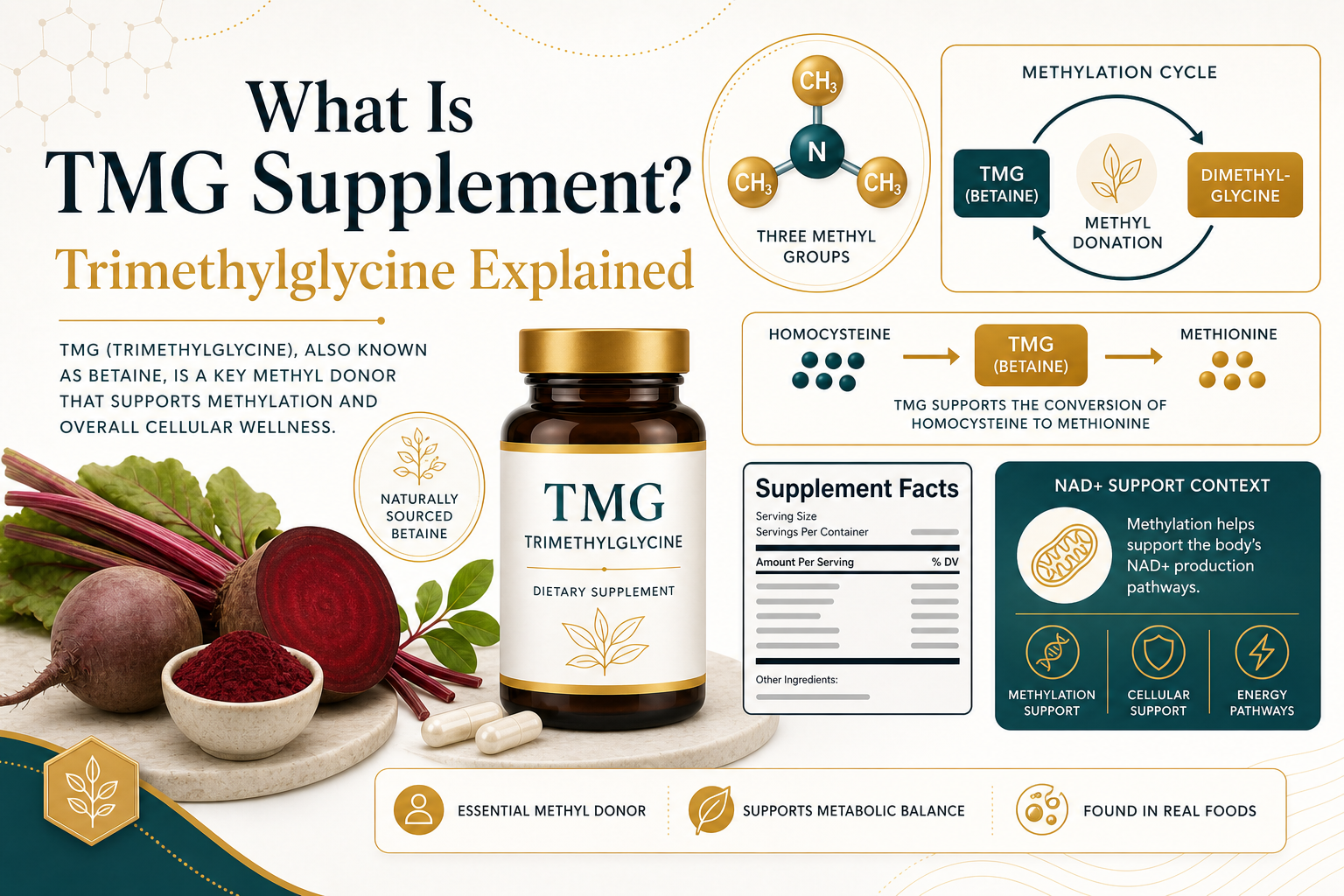
- TMG means trimethylglycine; betaine is the same compound name commonly used in nutrition and research.
- TMG provides methyl groups that help support normal methylation pathways.
- TMG is often discussed with B vitamins, homocysteine metabolism, NAD+ support, and NMN routines.
- A TMG supplement is not automatically right for everyone; label clarity, health context, and medication use matter.
Content
What does TMG mean?
TMG means trimethylglycine. The name tells you a lot: “tri” means three, “methyl” refers to methyl groups, and “glycine” points to its relationship to the amino acid glycine. In simple terms, TMG is glycine with three methyl groups attached. Those methyl groups are the reason TMG is usually described as a methyl donor.
Methyl donors are compounds that can participate in methylation, a normal biochemical process involved in many cellular functions. Methylation is not one single benefit. It is a broad set of reactions that touches DNA regulation, neurotransmitter metabolism, liver pathways, creatine synthesis, phospholipid metabolism, and homocysteine metabolism. That is why TMG can appear in very different wellness conversations, from healthy aging to energy routines to methylated multivitamins.
For readers who are new to the category, it helps to separate “what TMG is” from “why someone might take it.” TMG is the compound. The supplement use case is usually methylation support or homocysteine metabolism support. It is not the same as NMN, NAD+, NR, CoQ10, or a B-complex, even if it can sit next to those ingredients in a broader cellular wellness plan.
How is TMG different from related ingredients?
The fastest way to understand TMG is to compare it with the ingredients it is often confused with. TMG and betaine are usually the same compound. TMG and methylfolate are both part of methylation conversations, but they are not interchangeable. TMG and NMN sit in related longevity routines, but TMG supports methyl-group availability while NMN supports NAD+ pathways.
| Term | What It Is | Do Not Confuse It With |
|---|---|---|
| TMG | Trimethylglycine, a methyl donor used in methylation-support routines. | A stimulant, B vitamin, NAD+ precursor, or guaranteed lab-result solution. |
| Betaine | Another common name for trimethylglycine in nutrition and supplement contexts. | A separate ingredient from TMG unless the label specifies another betaine form. |
| Methylfolate | An active folate form often used in methylated multivitamins. | TMG; they support related pathways but play different roles. |
| NMN | A nutrient discussed as a precursor in NAD+ support routines. | TMG; NMN is about NAD+ context, while TMG is about methylation context. |
Is TMG the same as betaine?
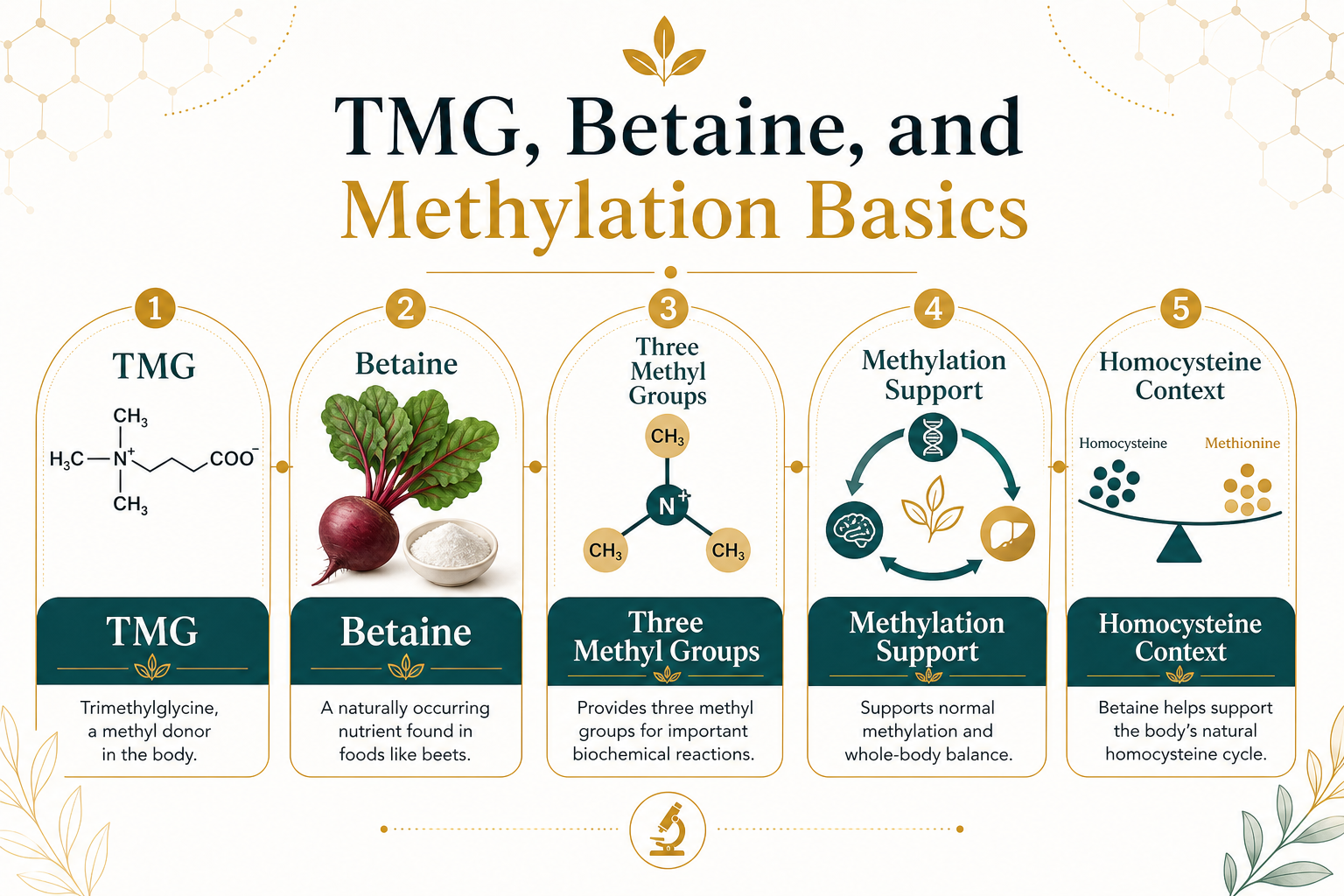
Yes. In supplement and nutrition contexts, TMG and betaine usually refer to the same compound: trimethylglycine. The term betaine is common because the compound was first identified in sugar beets, and beets remain one of the familiar food associations. You may see a label say “TMG,” “trimethylglycine,” “betaine,” or sometimes “betaine anhydrous.” For a shopper, the key is to read the Supplement Facts panel and confirm what form and amount are actually listed.
Betaine is also discussed in clinical and nutrition literature in relation to homocysteine metabolism and liver-related biochemical pathways. NCBI's LiverTox monograph describes betaine as a naturally occurring compound and methyl donor used in specific medical contexts under professional supervision [1]. That does not mean a dietary supplement should be treated like a drug. It means the compound has a real biochemical identity, and consumers should avoid vague marketing claims that never explain the methylation context.
| Term on Label | Plain-English Meaning | What to Check |
|---|---|---|
| TMG | Short name for trimethylglycine. | Serving size and whether it is a standalone formula or part of a blend. |
| Trimethylglycine | The full compound name; glycine carrying three methyl groups. | The amount per serving and label directions. |
| Betaine | Another common name for TMG, associated with beet-derived nutrition history. | Whether the label means betaine/TMG or another betaine-related ingredient. |
What does TMG do in methylation?
TMG supports methylation by donating methyl groups through the betaine-homocysteine methyltransferase pathway. In that pathway, betaine can help support the conversion of homocysteine to methionine. Homocysteine is a normal amino acid intermediate, and methionine is an essential amino acid involved in methylation cycles. This is the reason TMG is frequently discussed alongside folate, vitamin B12, vitamin B6, choline, and other nutrients connected to one-carbon metabolism.
The NIH Office of Dietary Supplements notes that choline and its metabolite betaine are involved in methyl-group metabolism and homocysteine-related pathways [2]. That does not mean every person needs a TMG supplement. It means TMG belongs in the methylation conversation, especially when someone is trying to understand labels, B-vitamin status, or why certain NAD+ routines mention methyl support.
A helpful comparison is methylated multivitamins. They usually focus on forms of B vitamins such as methylfolate or methylcobalamin, while TMG is a separate methyl donor. AIDEVI's guide to methylated vs regular multivitamins is a useful next read because it explains why nutrient form matters. TMG is not a replacement for all B vitamins, but it may be considered in a routine where methylation support is the central question.
Why is TMG discussed with NAD+ and NMN?
TMG is discussed with NAD+ and NMN because NAD+ metabolism, methylation, and cellular energy pathways are often considered together in longevity routines. NMN is a precursor used in the body's NAD+ pathway, while TMG is a methyl donor. They are not the same category of ingredient. The connection is that some users want to support NAD+ pathways while also thinking about methylation capacity and overall nutrient balance.
If NAD+ is the part you are trying to understand, start with the AIDEVI explainer on what NAD is and why it matters for cellular energy. If you want the biochemical loop, the guide to the NAD to NADH cycle gives more context. Those articles answer a different question than this one: they explain NAD+ biology, while this article explains why TMG may appear as methylation support nearby.
For shoppers comparing NAD+ ingredients, AIDEVI also has a guide to NAD+ vs NMN differences. That distinction matters because adding TMG should not be treated as adding “more NAD.” It is a support ingredient with a different job. The practical routine question is: are you building an NAD+ stack, a methylation stack, or a general healthy-aging stack? Each one leads to different label checks.
What is TMG not?
TMG is not a stimulant, a hormone, a B vitamin, or a direct anti-aging shortcut. It is also not a substitute for medical testing when someone has been told to monitor homocysteine, cardiovascular risk markers, liver health, or nutrient status. This distinction matters because methylation language can become vague very quickly online. A supplement can support normal nutrient pathways without being a treatment for a disease or a guarantee of better lab numbers.
TMG is also not automatically necessary just because someone takes NMN. Some NAD+ users may discuss methyl support because NAD+ metabolism and methylation share biochemical context, but that does not create a universal rule. A person with a simple routine, varied diet, and no specific methylation concern may not need to add another capsule. A person using a multi-ingredient longevity stack may already have methyl-support nutrients included. The label and the reason matter more than the trend.
Finally, TMG is not interchangeable with every “methyl” ingredient. Methylfolate, methylcobalamin, choline, SAMe, and TMG all appear in methylation conversations, but they are not the same tool. Thinking of them as a team of related nutrients is more accurate than thinking of them as duplicates. This is why a buyer should avoid building a routine from buzzwords alone. The goal is not to collect every methyl donor; it is to understand which gap, if any, you are trying to address.
How do you decide if TMG fits your routine?
Start with your goal. If your goal is simply “more energy,” TMG may not be the first ingredient to evaluate. If your goal is methylation support, homocysteine metabolism support, or a more complete NAD+ routine, then TMG becomes more relevant. Next, check whether your current multivitamin, B-complex, choline product, or longevity stack already addresses methylation. More methyl-related ingredients are not automatically better.
Timing also matters for routine design. Some users prefer taking methylation-support ingredients earlier in the day, while others follow the label or professional advice. If timing is your main question, the AIDEVI guide to the best time to take a TMG supplement is the most relevant follow-up. For a bigger lifestyle view, the article on ways to support NAD levels naturally can help keep supplement choices connected to sleep, diet, exercise, and consistency.
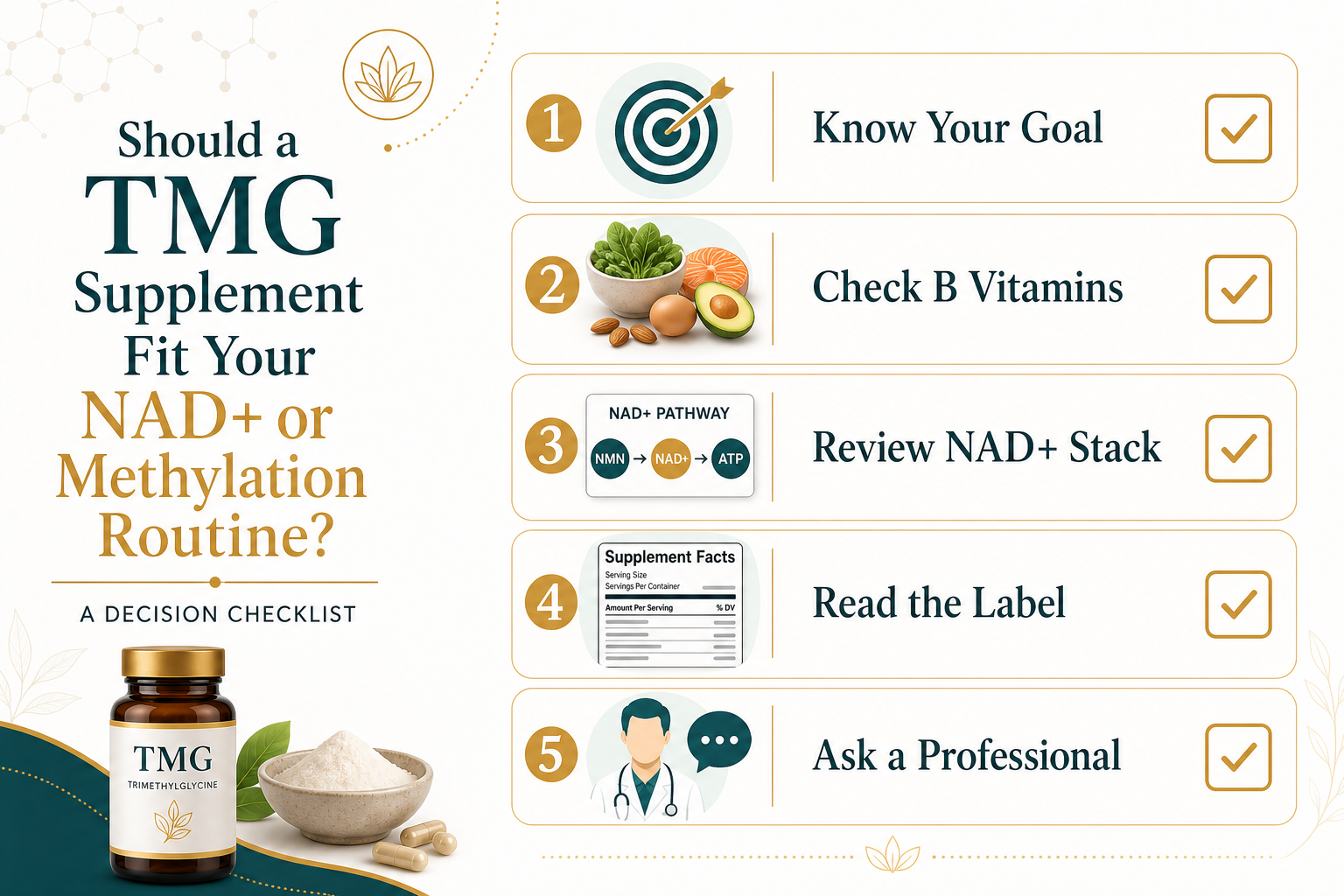
Use this five-step fit check before buying TMG: know your goal, check B-vitamin context, review any NAD+ or NMN stack, read the label carefully, and ask a healthcare professional if you take medication, are pregnant or nursing, manage a medical condition, or have been told to monitor homocysteine. TMG is a meaningful ingredient, but it is not a casual “add-on” for every routine.
A good label should make the form clear, show the amount per serving, explain serving directions, and avoid exaggerated medical promises. Be cautious with any product page that claims to treat disease, fix methylation for everyone, or guarantee anti-aging outcomes. Supplement decisions should be specific, boringly practical, and tied to your real routine.
If you start TMG, keep a simple note with the product name, serving direction, time of day, and the reason you added it. That record makes it easier to review your routine later and prevents TMG from becoming another unexplained bottle in a crowded supplement stack.
| Buyer Question | Practical Check |
|---|---|
| Am I buying this for methylation? | Make sure the label, formula, and timing actually match a methylation-support goal. |
| Do I already take related nutrients? | Review B vitamins, choline, multivitamins, NAD+ products, and methyl-support blends before adding TMG. |
| Can I explain the role in one sentence? | If the answer is only “it is popular,” keep researching before you buy. |
| Do I need professional input? | Ask before use if you take medication, manage a condition, are pregnant or nursing, or track homocysteine. |
Conclusion
TMG is trimethylglycine, also known as betaine. Its main identity is as a methyl donor involved in normal methylation and homocysteine metabolism pathways. That is why TMG often appears beside B vitamins, NAD+ support, and NMN routines, even though it is not the same type of ingredient. The best way to evaluate a TMG supplement is to ask what role it plays, whether your routine already covers that role, and whether your health context calls for professional guidance before use.
Frequently Asked Questions
Is TMG the same thing as betaine?
Yes, in most supplement and nutrition contexts, TMG, trimethylglycine, and betaine refer to the same compound. Always check the Supplement Facts panel to confirm the exact listed ingredient and serving directions.
Is TMG a B vitamin?
No. TMG is not a B vitamin. It is a methyl donor that is often discussed alongside folate, vitamin B12, vitamin B6, choline, and methylated multivitamins because those nutrients also connect to methylation pathways.
Does TMG increase NAD+?
TMG is not an NAD+ precursor like NMN or NR. It is usually discussed as methylation support that may sit beside NAD+ routines. Do not treat TMG as a direct replacement for NAD+, NMN, or NR.
Who should ask a healthcare professional before taking TMG?
Anyone who is pregnant, nursing, taking medication, managing a medical condition, monitoring homocysteine, or using a complex supplement stack should ask a healthcare professional before starting TMG.
References
These statements have not been evaluated by the Food and Drug Administration. This product is not intended to diagnose, treat, cure, or prevent any disease. Consult a healthcare professional before starting any new supplement, especially if pregnant, nursing, taking medication, or managing a medical condition.
