







AIDEVI Wellness Guide
TMG Morning Routine With B Vitamins and NAD+ Support
A TMG morning routine can make sense when your goal is methylation support, homocysteine metabolism context, or a more organized NAD+ wellness stack. The best routine is not “take everything at sunrise.” It is a clear sequence: hydrate, anchor supplements around food if the label allows, understand how B vitamins and TMG play different methylation roles, and keep NAD+ support ingredients in their own category.
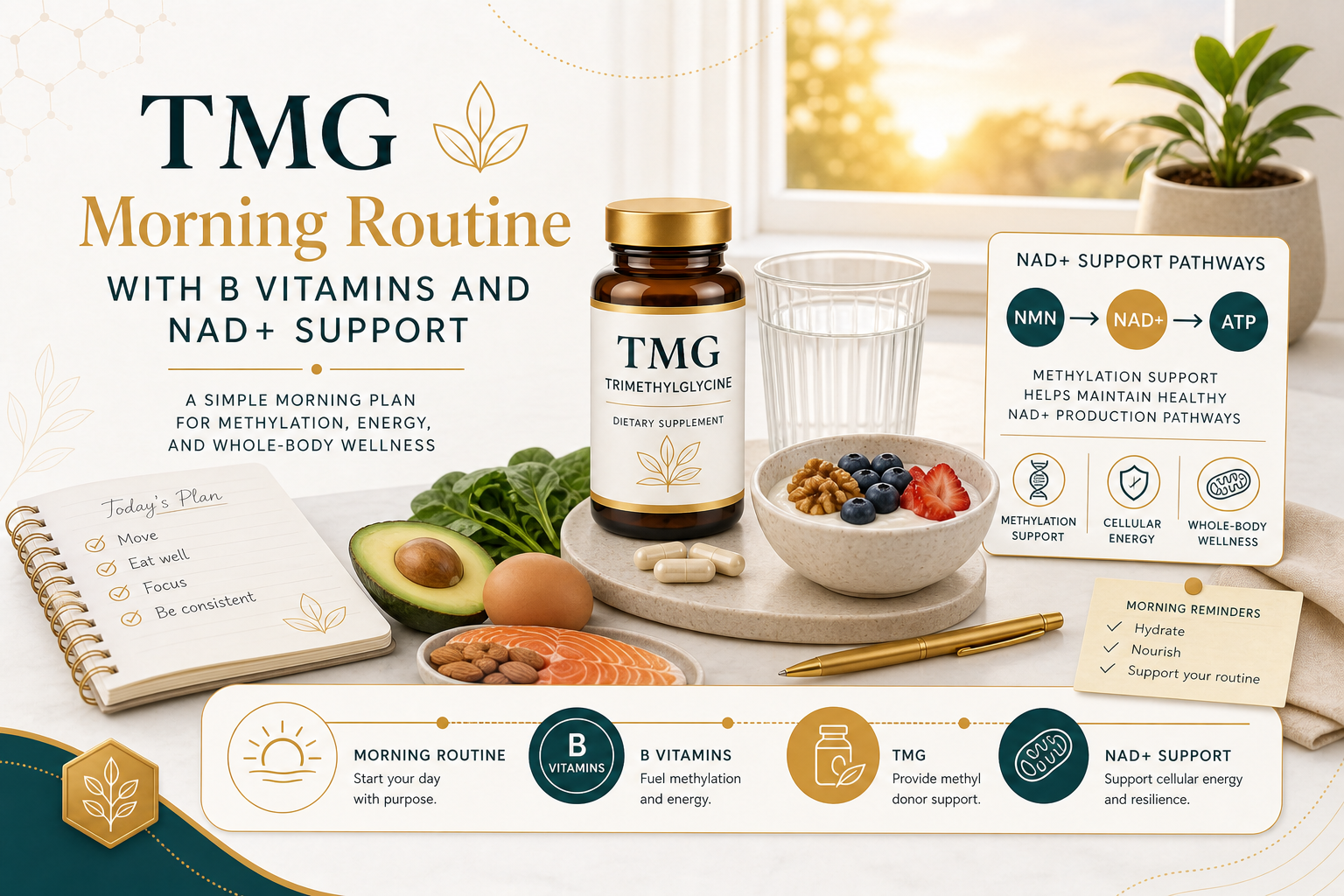
- TMG is usually discussed as a methyl donor, while B vitamins support related one-carbon and methylation pathways.
- Morning is a practical time for many people because it pairs well with hydration, breakfast, and a consistent supplement habit.
- TMG is not an NAD+ precursor; it may sit beside NAD+ support, but it does a different job.
- Ask a healthcare professional before using TMG if pregnant, nursing, taking medication, managing a condition, or monitoring homocysteine.
Content
- Does TMG fit better in the morning?
- How should TMG and B vitamins be separated conceptually?
- Where does NAD+ support fit?
- How do you build a simple morning routine?
- What are three practical morning routine scenarios?
- What should you track after starting?
- What should you check before combining them?
- Frequently Asked Questions
Does TMG fit better in the morning?
TMG does not have to be a morning-only supplement, but morning is often the easiest time to use it consistently. Many people already connect morning habits with water, breakfast, B vitamins, and energy-support routines. If the product label allows morning use and your healthcare professional has not advised otherwise, morning can be a practical anchor because it reduces missed servings and makes the routine easier to review.
The better question is not “morning or night?” It is “what problem does the timing solve?” If morning timing helps you take TMG with food, avoid late-day routine clutter, and keep your NAD+ support plan organized, it has a reason. If it makes you rush, forget label directions, or stack too many products at once, the timing is not helping. AIDEVI's guide to the best time to take a TMG supplement is the most relevant follow-up for readers deciding between morning, food timing, and personal comfort.
Think of morning as a habit container, not a biochemical magic window. Hydration, a simple breakfast, light exposure, movement, and a clear supplement plan may all make the day more consistent. TMG can fit inside that container when methylation support is the actual goal.
How should TMG and B vitamins be separated conceptually?
TMG and B vitamins are related, but they are not the same tool. TMG, also called betaine, is commonly described as a methyl donor. Certain B vitamins, including folate, vitamin B12, and vitamin B6, are involved in one-carbon metabolism and homocysteine-related pathways. NIH resources describe choline and betaine as part of methyl-group metabolism, while B vitamins have their own roles in normal nutrient metabolism [1].
This matters because people sometimes over-stack methylation products. A methylated multivitamin, a B-complex, a choline product, and TMG may all appear in the same shopping cart. That does not mean they all belong in the same morning routine. If you are comparing nutrient forms, AIDEVI's article on methylated vs regular multivitamins can help clarify why form and context matter.
A useful rule is to assign each item one job. B vitamins may support normal energy metabolism and methylation-related pathways. TMG may support methyl-group availability and homocysteine metabolism context. Food supports the baseline. If two products claim the same job, compare the labels before assuming they are complementary.
Where does NAD+ support fit?
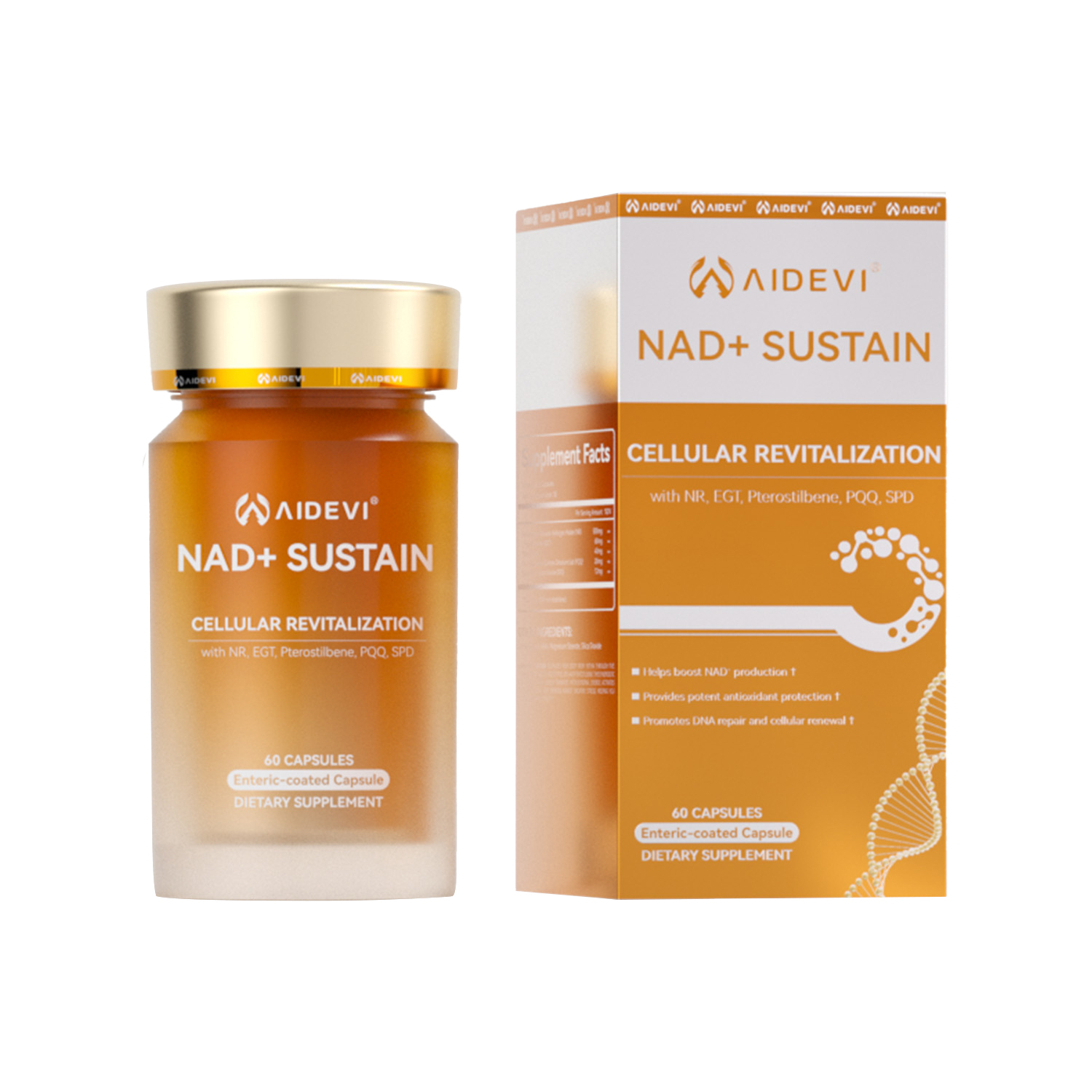
NAD+ support belongs beside the TMG conversation, not inside it. nmn, NR, NAD+ supplements, and lifestyle habits are usually discussed around cellular energy and NAD+ metabolism. TMG is discussed around methylation. The connection is that people building healthy-aging routines often want both cellular energy support and methylation support to make sense together. The mistake is treating every ingredient as if it performs the same task.
If you are still learning the NAD+ side, start with the AIDEVI guide to what NAD is and why it matters for cellular energy. For the biochemical cycle, the NAD to NADH cycle article gives more depth. For shoppers comparing ingredients, the article on NAD+ vs NMN differences can help separate precursor logic from finished-compound language.
A morning routine can include NAD+ support, but it should not become a pile-on. If you use NMN, NAD+, a B-complex, a multivitamin, and TMG, write down the purpose of each one. If you cannot explain why each product is there, the routine needs editing before it needs another supplement.
How do you build a simple morning routine?
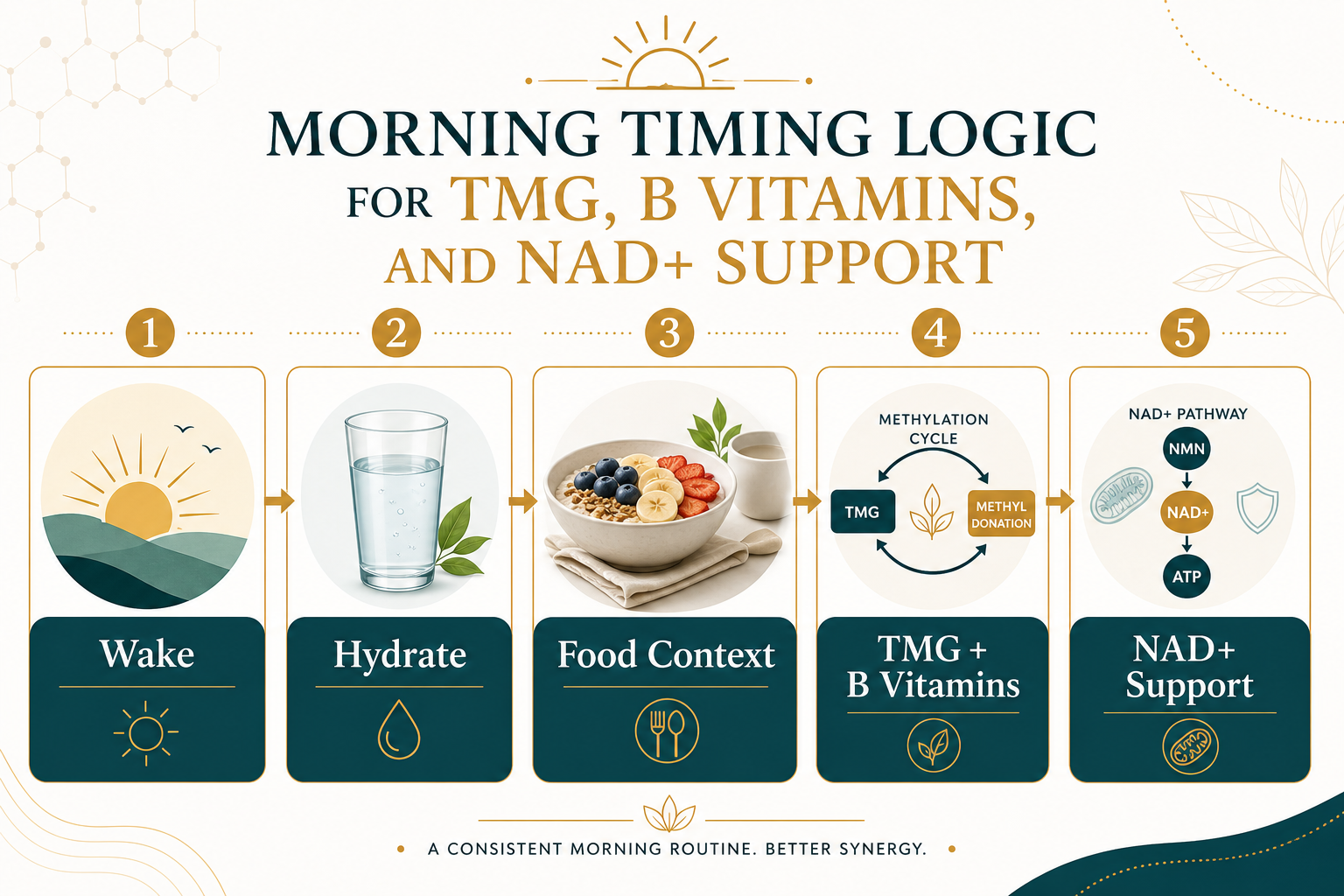
Build the routine from the outside in. Start with the habit you can repeat: wake, hydrate, eat if that works for the label, then take the products that genuinely belong in the morning. Do not begin by asking how many supplements you can combine. Begin by asking what the morning routine should accomplish: methylation support, nutrient consistency, NAD+ support, or general wellness structure.
| Morning Step | Purpose | What to Check |
|---|---|---|
| Hydrate first | Creates a consistent starting point before supplements. | Whether any product label requires food or specific directions. |
| Add food context | Helps organize B vitamins and routine comfort. | Whether breakfast fits your schedule and product directions. |
| Place TMG intentionally | Keeps methylation support separate from generic energy claims. | Why TMG is in your routine and whether related nutrients overlap. |
| Review NAD+ support | Keeps NMN, NAD+, and lifestyle support in their own category. | Whether your stack is complementary or simply crowded. |
Lifestyle still matters. Sleep, exercise, meal quality, and consistency are part of the NAD+ conversation too. AIDEVI's guide to ways to support NAD levels naturally can help prevent the routine from becoming supplement-only. The best morning plan usually has fewer moving parts than people expect.
What are three practical morning routine scenarios?
Not every user needs the same morning structure. A beginner, a methylation-focused user, and a NAD+ stack user are solving different problems. The routine should match the problem, not the number of bottles available. A beginner may only need to understand TMG timing and label directions. A methylation-focused user may need to compare TMG with B vitamins and diet. A NAD+ stack user needs to keep NMN, NAD+, and TMG roles separate so the morning does not become a confusing longevity bundle.
| User Scenario | Morning Focus | Best Next Question |
|---|---|---|
| TMG beginner | Keep the habit simple and follow the product label. | Can I explain why I am adding TMG? |
| Methylation routine user | Review B vitamins, choline, diet, and TMG together. | Am I duplicating methylation support? |
| NAD+ stack user | Separate NAD+ pathway support from methylation support. | Does TMG add clarity or just more complexity? |
The beginner scenario should stay boring: one change, one reason, one tracking note. The methylation scenario needs more label comparison because folate, B12, B6, choline, and TMG may all appear in related products. The NAD+ scenario needs the most discipline because longevity routines often expand quickly. If your morning routine requires a spreadsheet before breakfast, simplify it.
What should you track after starting?
Track the routine, not vague expectations. For two weeks, write down the time you take TMG, whether you took it with food, which B vitamins or NAD+ support products were used the same morning, and whether the routine felt easy to repeat. Also note comfort signals such as digestive changes, headache, sleep changes, unusual stimulation, or anything that feels different after adding the supplement.
This tracking does not prove that TMG caused a change, but it gives you a clean timeline. If you add TMG, a new B-complex, and a new NAD+ product on the same day, you will not know which variable mattered. One change at a time is slower, but it creates better information. That is the quiet advantage of a disciplined morning routine.
If the routine still feels confusing after two weeks, remove the least necessary variable and review again. A supplement plan that becomes simpler is often easier to follow and easier to discuss with a professional.
What should you check before combining them?
Before combining TMG, B vitamins, and NAD+ support, check your goal, current supplement stack, medication status, and label directions. Betaine has recognized biochemical roles and is discussed in clinical contexts under professional supervision [2]. That is a reason to be precise, not a reason to self-prescribe aggressively.
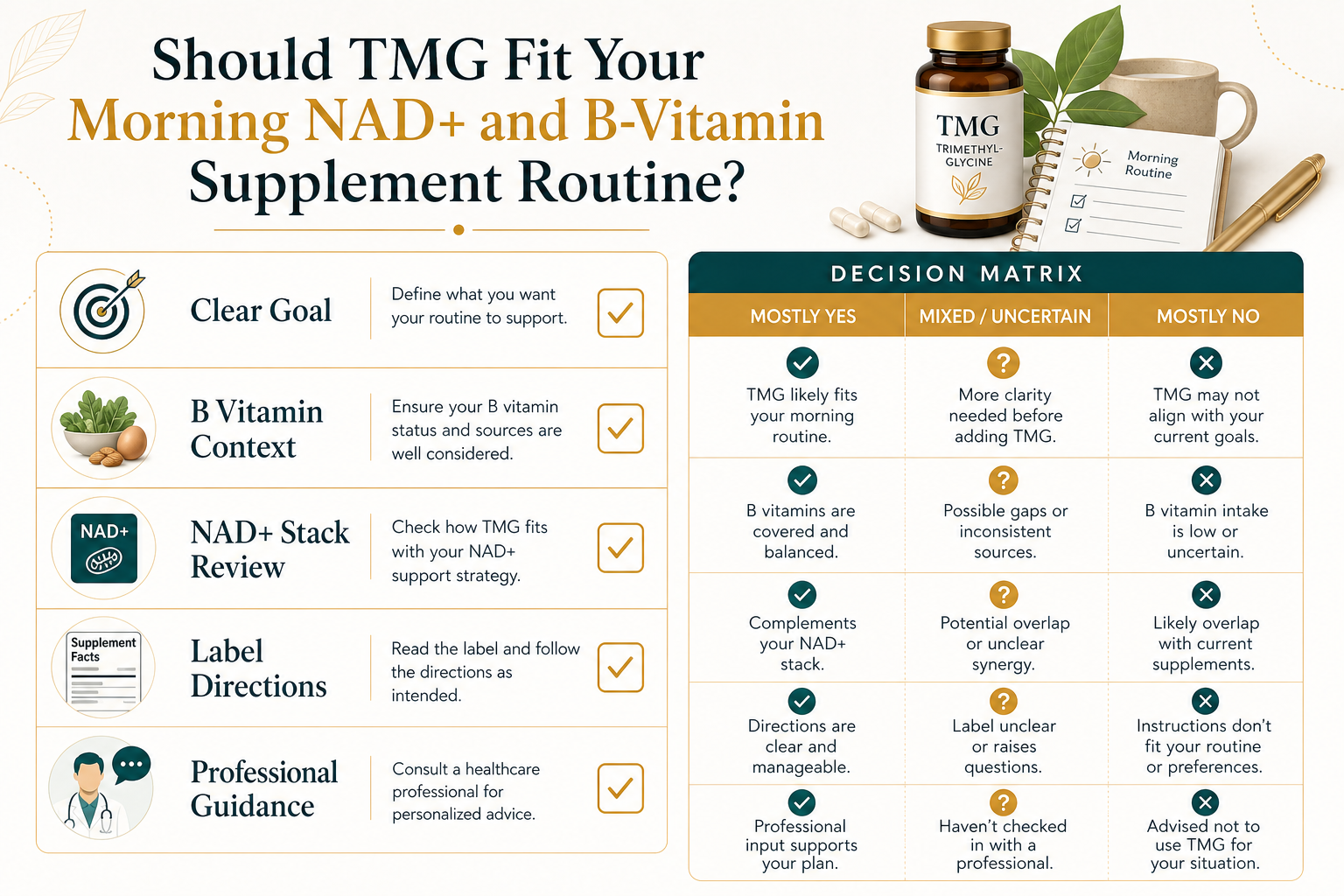
Use a simple fit test. If your goal is clear, your B-vitamin context is understood, your NAD+ stack is not overloaded, the label directions are manageable, and professional guidance supports your plan when needed, TMG may fit your morning routine. If those answers are mixed, slow down. More clarity should come before more capsules.
This is especially important if you monitor homocysteine, take medication, are pregnant or nursing, manage a medical condition, or have had unusual reactions to supplements. Supplement routines are easier to improve when they are written down. Keep a note with the product name, timing, reason for use, and any comfort changes you notice.
Also check for routine friction. A supplement plan can be scientifically interesting and still fail because it is inconvenient. If TMG with B vitamins and NAD+ support makes breakfast feel like a chore, adherence will suffer. Move from “maximum stack” to “minimum effective routine”: the fewest products that clearly support your goal, fit your label directions, and do not create avoidable confusion.
Finally, do not use morning timing to hide uncertainty. If you are unsure whether TMG belongs with your B-complex or NAD+ product, timing does not solve the question. The right move is to identify the role, compare labels, and ask for professional guidance when health context is complex. A clean routine is one where every product earns its place.
Conclusion
A TMG morning routine works best when it is structured, not crowded. Use morning as a reliable habit anchor, understand that TMG and B vitamins support related but different methylation pathways, and keep NAD+ support in its own category. The goal is not to take every healthy-aging ingredient at once. The goal is a routine you can explain, repeat, and adjust safely.
Frequently Asked Questions
Can I take TMG with B vitamins in the morning?
Many people place methylation-support ingredients in the morning because it is easier to remember, but the label and your personal context come first. TMG and B vitamins are related to methylation, yet they are not the same ingredient.
Should TMG be taken with NAD+ or NMN?
TMG is not an NAD+ precursor. It may sit beside NAD+ or NMN routines as methylation support, but it should be added only when the role is clear and the routine is not already overloaded.
Is breakfast necessary with TMG?
Not always. Follow the product label. Some people prefer supplement routines with breakfast because it is easier on the routine and helps them stay consistent, but label directions and individual tolerance matter.
Who should avoid combining TMG with a complex stack?
Anyone taking medication, managing a medical condition, pregnant or nursing, monitoring homocysteine, or using several methylation or NAD+ products should ask a healthcare professional before combining more ingredients.
References
These statements have not been evaluated by the Food and Drug Administration. This product is not intended to diagnose, treat, cure, or prevent any disease. Consult a healthcare professional before starting any new supplement, especially if pregnant, nursing, taking medication, or managing a medical condition.
