








AIDEVI Wellness Guide
TMG for Methylation: Common Lab Markers Explained
TMG is often discussed with methylation because it can act as a methyl donor, but lab markers should not be read as a simple “take TMG or do not take TMG” signal. Homocysteine, B12 status, folate context, MMA, and related bloodwork can give useful clues, yet they need professional interpretation, pattern recognition, and a review of diet, medications, supplements, and health history.
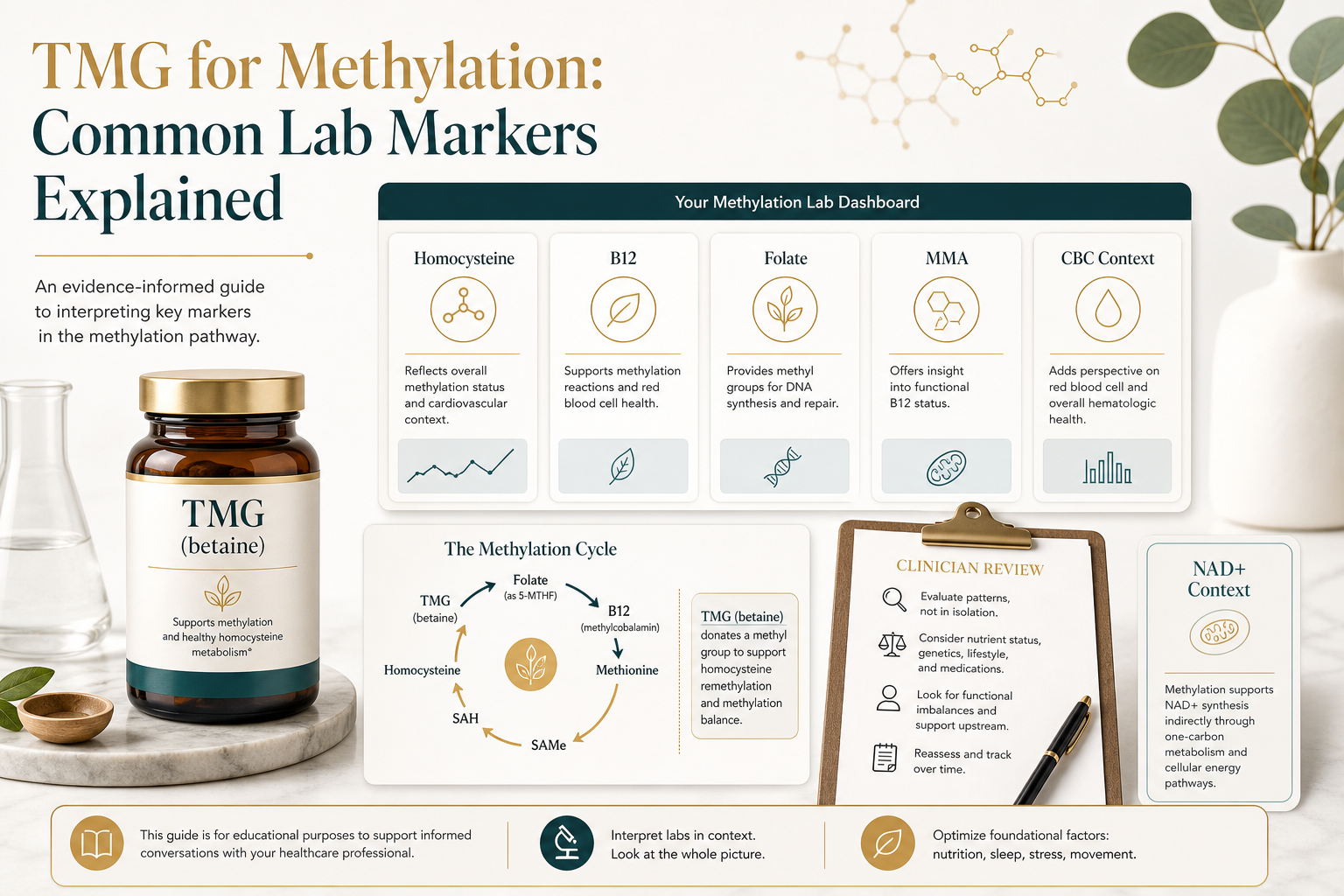
- Homocysteine is the marker most commonly connected to methylation discussions, but it is not a standalone diagnosis.
- B12, folate, MMA, and CBC context can help explain why a methylation conversation is more than one number.
- TMG may support methyl-group metabolism, but users should not use it to self-treat lab results.
- Bring lab results, supplement lists, and questions to a healthcare professional before changing a complex stack.
Content
- How should you read methylation lab markers?
- Why is homocysteine discussed with TMG?
- Which markers are commonly part of the conversation?
- What is a safe marker-reading framework?
- Where does TMG fit in this evidence picture?
- What should you not do after seeing a result?
- How do you discuss results with a professional?
- Frequently Asked Questions
How should you read methylation lab markers?
Read methylation-related lab markers as clues, not verdicts. A single result rarely explains the whole story. Homocysteine may point toward methylation and nutrient status questions, B12 and folate may clarify nutrient context, MMA may help with functional B12 interpretation, and CBC results may add a broader blood-health view. But the pattern matters more than any isolated line on a report.
That is why TMG decisions should not be made from a screenshot of one lab value. TMG, also called betaine, is usually discussed as a methyl donor. The NCBI LiverTox monograph describes betaine as a naturally occurring compound involved in methyl donation and used in specific medical contexts under professional supervision [1]. For supplement shoppers, the practical meaning is simple: understand the pathway, but do not turn an educational article into personal medical instruction.
If you need a foundation before reading lab discussions, the AIDEVI guide to the best time to take a TMG supplement explains TMG timing in a more routine-focused way. For nutrient-form context, the article on methylated vs regular multivitamins helps separate TMG from methylfolate, methylcobalamin, and B-complex decisions.
Why is homocysteine discussed with TMG?
Homocysteine is commonly discussed with TMG because betaine can participate in a pathway that helps convert homocysteine to methionine. That pathway is one reason TMG appears in methylation conversations. Folate, vitamin B12, vitamin B6, choline, and betaine are all part of broader one-carbon and methyl-group metabolism discussions. NIH's choline fact sheet notes the relationship between choline, betaine, methyl-group metabolism, and homocysteine pathways [2].
Still, homocysteine is not a simple supplement shopping signal. It can be influenced by nutrition, genetics, kidney function, medications, alcohol intake, lifestyle, and other health factors. That makes professional interpretation important. A user should not see homocysteine mentioned online and assume TMG is automatically the answer. The better question is: what pattern does the healthcare professional see across markers, symptoms, diet, and supplement history?
This is also where NAD+ and longevity routines can become confusing. Some users add TMG because they are using nmn or other NAD+ support ingredients. TMG may make sense in a methylation-aware stack, but it is not an NAD+ precursor. If that distinction is unclear, read AIDEVI's guide to what NAD is in cellular energy before trying to combine every ingredient into one morning routine.
Which markers are commonly part of the conversation?
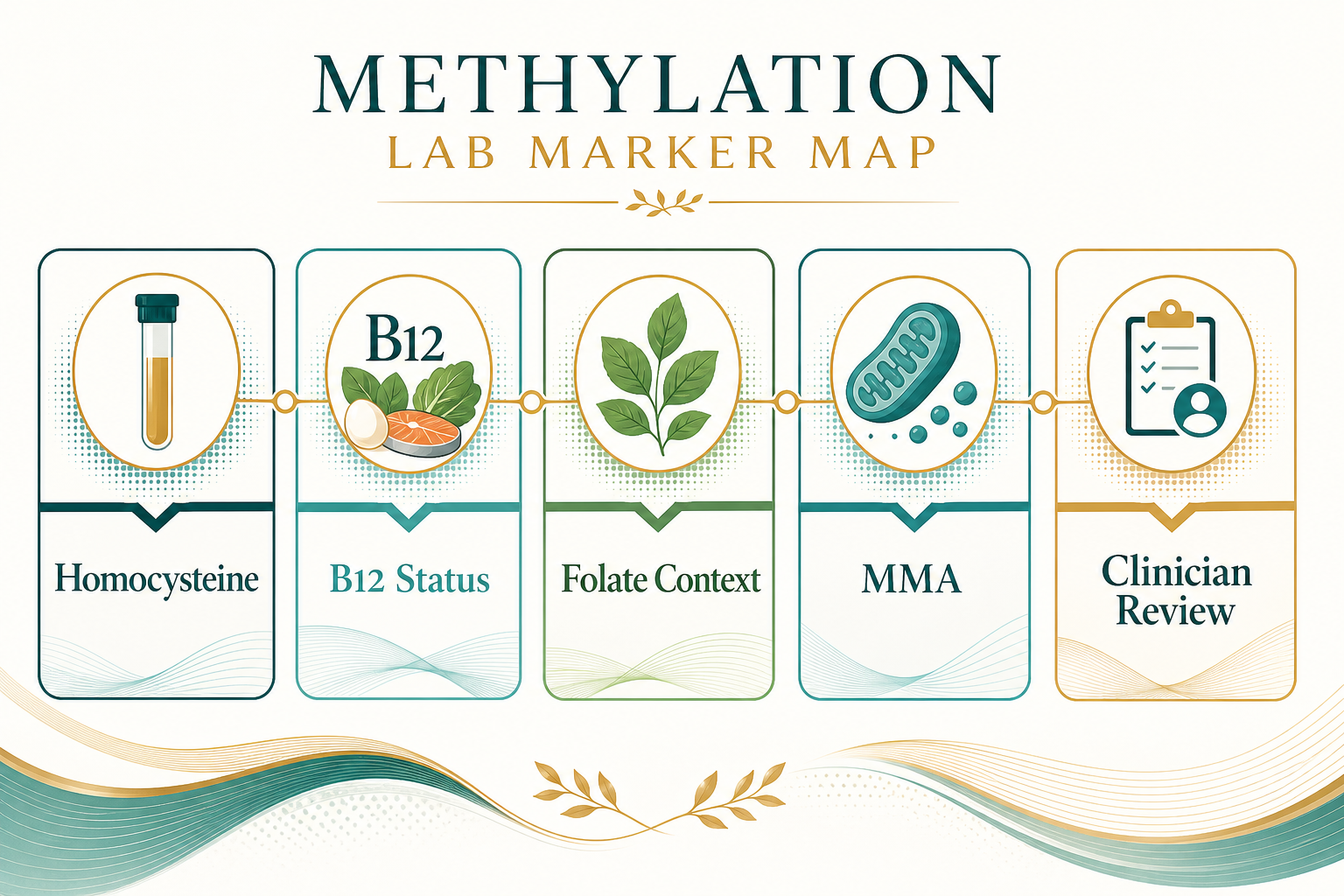
The most useful way to approach methylation markers is to group them by the question they raise. Homocysteine asks whether a methylation-related pathway may deserve attention. B12 and folate context ask whether key nutrients are adequate and usable. MMA can add context for B12 status. CBC patterns may help clinicians see whether blood-cell clues align with nutrient questions. None of these should be treated as a home diagnosis tool.
| Marker | What It Can Suggest | What It Cannot Do Alone |
|---|---|---|
| Homocysteine | May raise questions about methylation, B vitamins, betaine, and overall metabolic context. | Cannot identify the exact supplement a person should take without clinical context. |
| B12 status | Helps evaluate one major nutrient connected to methylation and blood-health discussions. | Cannot be interpreted perfectly without related markers, diet, symptoms, and medical history. |
| Folate context | Helps frame folate intake, methylfolate questions, and B-vitamin stack decisions. | Cannot prove that TMG is needed or unnecessary by itself. |
| MMA | May add useful context when B12 status is being evaluated. | Cannot replace professional interpretation of the full panel. |
What is a safe marker-reading framework?
A safe framework has four steps: identify the marker, identify the related nutrients, identify the possible non-supplement factors, and identify what needs professional review. This keeps the conversation from becoming too narrow. Homocysteine may lead to questions about folate, B12, B6, choline, betaine, kidney function, medications, and lifestyle. B12 context may lead to questions about diet, absorption, supplementation, and MMA. Folate context may raise questions about food intake, fortified foods, methylated forms, and B12 balance.
The point is not to memorize every pathway. The point is to avoid collapsing everything into one supplement decision. TMG is one methyl-donor option in a larger system. A marker can suggest that methylation should be discussed, but it does not automatically tell you the ingredient, form, timing, or amount that is right for you. Good interpretation starts with a pattern and ends with a plan, not with a panicked purchase.
| Step | Question to Ask | Why It Matters |
|---|---|---|
| Marker | Which lab result started the question? | Prevents vague claims like “my methylation is off.” |
| Pattern | Do related markers point in the same direction? | Reduces overreaction to one isolated result. |
| Context | What diet, medications, conditions, or supplements could matter? | Keeps the plan personalized instead of trend-driven. |
| Review | What should a clinician interpret before changes? | Turns lab data into a safer decision process. |
Where does TMG fit in this evidence picture?
TMG fits as one possible methylation-support ingredient, not as a universal lab-marker fix. It is most logically discussed when a healthcare professional is reviewing methyl donors, homocysteine metabolism, B-vitamin status, and supplement history together. The research conversation around betaine and homocysteine is real, but the consumer action should remain careful and individualized.
For users building broader NAD+ routines, this distinction matters. The AIDEVI article on the NAD to NADH cycle explains a different biochemical question: how NAD+ and NADH relate to cellular energy. The guide to NAD+ vs NMN differences helps separate precursor logic from finished NAD+ language. TMG may sit beside that stack, but it should still be judged through methylation context, not generic anti-aging enthusiasm.
A practical rule: if the reason for TMG is “my lab pattern and clinician discussion suggest methylation support deserves attention,” the decision has structure. If the reason is “I saw homocysteine mentioned online,” the decision is too thin. Better information should come before more supplements.
What should you not do after seeing a result?
Do not change five supplements at once. Do not add TMG, methylfolate, B12, choline, and an NAD+ product on the same day because a lab marker looked confusing. If anything changes later, you will not know which variable mattered. Do not compare your result to strangers online and assume the same supplement plan applies. Lab markers live inside individual biology, diet, medication use, and medical history.
Do not use TMG as a substitute for B12 or folate evaluation. TMG is related to methylation support, but it does not replace the need to understand B-vitamin status. Do not ignore symptoms because a supplement stack looks “wellness-oriented.” And do not treat NAD+ support as the same thing as methylation support. They can sit in the same healthy-aging conversation, but they answer different questions.
A better move is to create a short decision note: which marker raised the question, which related nutrients were reviewed, which supplements you already take, what your clinician recommended, and when the plan should be reassessed. This turns lab curiosity into a practical record instead of a supplement guessing game.
How do you discuss results with a professional?
Bring the full picture. That means current lab results, prior lab results if available, your supplement list, medication list, diet pattern, symptoms, and the reason you are interested in TMG. Ask whether homocysteine, B12, folate, MMA, CBC, thyroid markers, kidney function, or other context is relevant for your situation. The exact list depends on the clinician and your health history.
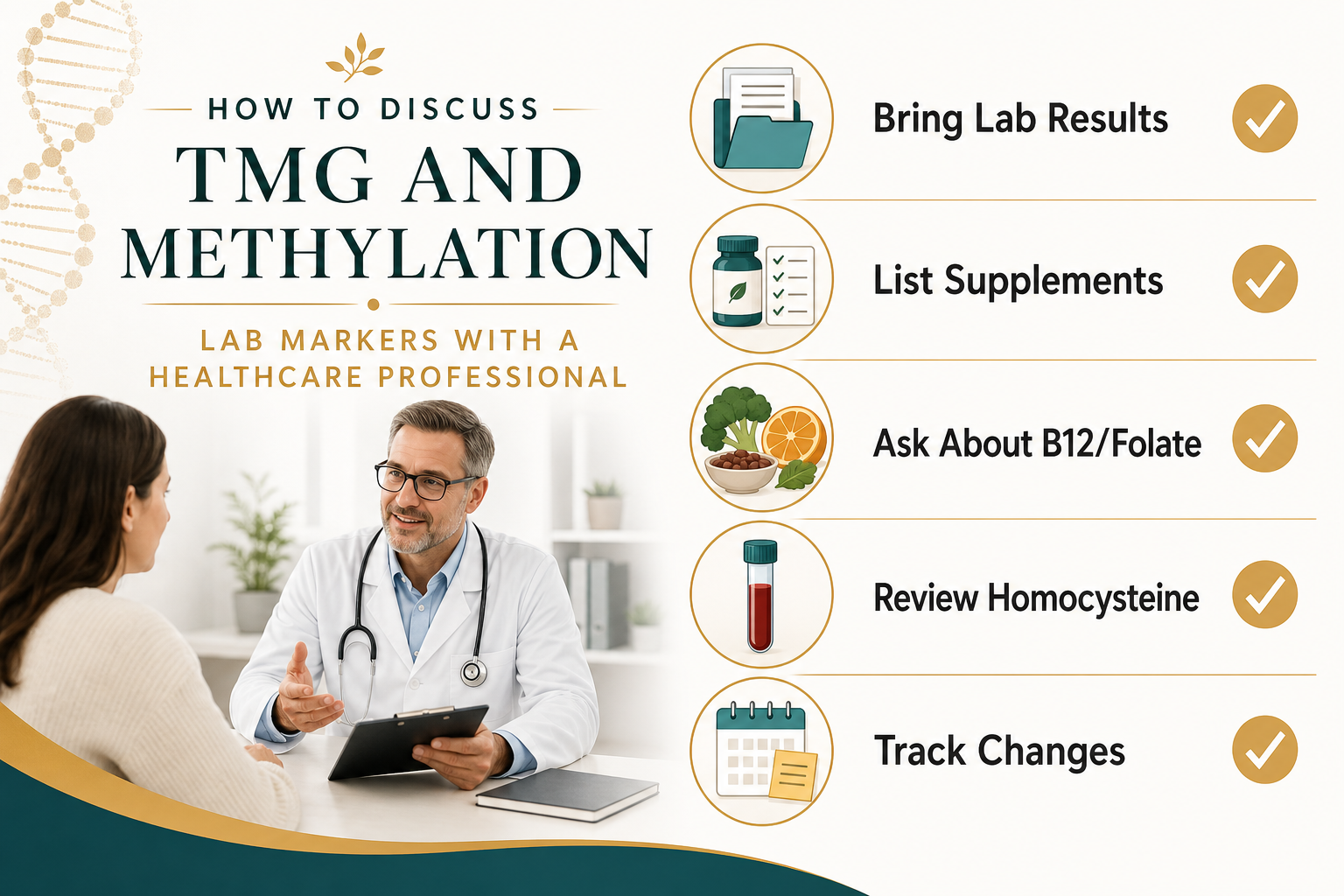
Also ask how any supplement change will be tracked. Will the clinician recheck a marker? Should the routine remain stable before testing? Are there medications or conditions that change the plan? A supplement log is useful here: product name, serving direction, start date, time of day, and any comfort changes. For lifestyle context, AIDEVI's article on ways to support NAD levels naturally is a reminder that sleep, exercise, diet, and consistency may matter alongside supplement choices.
Ask about timing for follow-up, too. Lab markers often need a stable routine before retesting makes sense, and changing several variables at once can muddy the picture. Your clinician may want to know whether diet, medication, exercise, alcohol intake, or supplements changed before interpreting a new result. This is why a simple timeline can be more useful than a long list of theories.
The goal is not to chase perfect numbers with a bigger stack. The goal is to understand whether the pattern makes sense, what your clinician recommends, and whether TMG has a clear role in the plan. If the role cannot be explained in one sentence, keep researching before adding it.
In other words, labs should make your routine more precise, not more frantic. Good methylation support starts with interpretation, then moves to a measured plan. That measured plan should be easy to repeat, easy to document, and easy to discuss at the next appointment.
Conclusion
TMG belongs in methylation discussions because betaine can serve as a methyl donor and is connected to homocysteine metabolism pathways. But lab markers are not purchase instructions. Homocysteine, B12, folate, MMA, and CBC context are best read as a pattern with professional guidance. If TMG belongs in your routine, it should be because the goal, lab context, supplement stack, and safety considerations all line up.
Frequently Asked Questions
Is homocysteine the main methylation marker for TMG users?
It is one of the most commonly discussed markers because TMG is connected to methyl-donor pathways involving homocysteine. It still needs clinical interpretation and should not be used alone to decide on a supplement.
Can TMG replace B12 or folate?
No. TMG, B12, and folate have related but different roles in methylation discussions. Do not use TMG as a substitute for evaluating B-vitamin status with a healthcare professional.
Should I take TMG if my lab markers look abnormal?
Do not self-treat lab results. Bring the full panel and supplement list to a healthcare professional, especially if you take medication or manage a medical condition.
Does TMG connect to NAD+ support?
Indirectly. TMG is usually discussed as methylation support, while NAD+ support involves different pathways. They may appear in the same wellness stack, but they should not be treated as the same kind of ingredient.
References
These statements have not been evaluated by the Food and Drug Administration. This product is not intended to diagnose, treat, cure, or prevent any disease. Consult a healthcare professional before starting any new supplement, especially if pregnant, nursing, taking medication, or managing a medical condition.
