



AIDEVI Seasonal Wellness Guide
Can nmn Help with Spring Allergies? What NAD+ Research Says About Immune Balance
Updated August 24, 2026 · A practical, evidence-aware guide to NMN, pollen exposure, and immune balance
NMN is not an antihistamine, allergy medicine, or proven treatment for seasonal allergic rhinitis. Early cell and animal research suggests that NAD+ metabolism may influence mast-cell signaling and inflammatory balance, but no strong human trial shows that taking NMN reduces spring sneezing, congestion, itchy eyes, or pollen sensitivity. It is best viewed as optional cellular-wellness support alongside evidence-based allergy care.

A seasonal wellness scene representing pollen exposure and practical self-care, not a claim that NMN prevents or treats allergies.
What the research supports
NAD+ is involved in cellular energy and immune signaling, and preclinical work has found that NAD+-boosting compounds can affect mast-cell degranulation. That is a research lead, not proof of symptom relief in people. For spring allergies, prioritize exposure reduction, clinician-guided medication, sleep, and a plan for urgent symptoms before considering NMN.
Content
- Why do spring allergies feel so inflammatory?
- What does NAD+ have to do with immune balance?
- How could NMN influence the NAD+ pathway?
- What does mast-cell research actually show?
- Are there human studies on NMN for spring allergies?
- How should NMN fit into a spring allergy routine?
- Who should be cautious before taking NMN?
- Frequently asked questions
Why do spring allergies feel so inflammatory?
Seasonal allergies begin when a sensitized immune system treats an otherwise harmless substance, such as tree or grass pollen, as a threat. After prior exposure, allergen-specific IgE antibodies can help activate mast cells. These cells release histamine and other mediators that contribute to sneezing, itching, watery eyes, nasal congestion, throat irritation, and sometimes coughing.
The uncomfortable experience is often a chain rather than one isolated symptom. Nasal blockage can make sleep harder. Poor sleep can increase daytime fatigue and reduce concentration. Mouth breathing may dry the throat, while repeated rubbing or blowing can make the skin around the nose feel irritated. These effects can make a person feel generally inflamed even when the trigger is seasonal and localized.
Allergic rhinitis is also different from a viral infection, irritant exposure, or asthma flare. A fever, marked facial pain, wheezing, chest tightness, or shortness of breath deserves a more careful assessment instead of being automatically attributed to pollen. If breathing is difficult or swelling develops around the face, lips, or throat, seek urgent medical care.
Clinical allergy guidelines emphasize proven symptom-management options and individualized assessment rather than relying on a single supplement [1]. NMN may be interesting as a cellular-health question, but it does not remove the need to identify the trigger or manage the allergic response appropriately.
What does NAD+ have to do with immune balance?
NAD+, or nicotinamide adenine dinucleotide, is a coenzyme used in redox reactions and energy metabolism. It also acts as a substrate for enzymes such as sirtuins, CD38, and PARPs. These pathways help connect nutrient availability, mitochondrial function, DNA-stress responses, and immune-cell behavior.
That biology makes NAD+ relevant to inflammation research. Immune cells change their metabolism when they are activated, and NAD+ availability can affect signaling, energy production, and the way an inflammatory response develops or resolves. Reviews describe this relationship as context-dependent: altering NAD+ metabolism can influence immune function, but the direction and meaning depend on the cell type, stimulus, tissue, and disease model [2].
This is why “more NAD+” is too simple as an allergy explanation. An allergic response is not caused by one missing nutrient. It involves allergen recognition, IgE, mast-cell signaling, histamine, cytokines, airway or nasal-barrier conditions, genetics, season, and prior sensitization. Supporting a metabolic cofactor may be worth researching, but it does not automatically recalibrate a person's immune system.
For a broader foundation, AIDEVI’s NAD+ and NMN explainer covers the relationship between the two molecules and the practical questions people commonly ask before starting a routine. Keep that background separate from a clinical allergy claim.
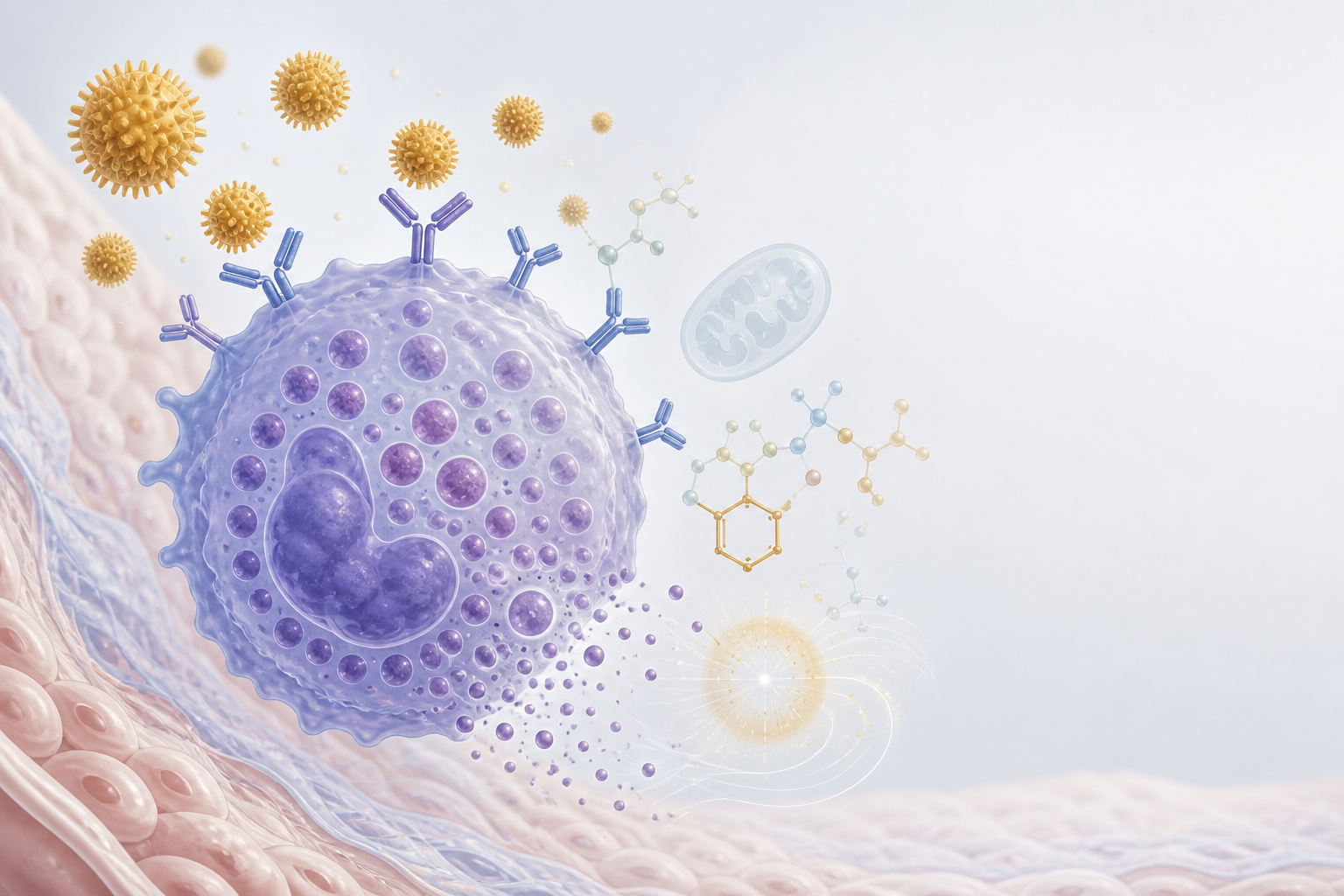
A conceptual illustration of mast-cell and NAD+ research. It does not show a clinically proven pathway for stopping seasonal allergy symptoms.
How could NMN influence the NAD+ pathway?
NMN, or nicotinamide mononucleotide, is a precursor involved in the NAD+ salvage pathway. In simplified terms, the body can use NMN as one input for maintaining NAD+ pools. NAD+ then participates in cellular energy metabolism and in the activity of several NAD+-dependent enzymes.
The practical implication is modest: NMN may support a biochemical pathway that cells already use. It is not a targeted pollen blocker, and it does not work like an oral antihistamine or a nasal spray. It also should not be described as “turning off” immunity. A balanced immune response requires appropriate activation when needed and appropriate resolution afterward.
AIDEVI’s guide to NMN and cellular energy production provides more context on what the precursor relationship can reasonably mean. The same caution applies here: a pathway-level explanation is not the same as a demonstrated change in hay-fever symptoms.
NMN also does not have a validated seasonal-allergy dose or timing protocol. Taking a larger amount when pollen counts rise is not supported by clinical evidence. If someone already uses NMN and tolerates it, consistency and label-directed use are more sensible than experimenting with a high dose during a severe flare.
What does mast-cell research actually show?
Mast cells are central to many immediate allergic reactions. When activated through IgE-related signaling, they can release histamine, proteases, cytokines, and other mediators. This makes mast-cell degranulation an appealing research target for understanding allergic inflammation.
In a 2022 study, NMN and nicotinamide riboside reduced IgE-triggered degranulation in human cord-blood-derived mast cells and reduced several allergic-response measures in mouse models [3]. The finding is biologically relevant, but it has three important limits:
| What was studied | What it does not establish |
|---|---|
| Cultured mast cells and controlled mouse allergy models | That an NMN capsule relieves seasonal allergic rhinitis in people |
| Mast-cell degranulation, histamine-related markers, and acute reactions | A validated dose, timing plan, or long-term allergy outcome |
| One experimental NAD+-boosting approach | Proof that every NMN product has the same composition or effect |
The study is a useful mechanism signal, not a green light to replace medical allergy care. It also does not establish that NMN can prevent anaphylaxis, treat mast-cell disorders, or make a person less sensitive to pollen. Those are separate and higher-stakes questions that require clinical expertise.
Are there human studies on NMN for spring allergies?
At present, the important answer is no: there is no strong human clinical evidence showing that NMN prevents or treats spring allergies. Human NMN studies have mainly examined short-term safety, blood NAD+ changes, physical function, sleep, or selected metabolic outcomes. A review of human clinical trials does not establish seasonal allergic rhinitis as a proven indication [5].
This distinction matters because it is easy to move too quickly from mechanism to marketing. A compound may change a laboratory marker, influence a cell in culture, or improve an outcome in an animal model without producing the same benefit in people. Human allergy studies would need to test clearly defined participants, pollen exposure or seasonal timing, validated symptom scores, rescue-medication use, safety, and meaningful clinical outcomes.
There is also related airway research. One preclinical asthma study reported that NMN influenced airway epithelial barrier dysfunction through a pathway involving SIRT3 [4]. That result may help explain why researchers are interested in NAD+ biology in respiratory tissues, but asthma and seasonal allergic rhinitis are not interchangeable. A mouse or cellular airway finding cannot be used to promise relief for a person with hay fever.
Evidence translation rule
Mechanism suggests a question. Preclinical research suggests plausibility. A well-designed human trial establishes whether a benefit is real, useful, and safe for the intended population. NMN and spring allergies are currently between the first two stages.
How should NMN fit into a spring allergy routine?
If you are considering NMN during pollen season, use a “Reduce, Relieve, Recover, Review” framework. It gives the supplement a limited place without allowing it to displace actions with clearer evidence.
| Step | Practical focus | Where NMN fits |
|---|---|---|
| Reduce | Check local pollen conditions, keep windows closed when appropriate, change clothes after outdoor exposure, and rinse hair or shower before bed. | NMN does not reduce the amount of pollen you inhale. |
| Relieve | Use clinician- or pharmacist-guided allergy tools and follow the label or prescription instructions. | NMN is not a fast histamine blocker or rescue medicine. |
| Recover | Protect sleep, hydration, balanced meals, and normal movement so allergy symptoms do not erode daily resilience. | NMN may be considered as optional cellular-wellness support if already tolerated. |
| Review | Track symptoms, sleep, pollen exposure, and medication use instead of judging one change in isolation. | Stop or reassess if a new supplement causes unusual symptoms. |
Sleep deserves special attention because congestion and itching can create a feedback loop of fatigue and poor recovery. AIDEVI’s article on NMN and sleep quality can help readers explore that separate question, but sleep-related research should not be repackaged as proof of allergy relief.
If you are comparing products, read the actual Supplement Facts panel rather than relying on phrases such as “immune booster.” The current AIDEVI NMN 18000 product page provides its listed serving information and formula details. Product information can change, so check the current label and use only as directed.
For a broader comparison of NAD+ and NMN as supplement formats, AIDEVI’s NMN versus NAD+ bioavailability guide may be useful. The choice of format still does not answer the separate clinical question of whether either option improves seasonal allergies.

Practical exposure-control and recovery habits belong at the center of an allergy-season plan.
Who should be cautious before taking NMN?
Ask a healthcare professional before starting NMN if you are pregnant or breastfeeding, take prescription medication, manage asthma or an autoimmune condition, have a history of cancer, or have a chronic metabolic or cardiovascular condition. This is not because NMN is proven to cause a specific allergy problem; it is because supplement decisions depend on the whole health context, product formulation, and medication list.
Extra caution is appropriate for anyone with recurrent anaphylaxis, a diagnosed mast-cell disorder, severe asthma, or a history of rapid reactions to new products. Do not test a supplement as an experiment during a high-risk period, and do not delay an emergency plan while waiting for a wellness product to work.
Available human NMN studies have generally been small and short. Individual responses can vary, and a new supplement may cause personal reactions such as digestive discomfort, headache, or changes in sleep. Start only according to the current product directions, avoid stacking several new products at once, and stop use if unusual symptoms appear.
For additional background on NMN use and safety questions, AIDEVI’s NMN benefits, side effects, and dosage guide can be read alongside professional advice. Older online guidance should not override the current label or a clinician’s recommendation.
Conclusion
NMN may be relevant to spring-allergy research because NAD+ metabolism is connected to cellular energy, immune signaling, and mast-cell biology. However, the most direct allergy findings currently come from cells and animals, not from large human trials of seasonal allergic rhinitis. That means NMN is an interesting research-informed wellness option, not a proven antihistamine or allergy treatment.
A sensible plan starts with reducing pollen exposure, using appropriate allergy care, protecting sleep and recovery, and knowing when symptoms require medical attention. If you choose NMN, use it conservatively and consistently as optional cellular support, with realistic expectations and professional guidance when your health situation is complex.
Frequently Asked Questions
Can NMN reduce sneezing and itchy eyes?
There is no strong human evidence that NMN reduces those seasonal-allergy symptoms. Preclinical studies suggest possible effects on mast-cell signaling, but that does not establish symptom relief in people.
Does NMN work like an antihistamine?
No. Antihistamines are designed to reduce the effects of histamine through specific receptor pathways. NMN is a precursor involved in NAD+ metabolism and should not be presented as fast allergy relief.
Could NMN stabilize mast cells?
Cell and mouse research provides a plausible mechanism, including reduced degranulation in experimental models. It does not prove that an oral NMN supplement stabilizes mast cells during a person's pollen season.
Should I take more NMN when pollen counts are high?
No validated allergy-specific dose has been established. Follow the current product directions and do not increase the amount to chase a faster immune effect.
Can I take NMN with allergy medication?
Ask a healthcare professional or pharmacist, especially if you take prescription drugs, have asthma, or use multiple supplements. Do not change prescribed treatment based on an NMN article.
When should allergy symptoms be treated as urgent?
Facial or throat swelling, difficulty breathing, wheezing, faintness, or rapidly worsening symptoms require urgent medical care. A supplement should never replace an emergency plan.
References
- American Academy of Allergy, Asthma & Immunology. Rhinitis 2017: A practice parameter update. AAAAI guideline PDF.
- Zhang, T., et al. NAD+ metabolism-based immunoregulation and therapeutic potential. Signal Transduction and Targeted Therapy. PMC.
- Kim, H. W., et al. NAD+-boosting molecules suppress mast cell degranulation and anaphylactic responses in mice. Theranostics. PMC.
- Liang, J., et al. Nicotinamide mononucleotide attenuates airway epithelial barrier dysfunction via inhibiting SIRT3 SUMOylation in asthma. International Immunopharmacology. ScienceDirect.
- Nicotinamide mononucleotide in human clinical trials: safety and efficacy evidence review. PMC review.
These statements have not been evaluated by the Food and Drug Administration. This product is not intended to diagnose, treat, cure, or prevent any disease. Individual results may vary. Consult your healthcare professional before starting any new supplement, especially if pregnant, nursing, taking medication, or managing allergies, asthma, or another medical condition.
