



AIDEVI Winter Wellness Guide
Can nmn Help with Winter Blues? NAD+, Brain Energy, and Seasonal Mood Support
Updated August 24, 2026 · An evidence-aware guide to winter mood changes, circadian rhythm, and NMN
NMN is not a treatment for winter blues, Seasonal Affective Disorder (SAD), depression, or bipolar disorder. It may support NAD+ metabolism, cellular energy, and pathways connected with circadian biology, but the direct mood evidence comes mainly from laboratory and mouse studies. For persistent or severe symptoms, light therapy, psychotherapy, medication, and professional care matter more than any supplement.

A winter wellness scene representing shorter daylight and thoughtful daily support, not a depiction of NMN treating a mood disorder.
What the evidence supports
NAD+ helps cells manage energy and supports enzymes involved in metabolic and circadian signaling. NMN is a precursor used in NAD+ biology, so it is a plausible cellular-wellness ingredient. That plausibility is not proof that NMN improves seasonal mood, prevents SAD, or replaces mental-health treatment.
Content
- Why can winter change your energy and mood?
- Is it winter blues or Seasonal Affective Disorder?
- What does NAD+ have to do with brain energy and mood?
- Can NMN support brain energy during darker months?
- Can NMN support a healthier circadian rhythm?
- How should NMN fit into a winter wellness routine?
- Who should speak with a healthcare professional first?
- Frequently asked questions
Why can winter change your energy and mood?
When days become shorter, many people spend less time in bright outdoor light and more time indoors. That shift can influence the signals that help coordinate the sleep-wake cycle, daytime alertness, appetite, activity, and social routines. A person may feel sleepier in the morning, less motivated after work, or more inclined to stay home even when nothing else has changed.
Winter mood changes can also be reinforced by behavior. Cold weather may reduce movement, darker afternoons can make plans feel harder, and disrupted sleep can lower concentration the next day. Some people notice increased appetite or carbohydrate cravings, while others experience a general sense of mental resistance: ordinary tasks require more effort than usual.
These experiences do not automatically mean that NAD+ is low or that a supplement is needed. Fatigue and low mood can also reflect insufficient sleep, stress, anemia, thyroid disease, medication effects, vitamin deficiencies, depression, or another health condition. A seasonal pattern is a useful clue, not a diagnosis.
The National Institute of Mental Health explains that winter-pattern SAD is associated with changes in daylight and may involve sleep, melatonin, serotonin, and vitamin D-related pathways [1]. The important practical point is that light and daily rhythm are central parts of the story; NMN cannot substitute for them.
Is it winter blues or Seasonal Affective Disorder?
“Winter blues” is an informal phrase for mild, temporary changes in mood or energy. SAD is a form of depression with a recurring seasonal pattern. It can affect sleep, appetite, concentration, motivation, pleasure, relationships, and the ability to function. NIMH notes that winter-pattern SAD often begins in late fall or early winter and improves in spring or summer, but a clinician must assess the pattern rather than an article or supplement label.
| Pattern | What it may look like | Best next step |
|---|---|---|
| Mild seasonal dip | Lower energy, less outdoor time, or a temporary change in motivation. | Strengthen light, sleep, movement, meals, and social routines. |
| Possible SAD pattern | Recurring seasonal depression symptoms that last weeks and interfere with daily life. | Talk with a healthcare or mental-health professional about diagnosis and treatment. |
| Urgent concern | Thoughts of self-harm, feeling unsafe, inability to function, or rapidly worsening symptoms. | Seek urgent help; in the U.S., call or text 988, or use local emergency services elsewhere. |
NIMH lists light therapy, psychotherapy, antidepressant medication, and vitamin D as treatment categories for SAD, with the right choice depending on the person and medical context [1]. NMN should not be positioned as a fifth replacement category or as an alternative to treatment.
What does NAD+ have to do with brain energy and mood?
NAD+, or nicotinamide adenine dinucleotide, is a coenzyme involved in redox reactions and cellular energy metabolism. It also supports the activity of NAD+-dependent enzymes, including sirtuins and PARPs, which participate in stress responses, protein regulation, DNA-related processes, and metabolic signaling.
The brain has a high and continuous energy demand. Neurons need ATP to maintain electrical gradients, communicate, and preserve normal cellular function. Mitochondria help supply that energy, so researchers are interested in how NAD+ availability, mitochondrial performance, oxidative stress, and brain signaling interact.
That connection is biologically meaningful but not a one-cause explanation for winter mood changes. Mood depends on brain circuits, sleep, light exposure, hormones, stress, social context, medical conditions, and many other factors. A supplement can support a pathway without correcting the full cause of a mood disorder.
For a broader introduction to the ingredient relationship, AIDEVI’s NAD+ and NMN explainer describes how NMN fits into NAD+ biology. A separate NMN cellular-energy guide can help explain the metabolism angle without turning it into a promise of improved mood.
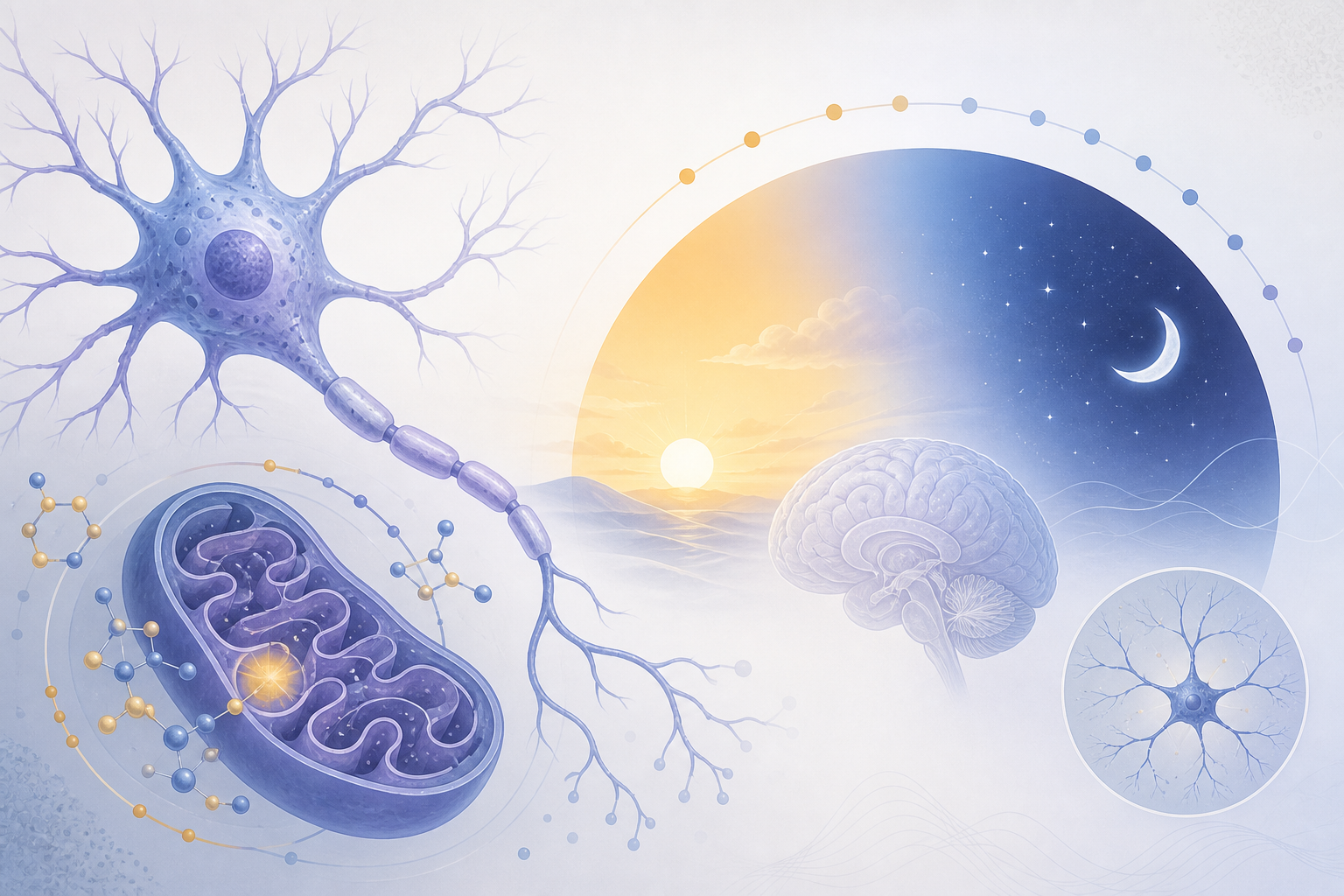
A conceptual illustration of brain energy and circadian research. It does not show NMN treating depression or changing mood in a person.
Can NMN support brain energy during darker months?
NMN is a precursor involved in the NAD+ salvage pathway. In principle, using NMN may give cells an additional input for maintaining NAD+ pools, which are used in energy metabolism and enzyme activity. This is the basis for describing NMN as cellular-energy support rather than as an emotional stimulant.
Animal studies have explored whether NMN affects stress-related behaviors and brain bioenergetics. One mouse study reported fewer depression-like behaviors alongside changes in mitochondrial energy metabolism after NMN administration [2]. A later mouse study reported that prophylactic NMN preserved ATP levels in the medial prefrontal cortex in a stress model [3].
These findings are useful for generating hypotheses, but they do not show that NMN treats depression, SAD, or ordinary winter fatigue in humans. Mouse behavioral tests are not the same as a clinical diagnosis, and the dose, route, timing, stress model, and biological context may not translate to a daily human capsule.
A responsible interpretation is therefore: NMN may support a biochemical system relevant to brain energy, while direct winter-mood benefits remain unproven. If you already use NMN for a general wellness routine, it may be reasonable to track energy and sleep without treating those observations as a diagnostic test.
Can NMN support a healthier circadian rhythm?
NAD+ metabolism and the circadian clock are connected in both directions. Circadian cycles influence metabolic enzymes, while NAD(P)(H) availability can affect clock-related cellular processes. A review describes daily NAD(P)(H) cycles as part of the relationship between cell metabolism and circadian timing [4].
This does not mean that taking NMN resets the human body clock on demand. In winter, the strongest external cue remains the light-dark cycle. Morning daylight, regular wake time, consistent meals, activity, and a dark sleep environment provide behavioral signals that a supplement cannot replace.
Some people prefer taking NMN earlier in the day because it fits a daytime energy routine and avoids introducing a new energizing-feeling supplement close to bedtime. There is no universally proven timing rule for seasonal mood support. AIDEVI’s NMN timing guide can be used as general background, but your response and the current product label matter more than a rigid schedule.
If NMN appears to change sleep, dreams, digestion, or alertness, reassess the timing and discuss it with a healthcare professional. Do not use an online timing recommendation to change prescribed sleep or psychiatric medication.
How should NMN fit into a winter wellness routine?
Use a “Light, Rhythm, Move, Support, Review” framework. It keeps the most established daily inputs at the center and gives NMN a clearly limited role.
| Priority | Practical action | Decision boundary |
|---|---|---|
| Light | Get outdoor morning light when practical, or discuss a properly used light box if SAD is suspected. | Ask a clinician first if you have an eye condition, take photosensitizing medication, or have bipolar disorder. |
| Rhythm | Keep a stable wake time, regular meals, and a dark, quiet sleep environment. | Do not chase daytime energy by sacrificing sleep. |
| Move | Schedule manageable movement, even when motivation is low, and maintain social contact. | Scale the plan to your health; consistency is more useful than an extreme goal. |
| Support | If you choose NMN, use the current label and track tolerance, sleep, energy, and routine consistency. | NMN is optional cellular support, not an antidepressant or SAD treatment. |
| Review | Review patterns over several weeks and bring persistent symptoms to a professional. | Do not use a supplement diary to delay care for worsening depression. |
AIDEVI’s article on NMN and sleep quality explores a related but separate question. Better sleep may help daily resilience, but sleep research should not be presented as evidence that NMN improves seasonal depression.
When comparing products, check the amount per serving, additional ingredients, directions, and whether the format is easy to use consistently. The current AIDEVI NMN 18000 product page lists its current capsule and serving information. Product facts can change, so read the present label and ask a professional if the formula is appropriate for you.

Morning light, movement, regular meals, hydration, and sleep consistency are the practical foundation of winter wellness.
Who should speak with a healthcare professional first?
Talk with a healthcare professional before using NMN for mood-related wellness if you have diagnosed depression, SAD, bipolar disorder, anxiety, a sleep disorder, or another chronic condition. Also ask first if you are pregnant or breastfeeding, take prescription medication, or are considering several supplements at the same time.
This is especially important if you are considering light therapy. NIMH notes that some eye conditions and medications that increase sensitivity to light may require alternative treatment or medical supervision [1]. People with bipolar disorder should also seek professional guidance because changes in light exposure, sleep, or mood treatment can affect mood stability.
Do not use NMN to self-manage hopelessness, severe insomnia, panic, inability to function, or thoughts of self-harm. In the United States, call or text 988 for the Suicide & Crisis Lifeline; in an immediate life-threatening emergency, call 911. Outside the U.S., use your local crisis or emergency service.
Short human NMN studies do not establish long-term safety for every person or every product. A new supplement may cause individual reactions such as digestive discomfort, headache, or sleep changes. Follow the current product directions, avoid escalating the amount to chase a mood effect, and stop or seek advice if unusual symptoms appear.
Conclusion
NMN may be relevant to winter-wellness conversations because NAD+ participates in cellular energy metabolism and circadian biology. Early mouse research also gives scientists reasons to study NMN and stress-related brain bioenergetics. But there is not enough human evidence to say that NMN treats winter blues, improves SAD, or prevents seasonal depression.
The strongest plan is practical and layered: get appropriate morning light, protect sleep timing, move regularly, eat consistently, maintain connection, and seek professional care when symptoms persist or interfere with life. If NMN is part of your routine, keep its role modest: optional cellular support, not emotional rescue or a substitute for mental-health treatment.
Frequently Asked Questions
Can NMN treat Seasonal Affective Disorder?
No. SAD is a form of depression, and NMN has not been established as a treatment. Talk with a healthcare professional about evidence-based options such as light therapy, psychotherapy, medication, or vitamin D when appropriate.
Could NMN help with winter fatigue?
NMN may support NAD+ metabolism and cellular energy pathways, but human evidence for winter-specific fatigue is lacking. Fatigue can also have medical, sleep-related, nutritional, or mental-health causes that need assessment.
Does NMN increase serotonin or melatonin?
There is no established human protocol showing that NMN directly corrects serotonin or melatonin changes in SAD. Do not describe NMN as a replacement for treatments that target those pathways.
When should NMN be taken during winter?
There is no universally proven timing for seasonal mood support. Many people prefer earlier use because it fits daytime routines. Follow the current product directions and reassess if your sleep changes.
Can I use NMN with light therapy or antidepressants?
Ask a healthcare professional or pharmacist before combining NMN with prescription treatment or starting light therapy, especially if you have bipolar disorder, an eye condition, medication-related light sensitivity, or other chronic health concerns.
What should I do if winter mood symptoms feel unsafe?
Seek urgent mental-health support rather than trying a supplement. In the U.S., call or text 988; in an immediate emergency call 911. Use local crisis services outside the U.S.
References
- National Institute of Mental Health. Seasonal Affective Disorder. NIMH.
- Xie, X., et al. Nicotinamide mononucleotide ameliorates the depression-like behaviors and is associated with attenuating the disruption of mitochondrial bioenergetics in depressed mice. Journal of Affective Disorders. ScienceDirect.
- Xie, X., et al. Prophylactic nicotinamide mononucleotide mitigates stress-induced depressive-like behaviors in mice via preserving ATP level in the medial prefrontal cortex. Biomedicine & Pharmacotherapy. ScienceDirect.
- Peek, C. B., et al. Circadian NAD(P)(H) cycles in cell metabolism. Seminars in Cell & Developmental Biology. PMC.
- Nicotinamide mononucleotide in human clinical trials: safety and efficacy evidence review. PMC review.
These statements have not been evaluated by the Food and Drug Administration. This product is not intended to diagnose, treat, cure, or prevent any disease. Individual results may vary. Consult your healthcare professional before starting any new supplement, especially if you have depression, Seasonal Affective Disorder, bipolar disorder, sleep disorders, chronic health conditions, or take medication.
