



AIDEVI Wellness Guide
nmn Certificate of Analysis: How to Read a COA Before You Buy
An NMN Certificate of Analysis is useful only when it identifies the tested product and batch, names the laboratory and methods, shows specifications beside actual results, and can be connected to the bottle you are buying. A polished PDF or a large purity number is not enough. Buyers should verify what was tested, when it was tested, whether the batch matches, and what the COA cannot prove.
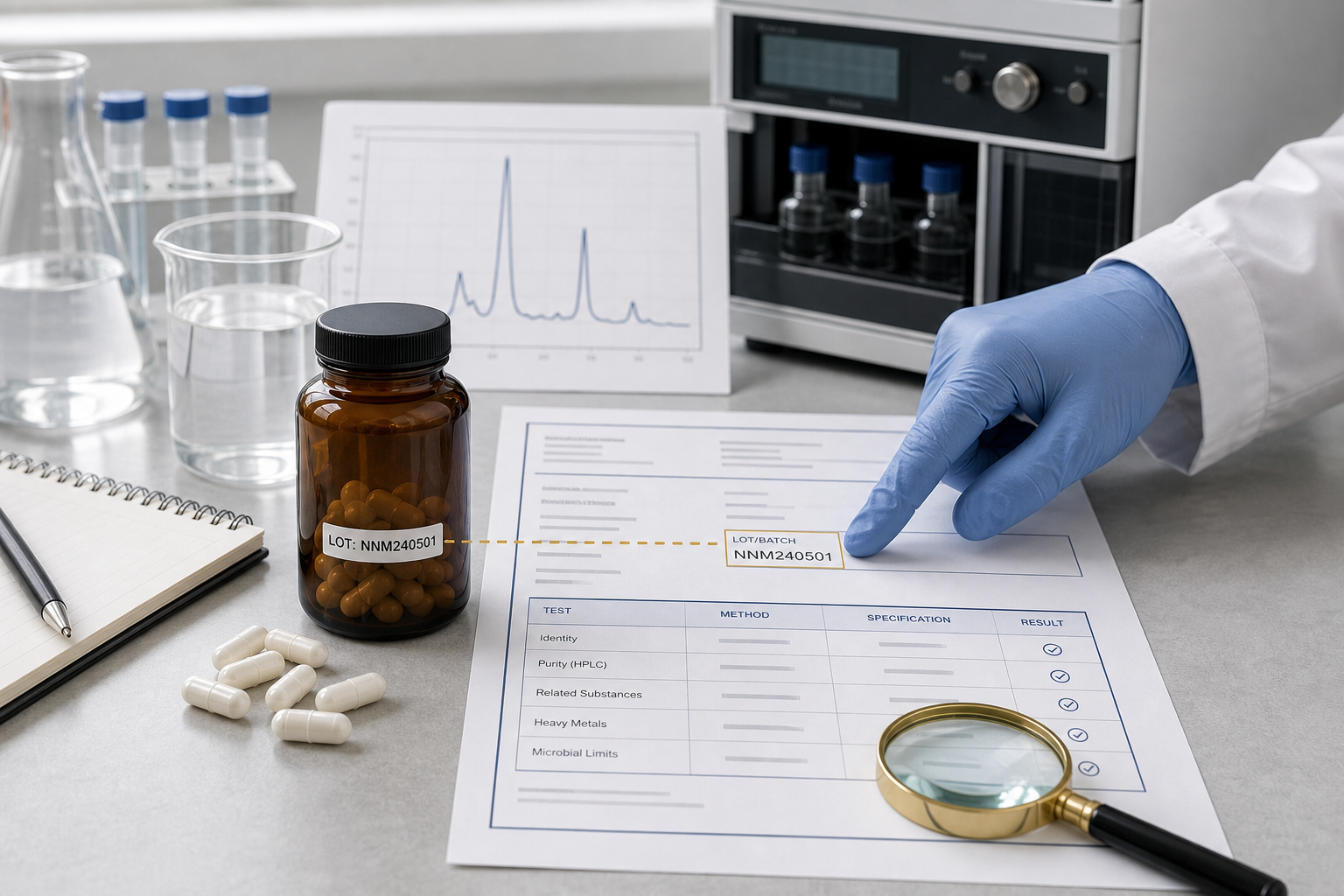
The fastest COA check is this: match the lot number first, then read the test method, specification, measured result, and pass or fail decision. If the certificate cannot be tied to the product in your hand, it may still be a real lab report, but it is not strong batch-specific evidence for your purchase.
- Match the COA lot or batch number to the product before trusting the results.
- Look for laboratory identity, test date, method, specification, result, and pass/fail decision.
- Identity, assay or purity, contaminants, and microbiological testing answer different quality questions.
- A COA cannot prove clinical benefits, guarantee safety for everyone, or mean the FDA approved the supplement.
Content
What is an NMN Certificate of Analysis?
A Certificate of Analysis, often shortened to COA, is a document that reports laboratory testing for a material or finished product. For an NMN supplement, a COA may report whether the tested sample was identified as NMN, whether its assay or purity met a stated specification, and whether selected contaminants were below established limits. The exact scope varies, so the document should be read carefully rather than treated as a universal quality badge.
A raw-material COA is not the same as a finished-product COA. Raw-material testing addresses the ingredient before manufacturing. Finished-product testing addresses the capsules, powder, liquid, or other final form sold to consumers. Both can be useful, but a raw-material report alone does not show that the finished bottle contains the labeled amount after manufacturing, packaging, and storage.
In the United States, dietary supplement manufacturers are subject to current good manufacturing practice requirements under 21 CFR Part 111. These rules cover areas such as specifications, quality control, and testing or examination. They do not mean the FDA approves each supplement or issues every COA [1]. When reviewing a particular formula, start with its label and product information, such as the AIDEVI NMN 18000 product page, then compare those details with the applicable report.
How do you read an NMN COA?
Read the document from the identifying information toward the results. A credible-looking result is not useful if the certificate belongs to a different product, ingredient, or batch. The following fields create the chain between the sample, the test, and the conclusion.
| COA Field | What to Verify | Why It Matters |
|---|---|---|
| Product and sample | NMN ingredient or finished supplement, format, and identifying details | Prevents applying results from a different material or product |
| Lot or batch | Exact code that can be matched to the bottle or packaging | Connects the report to the item being purchased |
| Laboratory and dates | Lab identity, sample receipt, test date, and report date when available | Provides traceability and context for how current the report is |
| Method | Named or referenced analytical method for each test | Shows how the laboratory produced the result |
| Specification and result | Acceptance limit beside the actual measured result | Lets the reader understand why the sample passed or failed |
The AIDEVI Trace, Test, Interpret, Boundary framework
- Trace: Confirm the product, sample type, laboratory, test date, and batch code.
- Test: Identify whether the COA covers identity, assay, purity, contaminants, microbes, or other tests.
- Interpret: Read the method, unit, specification, result, and pass/fail decision together.
- Boundary: Remember that a COA supports quality attributes, not clinical results or FDA approval.
Specifications and results are different. A specification describes the acceptance criterion, such as a minimum assay or maximum contaminant limit. The result is what the laboratory measured. A report that shows only "pass" without the method, specification, or measurable result provides less information than a transparent certificate. For wider buyer context, AIDEVI's guide to choosing an NMN supplement explains why label clarity and quality signals should be considered together.
Which lab tests matter most on an NMN COA?
No single test answers every quality question. Identity, assay, purity, and contaminant tests serve different purposes. A certificate that reports a high assay but does not address identity or relevant contaminants may still leave important gaps.
Identity testing asks whether the material is NMN
Identity testing is foundational because it asks whether the sample is the ingredient it claims to be. The method may compare a sample against a reference standard or characteristic profile. A purity value should not substitute for a clear identity determination.
Assay or purity testing asks how much target material is present
Assay commonly measures the amount of a target compound, often using a method such as high-performance liquid chromatography. Interpret the result alongside the basis of calculation, units, method, and specification. A large number presented without those details can be misleading. Also distinguish raw NMN powder purity from the labeled NMN amount in a finished capsule.
Contaminant testing asks what unwanted materials were assessed
Depending on the product and risk assessment, a report may address heavy metals, microorganisms, residual solvents, or other relevant contaminants. Check which individual analytes were tested and whether results are reported against limits. "Tested for contaminants" is not specific enough by itself.
Testing supports product quality decisions, while scientific research addresses different questions about NMN biology and human outcomes. AIDEVI's overview of whether NMN works belongs in that separate evidence category. A clean laboratory result does not establish clinical effectiveness.
Laboratory results also need units. Assay may be reported as a percentage, while contaminants may be reported in parts per million, parts per billion, or mass per serving. Do not compare two values until you confirm they describe the same analyte, sample type, unit, and calculation basis. Reports may also use terms such as "not detected," "below the limit of detection," or "below the limit of quantitation." These phrases do not always mean absolute zero; they describe what the method could detect or quantify.
How do you verify that the COA matches your NMN bottle?
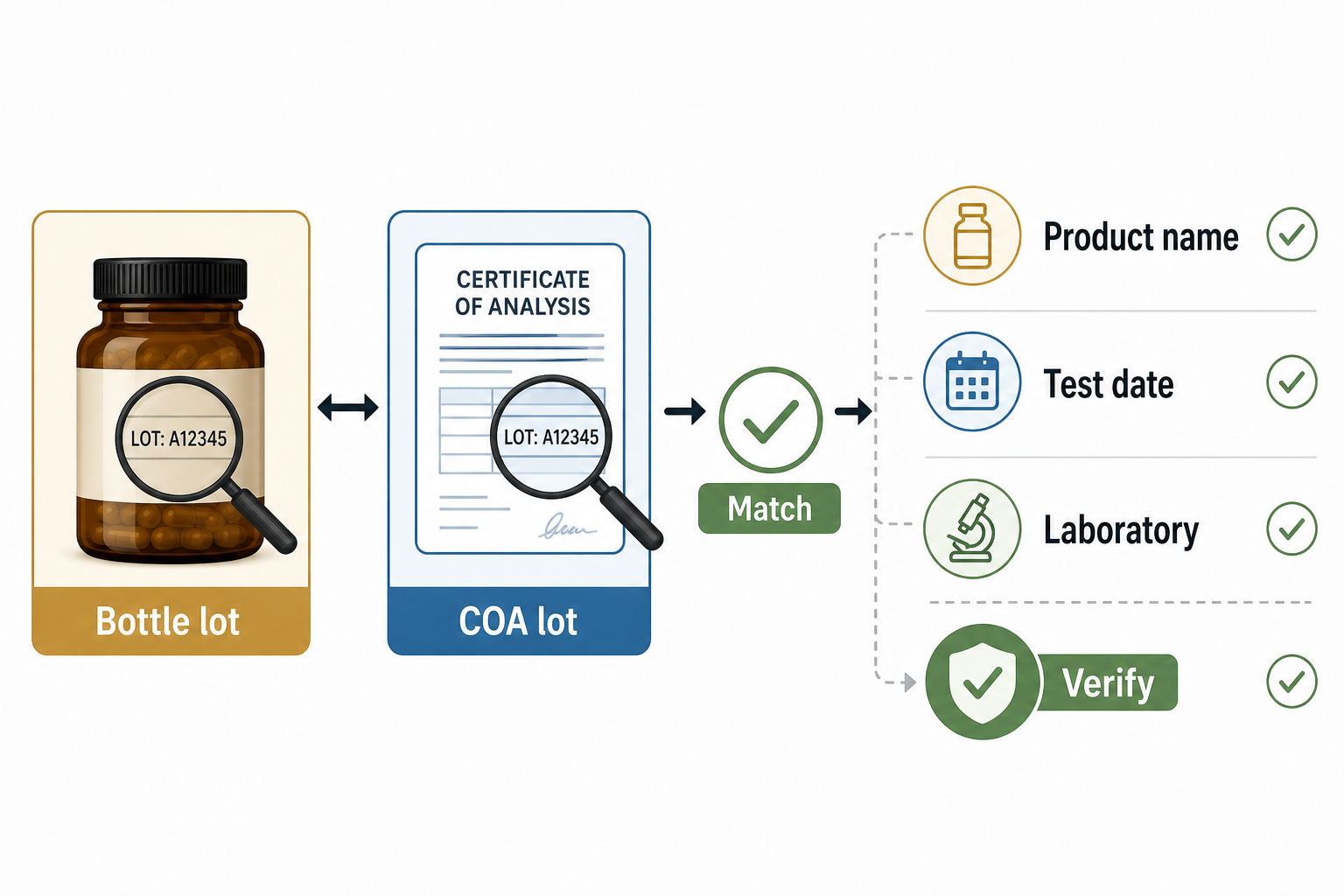
The most practical buyer check is also the easiest to overlook: compare the bottle's lot or batch number with the certificate. A generic certificate from an older or unrelated batch may describe a real test, but it does not provide batch-specific transparency for the bottle in your hand.
- Find the bottle lot. Look on the label, bottle base, neck, cap, carton, or printed seal.
- Find the COA lot. It may appear as lot, batch, sample ID, or another traceable code.
- Confirm the match. Similar-looking codes are not enough; the applicable identifier should connect clearly.
- Confirm the product. Check the product name, ingredient, format, and strength or serving description.
- Review the dates. Make sure the report logically relates to the batch and is not merely a permanently reused marketing document.
- Verify the source. Ask the company for clarification when the certificate, laboratory, or batch relationship is unclear.
Third-party testing usually means an outside laboratory performed testing, but the phrase alone does not explain the sample source, methods, tests, or independence of the process. Look for the laboratory name and scope. Quality seals can add information when their standards and verification process are clear, but no logo replaces reading the certificate. The NIH Office of Dietary Supplements notes that independent organizations offer quality testing and seals, while these seals do not guarantee that a product is safe or effective [2].
This is especially important when a brand highlights raw-material quality. A raw-material story can be useful when it is specific, documented, and separated from finished-product claims. AIDEVI's article on high-quality NMN raw material can help readers understand that layer of the discussion, but a buyer should still ask whether the report is raw material, finished product, or both.
What are common NMN COA red flags?
- No lot or batch connection: the report cannot be linked to the product being sold.
- No laboratory identity: the document does not show who performed the tests.
- No methods or specifications: results appear without explaining how they were measured or judged.
- Only one attractive number: a purity percentage is highlighted while identity, contaminants, or finished-product questions are absent.
- Raw material presented as finished-product proof: the certificate covers an ingredient but is used to imply every final bottle was tested.
- Old or reused certificate: the same report appears across changing products or batches without explanation.
- COA used as an effectiveness claim: laboratory quality results are presented as proof of health outcomes.
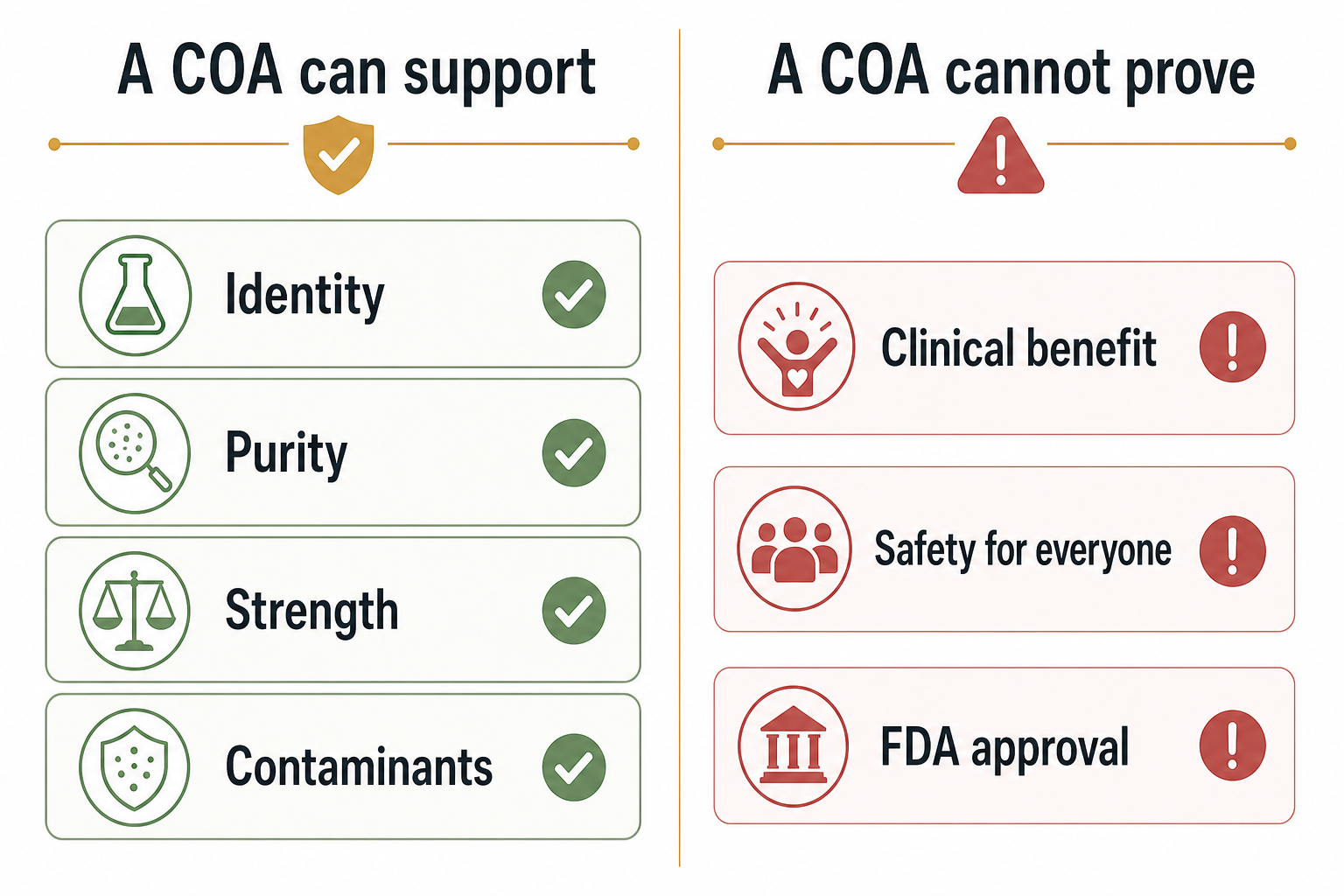
A COA can support confidence in specific tested quality attributes. It cannot prove that NMN will produce a clinical benefit, that the supplement is appropriate for every person, or that the FDA approved it. FDA explains that dietary supplements are regulated under a different framework from conventional foods and drug products, and manufacturers are responsible for ensuring products meet applicable requirements [3].
Marketing language deserves the same scrutiny as the certificate. The NMN versus NAD+ bioavailability comparison illustrates why performance questions require evidence beyond product testing. AIDEVI's NMN dosage by age guide also shows why serving decisions should not be built from purity numbers alone. Keep quality verification, dose selection, and clinical expectations in their proper lanes.
How should buyers use a COA in the final decision?
A COA should help you decide whether the product is transparent enough to keep evaluating. It should not be the only reason to buy. Also review the label, serving amount, other ingredients, storage directions, company support, and whether the product fits your routine. If you are comparing NMN with related NAD+ support directions, AIDEVI's guide to NMN versus NR can help you keep ingredient selection separate from lab-document review.
| Best fit | Consider instead | Avoid or pause if |
|---|---|---|
| The COA matches the product and lot, shows methods, and reports measurable results. | Ask customer support for batch-specific documentation if the public report is generic. | The document has no lot number, no lab name, or only a marketing-friendly purity number. |
| Identity, assay, and relevant contaminant tests are all explained clearly. | Compare another NMN product if the quality story remains vague after questions. | The COA is used to imply FDA approval, disease protection, or guaranteed results. |
| The label, serving directions, and COA all tell a consistent story. | Choose a simpler formula if multiple actives make testing and interpretation unclear. | You cannot confirm whether the report is raw-material or finished-product testing. |
Do not ask only, "Does this product have a COA?" Ask, "Does this COA match the product and batch, show meaningful methods and results, and address the quality questions that matter?"
Conclusion
A useful NMN Certificate of Analysis is traceable, specific, and readable. Begin by matching the product and lot number, then review the laboratory, dates, methods, specifications, measured results, and pass/fail conclusions. Look beyond a single purity claim to identity and relevant contaminant testing. Most importantly, remember the boundary: a COA can provide evidence about tested quality attributes, but it cannot prove clinical benefits, universal safety, or FDA approval.
The best COA does not ask you to trust a big number. It gives you a clear path from bottle to batch, from method to result, and from result to a reasonable quality conclusion. That kind of transparency is what makes a lab report useful for real supplement buyers.
Frequently Asked Questions
Does every NMN supplement need a public COA?
A public-facing COA can improve buyer transparency, but the regulatory requirements and company records are more complex than simply posting a PDF. Ask the company for batch-specific quality information when it is not publicly available.
Does third-party tested mean the product is effective?
No. Third-party laboratory testing can support particular quality claims, depending on what was tested. It does not prove that the supplement produces health benefits.
What does NMN purity mean?
Purity or assay generally describes how much target NMN was measured in a tested material. Interpret it with the method, units, specification, sample type, and identity results. Raw-material purity is not the same as the amount per finished serving.
Is an old COA still useful?
It may provide historical information, but it should not be treated as batch-specific proof for a newer bottle unless the company clearly explains the relationship.
Does a COA mean the FDA approved the NMN supplement?
No. A COA is a laboratory report, not FDA approval. Dietary supplements are regulated differently from drugs, and a company-issued or laboratory-issued certificate does not represent FDA endorsement.
References
Individual results may vary. Consult a healthcare professional before starting any new supplement, especially if pregnant, nursing, taking medication, or managing a medical condition.
These statements have not been evaluated by the Food and Drug Administration. This product is not intended to diagnose, treat, cure, or prevent any disease.
