



AIDEVI Wellness Guide
Ergothioneine and Sleep Quality: Emerging User Questions, Evidence, and Routine Fit
Ergothioneine is not an established sleep aid, and current evidence does not show that taking EGT will reliably make you fall asleep faster, sleep longer, or wake more refreshed. Its connection to sleep is indirect: EGT is studied for antioxidant and cellular-resilience biology, while sleep is a core recovery habit. The most responsible approach is to separate sleep claims from antioxidant-support claims.

If your main question is whether EGT can replace melatonin, sleep hygiene, or medical guidance for insomnia, the answer is no. Consider ergothioneine for its researched antioxidant and cellular-wellness context, not as a bedtime sedative. Track sleep separately from supplement expectations so you do not over-credit or over-blame one ingredient.
- EGT is not proven to treat insomnia or directly improve sleep quality.
- Its scientific interest centers on antioxidant behavior, cellular transport, and healthy-aging research.
- Morning versus evening use is usually a comfort and consistency decision unless the label says otherwise.
- Persistent sleep problems should be discussed with a healthcare professional rather than managed by supplement trial and error.
Content
Does ergothioneine help you sleep?
There is not enough direct clinical evidence to say that ergothioneine improves sleep quality. EGT should not be described as a sedative, a melatonin alternative, or a treatment for insomnia. Most published discussion focuses on its antioxidant chemistry, dietary sources, tissue distribution, and transporter biology rather than validated sleep outcomes [1].
That distinction matters because "supports recovery" can be misunderstood as "causes better sleep." Recovery is broad. It includes sleep, nutrition, movement, stress management, and many internal repair processes. An antioxidant compound may be relevant to cellular resilience without creating a noticeable bedtime effect. If someone sleeps better after starting EGT, that single observation does not prove EGT caused the change. If someone notices no sleep change, that does not automatically tell us whether EGT has any other antioxidant-support role.
If sleep is the primary concern, begin with the inputs that have a clearer relationship with sleep: consistent schedule, morning light, evening light control, caffeine timing, alcohol intake, bedroom temperature, stress load, and possible health issues. AIDEVI's article on sleep, mental wellness, and healthy aging is a better next step for understanding why sleep should be treated as a foundation, not a benefit expected from one antioxidant ingredient.
Why are ergothioneine and sleep discussed together?
EGT and sleep are often discussed together because both sit inside the larger language of healthy aging, recovery, and resilience. Ergothioneine is a sulfur-containing compound made by certain fungi and microorganisms. Humans mainly obtain it from the diet, especially mushrooms. The body also uses a transporter called OCTN1, or SLC22A4, that helps explain why EGT has a distinct research profile [2].
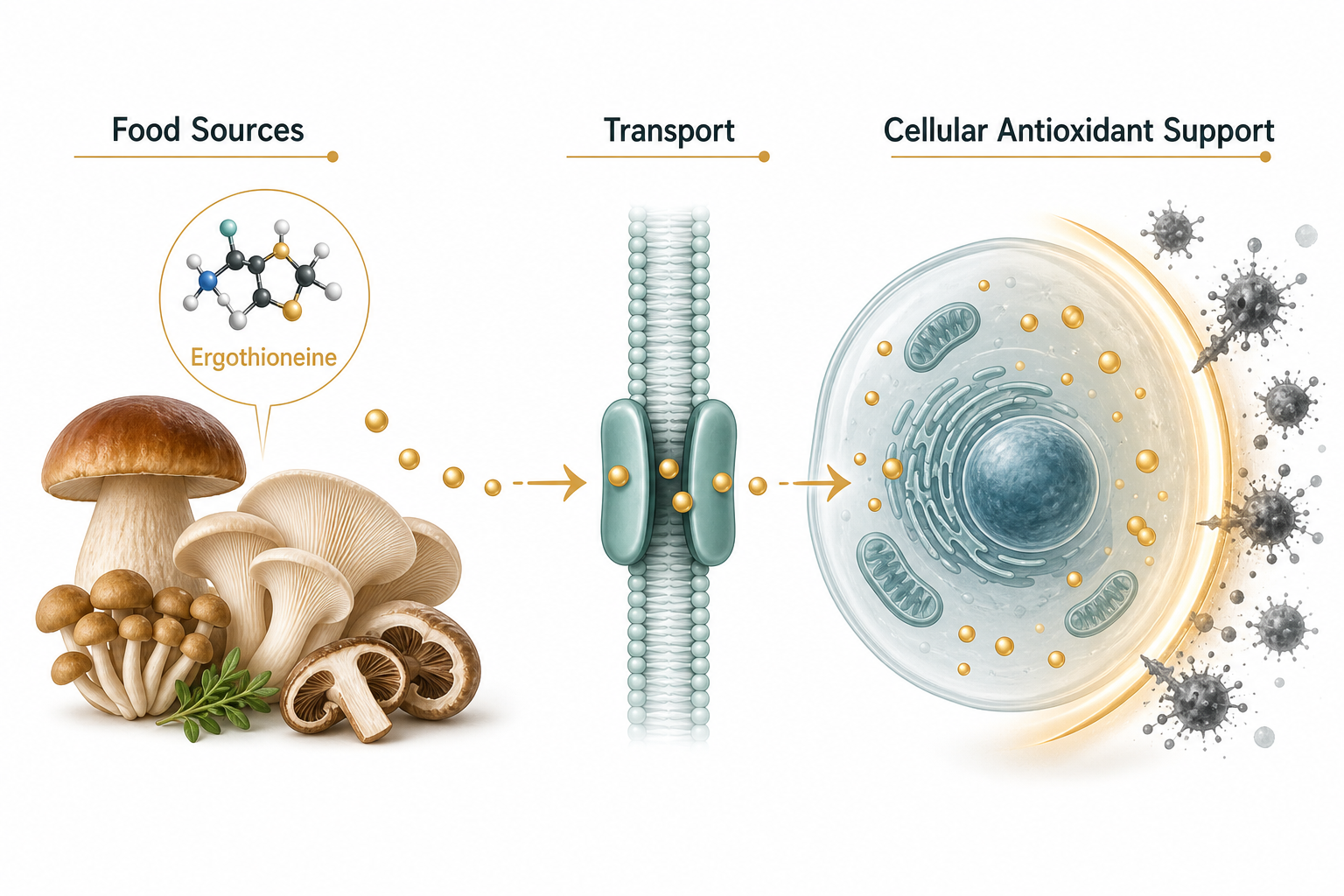
The research path is interesting, but the claim boundary is important. A plausible antioxidant or cellular role does not automatically become a consumer sleep benefit. Good science communication moves in order: first mechanism, then human evidence, then practical claims. When content skips directly from "EGT is an antioxidant" to "EGT improves sleep," it is doing more marketing than science.
For readers who want the broader ingredient background, AIDEVI's guide to ergothioneine supplements and healthy-aging research explains why EGT has attracted attention. It also helps to compare antioxidant ingredients by role rather than treating them as interchangeable. AIDEVI's comparison of ergothioneine versus astaxanthin shows how two antioxidant ingredients can differ in source, evidence, and practical fit.
| Question | What the Evidence Supports | What It Does Not Establish |
|---|---|---|
| Is EGT an antioxidant compound? | Its antioxidant properties and cellular biology are active research areas. | That every user will notice a specific benefit. |
| Does the body handle EGT selectively? | Transporter biology helps explain why EGT is studied separately from generic antioxidants. | That higher intake always creates better outcomes. |
| Does EGT improve sleep? | Direct human sleep evidence remains insufficient. | That EGT treats insomnia or works as a bedtime sedative. |
Should you take ergothioneine at night?
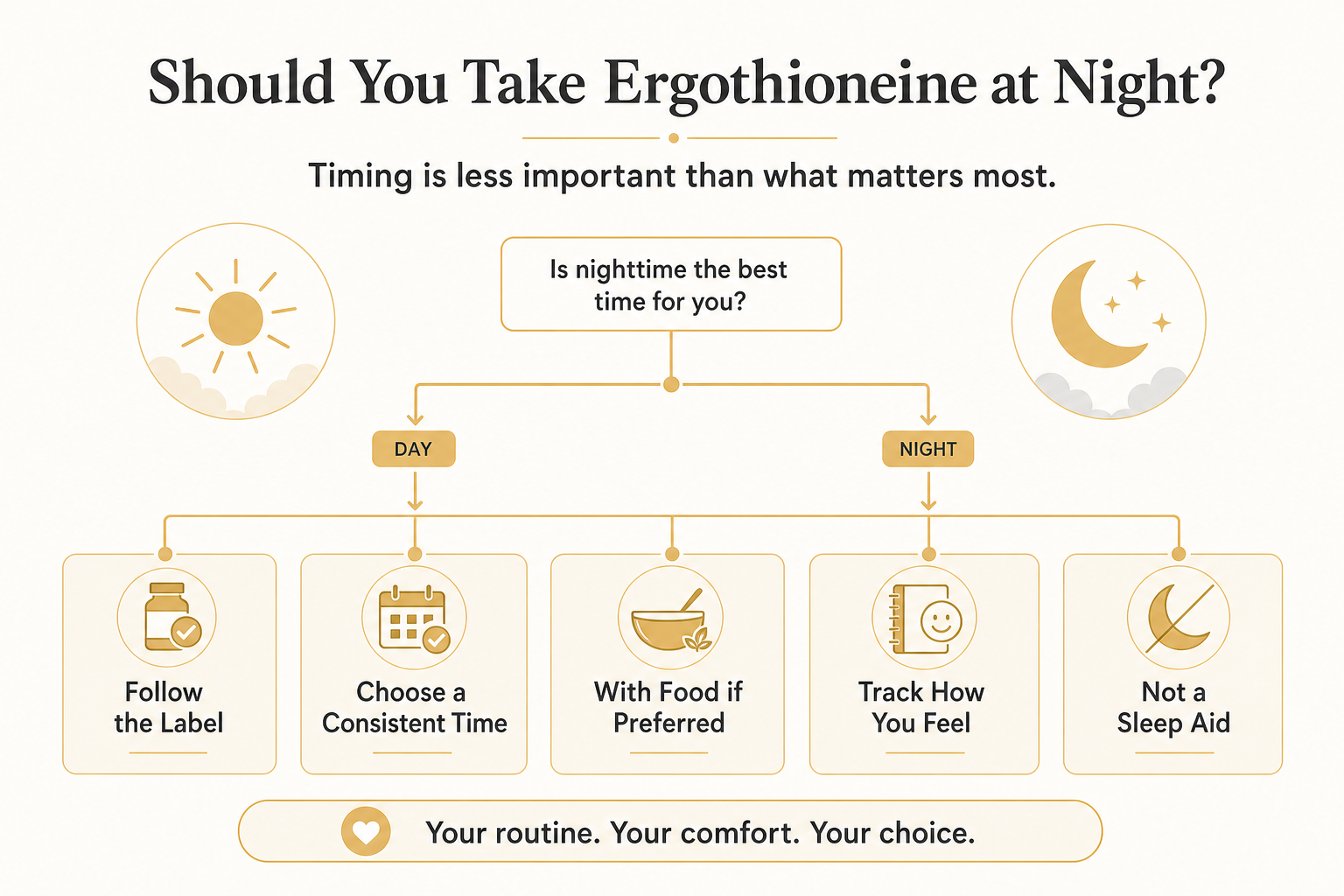
There is no broadly established evidence-based rule that ergothioneine must be taken at night. Unless a product label or healthcare professional gives a specific direction, the practical priority is choosing a consistent time that fits your routine. Some people prefer breakfast because it is easier to remember supplements with a meal. Others prefer dinner because that is when they organize their evening wellness routine. Neither preference proves a special sleep advantage.
Follow the serving directions on your specific product. If a supplement feels uncomfortable on an empty stomach, ask whether taking it with food is appropriate. Avoid changing several supplements and habits at the same time, because simultaneous changes make it difficult to identify what caused a positive or negative experience. People interested in multi-ingredient routines can read how AIDEVI discusses EGT and PQQ in a combined formula, while remembering that combination products require careful label review.
Be cautious with claims that a nighttime dose "works while you sleep." The body performs maintenance processes throughout the day and night, and a marketing-friendly phrase does not demonstrate that evening use is superior. If EGT seems energizing, calming, or neutral to you, record that observation without treating it as universal evidence. Personal experience can help organize a routine, but it does not replace controlled research.
The AIDEVI Separate, Stabilize, Track, Reassess framework
- Separate: Do not confuse antioxidant support with a proven sleep effect.
- Stabilize: Keep bedtime, caffeine timing, and supplement timing as consistent as possible.
- Track: Note sleep pattern, morning alertness, stress, activity, and digestive comfort.
- Reassess: Stop guessing and ask for guidance if sleep problems persist or the routine feels complicated.
How should you track sleep while using EGT?
Use a simple tracking period instead of judging the supplement after one unusually good or bad night. Record bedtime, wake time, nighttime awakenings, morning alertness, late caffeine or alcohol, exercise, stress, and supplement timing. The goal is not to prove that EGT works. The goal is to notice patterns and avoid attributing every change to the newest item in your routine.
A consistent sleep schedule, a dark room, and a cool comfortable environment are more directly actionable than searching for an ideal EGT bedtime. Morning light exposure can help anchor the sleep-wake rhythm, while late caffeine can interfere with sleep in sensitive people. Adults generally need regular, adequate sleep, but individual needs and medical circumstances vary [3]. For the bigger picture, AIDEVI's guide to lifestyle changes that support cellular health keeps supplements in the right context.
Begin with a stable baseline. For several days, write down your normal sleep and daytime experience before adding EGT. Then introduce only the EGT product, following its label, while keeping the same brief record. This approach cannot establish a clinical effect, but it reduces the confusion created when someone starts EGT, changes exercise, stops coffee, and buys a new mattress in the same week.
Stop experimenting and seek professional guidance when sleep difficulty is persistent, severe, worsening, or associated with loud snoring, breathing pauses, significant daytime sleepiness, mood changes, or safety concerns. A supplement should not delay an evaluation for a possible sleep disorder or another health issue. Also consult a healthcare professional before starting EGT if you are pregnant, nursing, taking medication, managing a medical condition, or considering it for a child.
How do you choose an EGT product when sleep is part of the question?
Choose based on label transparency and routine fit, not sleep promises. The label should clearly identify ergothioneine or L-Ergothioneine, state the amount per serving, define the serving size, list other active and inactive ingredients, and provide use and caution directions. A longer ingredient list may be useful for a specific goal, but it also makes it harder to understand which ingredient affects comfort or routine adherence.
Safety evaluations have considered synthetic L-ergothioneine for specified food and supplement uses, but a safety assessment is not proof that EGT improves sleep or that every dose and product is appropriate for every person [4]. Look for clear manufacturing and quality information, avoid products that promise to cure insomnia, and be skeptical of claims that guarantee overnight results.
| Best fit | Consider instead | Avoid or pause if |
|---|---|---|
| You want EGT for antioxidant and cellular-wellness support, with realistic expectations. | A dedicated sleep-habit review if poor sleep is the main problem. | The product promises to treat insomnia, sedate you, or guarantee deeper sleep. |
| You can keep the routine stable and track basic sleep patterns. | A simpler single-ingredient product if a blend makes cause and effect unclear. | You are pregnant, nursing, taking medication, or managing a medical condition without guidance. |
| You value clear ingredient identity, serving instructions, and quality language. | A broader antioxidant routine audit if you already take many overlapping products. | The label hides the amount per serving or uses vague mushroom-blend language instead of measured EGT. |
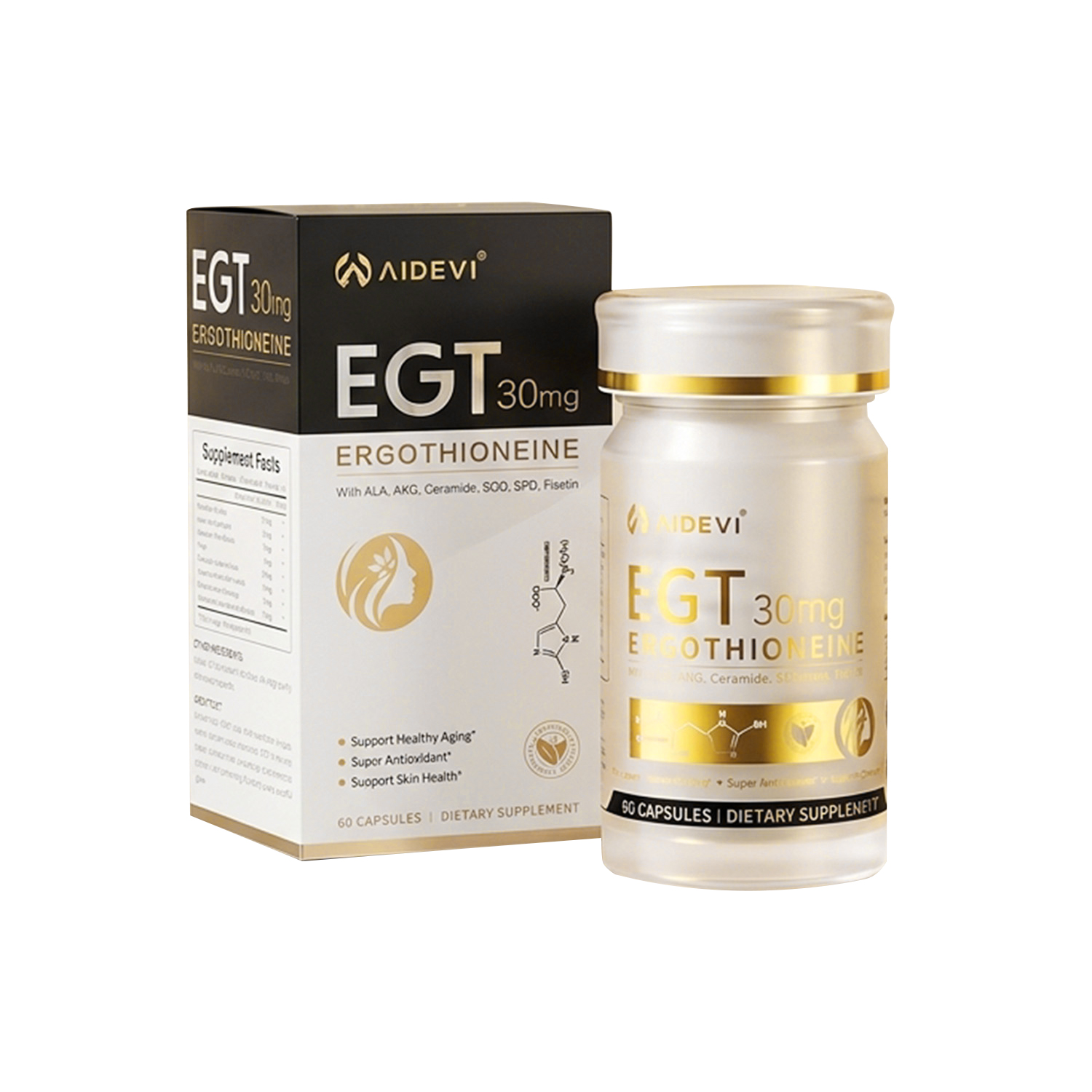
Readers comparing options can examine the label and format of AIDEVI EGT ergothioneine capsules as one example of a dedicated EGT product. To decide whether EGT belongs in a larger routine, the guide to choosing a daily antioxidant supplement explains why goals, ingredient overlap, and consistency matter more than collecting as many antioxidants as possible.
Women building a healthy-aging routine may also see EGT discussed alongside NAD+ support, skin health, and energy metabolism. That does not make EGT a sleep product. It simply means the ingredient can sit inside a wider routine for long-term wellness. AIDEVI's guide to women over 40, NMN, and ergothioneine shows how EGT can be positioned beside other longevity-support ingredients without pretending all of them do the same job.
Conclusion
Ergothioneine and sleep quality belong in the same wellness conversation only with careful boundaries. Sleep supports recovery, and EGT is studied for antioxidant and cellular roles, but those facts do not establish EGT as a sleep aid. Current evidence does not justify promises that it improves sleep duration, sleep depth, or insomnia. For most users, the sensible approach is to choose a transparent product, follow its label, use it at a consistent and comfortable time, and keep proven sleep habits at the center of the routine.
That is the calmer, more useful answer for emerging user questions: do not dismiss EGT, but do not overstate it. Treat it as an antioxidant-support ingredient, track your routine honestly, and reserve sleep-treatment decisions for evidence-based sleep care and professional guidance when needed.
Frequently Asked Questions
Is ergothioneine a sleep supplement?
No. Ergothioneine is generally discussed as a diet-derived antioxidant compound, not an established sleep ingredient. Direct human evidence showing that it improves sleep remains insufficient.
Can ergothioneine make you sleepy?
Sleepiness is not an established expected effect of EGT. If you notice unusual fatigue or sleepiness after starting any supplement, review other changes and discuss persistent or concerning symptoms with a healthcare professional.
Is morning or evening better for EGT?
There is no well-established universal best time. Follow the product label and choose a consistent time that is comfortable and easy to remember.
Can I take EGT with other antioxidants?
Combination may be possible, but first compare labels for overlapping ingredients and total intake. More ingredients do not automatically create a better routine. Ask a healthcare professional when medications, health conditions, pregnancy, or high-dose combinations are involved.
How long should I track my sleep routine?
A consistent multi-day record is more useful than judging one night, because sleep naturally varies. Track habits and timing without changing several variables at once, and seek professional care for persistent sleep problems.
References
Individual results may vary. Consult a healthcare professional before starting any new supplement, especially if pregnant, nursing, taking medication, or managing a medical condition.
These statements have not been evaluated by the Food and Drug Administration. This product is not intended to diagnose, treat, cure, or prevent any disease.
