



AIDEVI Product Development Archive
AIDEVI EGT 60MG REJUVENATE ULTRA Product Development Report
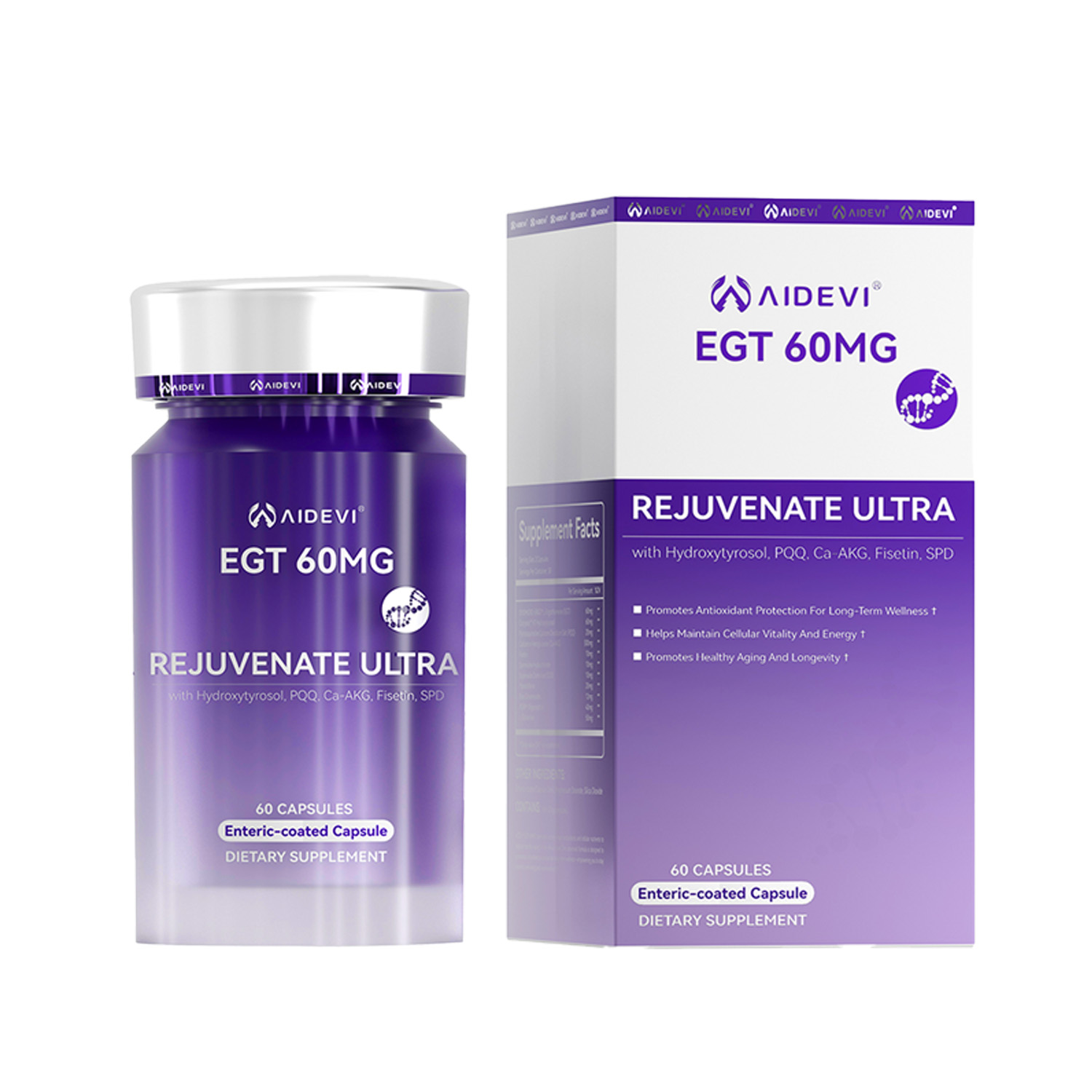
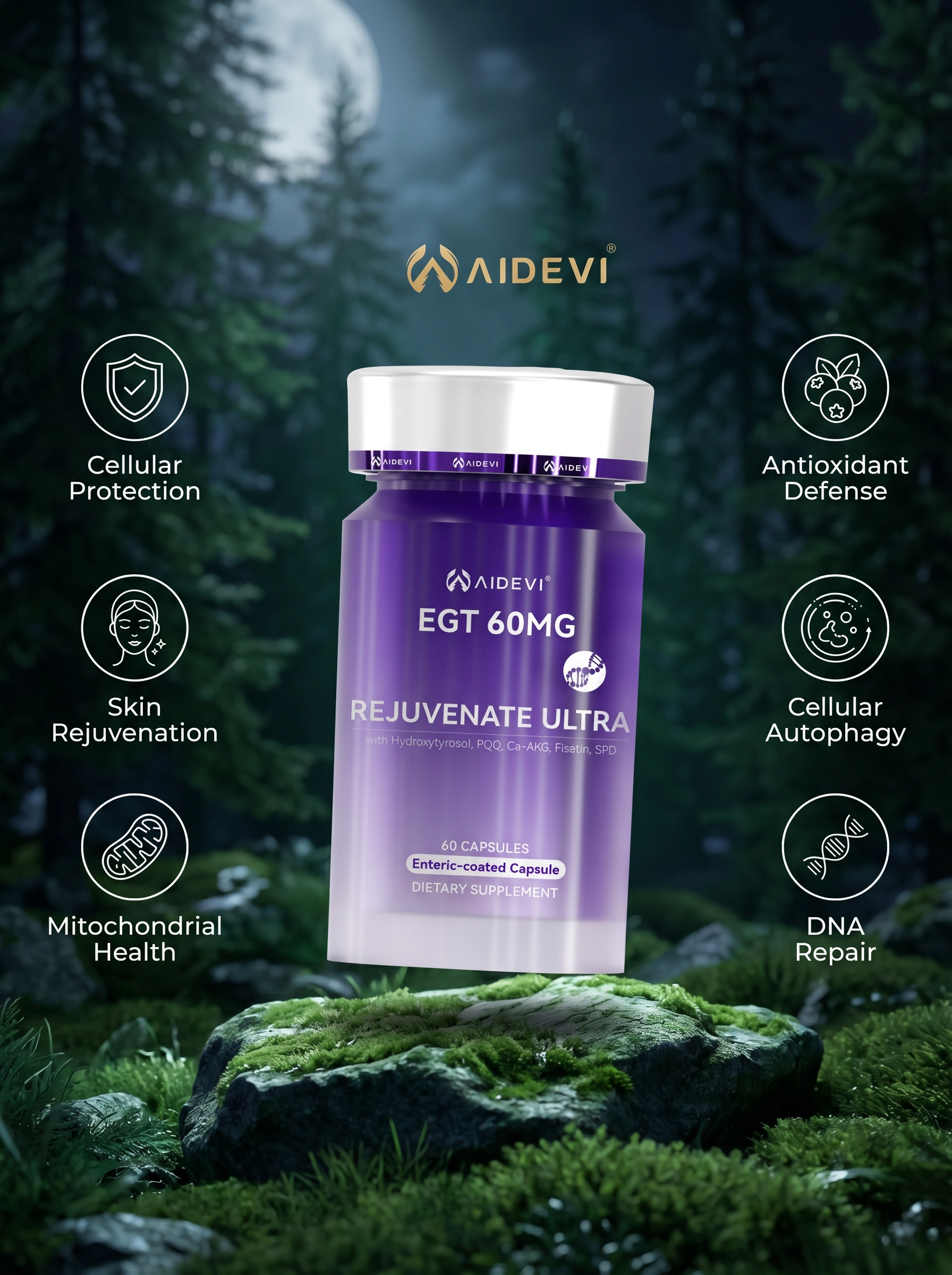
AIDEVI EGT 60MG REJUVENATE ULTRA was developed as a multi-ingredient cellular-wellness formula. Its design report organizes eleven active compounds into a five-module system spanning antioxidant resilience, mitochondrial context, cellular maintenance, extracellular-matrix support, and gut-brain research directions.
This page translates the supplied development report into a public research record: what was formulated, what was tested, what was observed in the reported 56-day study, and what the evidence does and does not establish.
- The development report maps 11 active ingredients across a 14-hallmark aging framework and groups them into five functional modules.
- The finished formula is described as an enteric-coated capsule, selected to support intestinal release of acid-sensitive ingredients.
- The supplied 56-day study enrolled 34 healthy women aged 37 to 50 in an open-label, self-controlled design with baseline, Day 28, and Day 56 assessments.
- Reported endpoints included Cutometer skin mechanics, PRIMOS 3D wrinkle measurements, two-photon dermal imaging, and participant self-evaluations.
How to read this report
The 14-hallmark model is used here as a formulation and research-organizing framework. Ingredient mechanisms and raw-material specifications explain the design rationale. The finished-product clinical data are limited to the measured skin and user-reported endpoints in the supplied 56-day study.
View the original AIDEVI EGT 60MG REJUVENATE ULTRA development report (PDF)
Page Contents
Product Snapshot
AIDEVI EGT 60MG REJUVENATE ULTRA is presented in the supplied development report as a systemic cellular-wellness formula rather than a single-ingredient product. The formulation combines L-Ergothioneine with Hydroxytyrosol, Superoxide Dismutase, a GEKG oligopeptide, PQQ, Calcium Alpha-Ketoglutarate, Fisetin, Spermidine, Ginsenoside Rg1, L-Glutamine, and Pterostilbene.
The product-development concept uses a 14-hallmark aging framework to identify different areas of cellular and tissue biology, including genomic stability, mitochondrial function, macroautophagy, intercellular communication, chronic inflammation, extracellular-matrix change, and gut-brain signaling. This framework does not mean the finished supplement was clinically shown to modify all fourteen hallmarks. It describes the biological rationale used to select complementary ingredients.
| Formula concept | Multi-pathway cellular wellness and skin-structure support. |
| Core ingredient | SIYOMICRO-ERGO® L-Ergothioneine, identified in the report as a biosynthetic fermentation material. |
| Delivery format | Enteric-coated capsule described in the development report. |
| Finished-product study | 56-day, open-label, self-controlled study in 34 healthy female participants aged 37-50. |
Development Framework: The 14-Hallmark Model
The supplied report uses the 14-hallmark aging framework as a research map for formulation development. This model separates aging biology into primary damage processes, compensatory or antagonistic responses, systemic consequences, and a psychosocial dimension. The purpose of the map is to prevent a single-ingredient interpretation of cellular wellness: mitochondrial function, oxidative stress, protein maintenance, extracellular-matrix structure, and intercellular signaling are biologically connected.
For AIDEVI EGT 60MG REJUVENATE ULTRA, each ingredient was assigned to one or more research directions. That assignment reflects published ingredient-level mechanisms and the internal formulation rationale. It is not direct clinical evidence that the finished product modifies each hallmark in humans.
| Hallmark Tier | Research Areas Used in the Report | Ingredient Directions Mapped by the Report |
|---|---|---|
| Primary hallmarks | Genomic instability, telomere attrition, epigenetic alteration, loss of proteostasis, and impaired macroautophagy. | L-Ergothioneine, SOD, Pterostilbene, Spermidine, Ca-AKG, L-Glutamine, and Fisetin. |
| Antagonistic hallmarks | Cellular senescence, mitochondrial dysfunction, and deregulated nutrient sensing. | Fisetin, Pterostilbene, PQQ, L-Ergothioneine, and Hydroxytyrosol. |
| Integrative hallmarks | Stem-cell exhaustion, altered intercellular communication, chronic inflammation, dysbiosis, and extracellular-matrix change. | Spermidine, Fisetin, L-Ergothioneine, Hydroxytyrosol, PQQ, SOD, Ca-AKG, Ginsenoside Rg1, L-Glutamine, and GEKG oligopeptide. |
| Psychosocial dimension | Psychosocial isolation and gut-brain-endocrine signaling. | Ginsenoside Rg1 as the primary reported ingredient direction. |
What this framework does and does not mean
The framework explains why the formula contains multiple classes of ingredients. It does not convert mechanistic literature into a claim that the formula has clinically treated, prevented, or reversed the fourteen hallmarks of aging. The finished-product study reported skin-related measurements only.
The Formulation Architecture: Five Complementary Modules
The report organizes the formula into five modules. The purpose is not to suggest that every ingredient produces the same outcome. Each module has a separate biological focus, allowing the formula to connect cellular energy, oxidative resilience, maintenance pathways, tissue structure, and neuro-cognitive context.
| Module | Key Ingredients | Development Rationale |
|---|---|---|
| 1. Cellular defense and internal homeostasis | L-Ergothioneine, Hydroxytyrosol, Pterostilbene, SOD, Spermidine | Antioxidant-resilience, redox, proteostasis, and cellular-stress research context. |
| 2. Cellular energy and mitochondrial context | PQQ, Ca-AKG, L-Ergothioneine | Mitochondrial biology, cellular energy metabolism, and oxidative-stress research context. |
| 3. Cellular renewal and maintenance | Spermidine, Fisetin, Pterostilbene | Autophagy, cellular-maintenance, and senescence-research context. |
| 4. ECM integrity and gut-skin support | GEKG oligopeptide, Ca-AKG, Ginsenoside Rg1, L-Glutamine | Dermal-matrix, collagen and elastin, gut-barrier, and tissue-support research context. |
| 5. Neuro-cognitive and gut-brain support | Ginsenoside Rg1, PQQ, L-Ergothioneine, Spermidine | High-energy neural-network, gut-brain, and cellular-maintenance research context. |
Ingredient Selection Logic
L-Ergothioneine: the antioxidant-resilience core
L-Ergothioneine is the lead ingredient in the report's protective-resilience architecture. The report identifies SIYOMICRO-ERGO® as a biosynthetic-fermentation L-Ergothioneine material with a stated standard of at least 99.9% purity and an actual batch value of 100.0%. It also describes crystalline-form control, neutral sensory properties, and accelerated stability data supplied for the material.
The report further describes a separate 28-day, self-controlled raw-material pre-study involving 30 participants aged 36-55 who received 30 mg/day of L-Ergothioneine. Reported measurements included under-eye wrinkle depth, crow's-feet area, cheek elasticity, ultraviolet-spot intensity, and pore count. This raw-material pre-study is distinct from the 56-day finished-product study and should not be treated as proof of the complete formula's effects. View the SIYOMICRO-ERGO® 30 mg human report (PDF)
Supporting ingredients: distinct biological roles
PQQ and Ca-AKG provide the formula's mitochondrial and energy-metabolism context. Spermidine, Fisetin, and Pterostilbene form the cellular-maintenance and polyphenol layer. Hydroxytyrosol and SOD add antioxidant-resilience context. The GEKG oligopeptide, L-Glutamine, and Ginsenoside Rg1 extend the formula toward extracellular-matrix, gut-barrier, and gut-brain research directions.
The supplied report lists raw-material standards and batch values for the formula inputs. Examples include CoCrystal™ Hydroxytyrosol at 55.3% batch purity against a minimum 53.0% specification, SYSTASE® SOD at 90,000 U/g against a 50,000 U/g standard, PGXR® Oligopeptide at 99.6% against a minimum 90.0% specification, PQQ at 98.92%, Ca-AKG at 99.42%, Fisetin at 98.71%, Spermidine Hydrochloride at 99.36%, Ginsenoside Rg1 at 51.46%, L-Glutamine at 99.7%, and Pterostilbene at 98.5%.
Raw-Material Specification and Batch Record
The development report records a standard and an actual batch value for each named input. These values describe raw-material quality at the development stage; they are not finished-product potency claims. The table preserves the supplied record so the formulation can be evaluated as an engineered material system rather than as a list of marketing ingredients.
| Raw Material | Reported Standard | Reported Actual Batch Value | Reported Source |
|---|---|---|---|
| SIYOMICRO-ERGO® L-Ergothioneine | ≥99.9% | 100.0% | Biosynthetic fermentation |
| CoCrystal™ Hydroxytyrosol | ≥53.0% | 55.3% | Supramolecular co-crystallization |
| SYSTASE® Superoxide Dismutase | 50,000 U/g | 90,000 U/g | Biosynthetic fermentation |
| PGXR® GEKG oligopeptide | ≥90.0% | 99.6% | Tilapia-derived oligopeptide |
| PQQ disodium salt | ≥98.0% | 98.92% | Biosynthetic |
| Calcium Alpha-Ketoglutarate | ≥99.0% | 99.42% | Reported as biosynthetic |
| Fisetin | ≥98.0% | 98.71% | Cotinus source |
| Spermidine Hydrochloride | ≥99.0% | 99.36% | Biosynthetic |
| Ginsenoside Rg1 | ≥50.0% | 51.46% | Ginseng |
| L-Glutamine | 98.5%-101.5% | 99.7% | Fermentation |
| Pterostilbene | ≥98.0% | 98.5% | Reported as biosynthetic |
Specialty-Ingredient Engineering
SIYOMICRO-ERGO®: crystalline L-Ergothioneine
The development report describes SIYOMICRO-ERGO® as a synthetic-biology fermentation material. It identifies a stated HPLC purity of at least 99.9%, a white rod-shaped crystal form, and accelerated storage at 60°C and 75% relative humidity for six months with reported purity above 99%. The report presents these details as solutions to moisture uptake, clumping, and discoloration associated with standard EGT materials. Any patent or production-process claims on a public page should remain attributable to the supplied report and source documentation.
CoCrystal™ Hydroxytyrosol: physical-state control
The report describes Hydroxytyrosol as a co-crystalline material with niacinamide. It reports a 62°C increase in melting point and an 83% reduction in hygroscopicity relative to the native liquid material. In the reported open-dish test at 40°C and 75% relative humidity, the co-crystal showed less than 0.5% weight change over 30 days. These are raw-material physical-stability observations, not clinical outcomes.
PGXR® and SYSTASE®: peptide specificity and enzyme activity
The report characterizes PGXR® as an oligopeptide averaging approximately 700 Da, with the GEKG sequence representing more than 85% of peptide content. SYSTASE® SOD is described as an enzyme material with a stated activity of 90,000 U/g in the actual batch. The report also describes thermal, pH, and storage-stability characteristics for the enzyme material. These engineering details help explain the selection of specific raw materials rather than generic collagen or antioxidant inputs.
Why raw-material engineering matters
A finished formula depends on more than an ingredient list. Material form, identity, purity, moisture behavior, enzyme activity, particle characteristics, and stability affect whether a formula can be manufactured and stored consistently. The development report therefore treats ingredient engineering and batch specification as part of the product's research record.
Protective Delivery and Quality Controls
The report describes an enteric-coated capsule approach for ingredients it identifies as sensitive to gastric conditions, including SOD, Spermidine, and Ginsenoside Rg1. The intended delivery logic is to keep the capsule intact through the stomach and release its contents in the small intestine. This is a formulation-design rationale; the report does not provide a finished-product human bioavailability comparison against a non-enteric capsule.
According to the report, the finished formulation is manufactured in a certified cGMP facility and receives third-party hormone, microbial, and heavy-metal testing. The cited report numbers are: Centre Testing International research report A2250717993101001C; SIYOMICRO-ERGO® human-efficacy evaluation report 202506253137; SGS hormone report GZF25-0052495-03; and SGS microbial and heavy-metal report GZF25-0052495-01.
Source documents: View the hormone screening report (PDF) and view the microbial and heavy-metal screening report (PDF).
| Control Area | Reported Control | Why It Matters |
|---|---|---|
| Raw-material identity and assay | Ingredient-specific purity, activity, and batch specifications. | Helps maintain consistent active-input quality. |
| Protective delivery | Enteric-coated capsule design. | Designed to support release after passage through the stomach. |
| Finished-product screening | Reported hormone, microbial, and heavy-metal analysis. | Supports a documented quality-control process. |
Development Document Register
The following source documents are cited in the supplied development report. Recording the issuing organization, report number, scope, and date helps distinguish a finished-product clinical report from a raw-material study or a quality-screening report.
| Document | Issuer and Report Number | Scope | Reported Date |
|---|---|---|---|
| Finished-product efficacy research | Centre Testing International (Guangzhou) Co., Ltd. A2250717993101001C |
Oral Product Efficacy Research: AIDEVI EGT 60MG. | January 5, 2026 |
| Raw-material human evaluation | ShangHai SHENGPING Co., Ltd. 202506253137 |
SIYOMICRO-ERGO® Human Efficacy Evaluation Trial. | September 2, 2025 |
| Hormone screening | SGS-CDTC Standards Technical Services Co., Ltd., Guangzhou Branch GZF25-0052495-03 |
Hormone test report cited by the development report. | Not specified in the supplied development-report reference list |
| Microbial and heavy-metal screening | SGS-CDTC Standards Technical Services Co., Ltd., Guangzhou Branch GZF25-0052495-01 |
Microbial and heavy-metal test report cited by the development report. | Not specified in the supplied development-report reference list |
These document identifiers provide traceability for the claims summarized on this page. They do not substitute for access to the underlying full test reports, certificates of analysis, current product specifications, or current label review.
56-Day Human Study: What Was Actually Measured?
The supplied report describes a prospective, open-label, self-controlled human study of 34 healthy female participants aged 37-50 with visible facial fine lines, wrinkles, and skin laxity. Participants took the report's recommended daily dose for 56 consecutive days. Measurements were recorded at baseline, Day 28, and Day 56. The report states that participants maintained their baseline skincare routines and avoided new supplements, excess UV exposure, and recent medical-aesthetic treatments.
The study used three instrument systems: Cutometer® Dual MPA 580 for skin mechanical properties, PRIMOS CR 3D surface profilometry for wrinkle topography, and two-photon imaging for collagen- and elastin-related dermal signals. Statistical analysis was reported as paired-sample t-tests.
View the finished-product human efficacy report (PDF)
| Study Element | Reported Protocol Detail |
|---|---|
| Study type | Prospective, open-label, self-controlled human clinical study. |
| Participants | 34 healthy female participants aged 37-50 with visible fine lines, wrinkles, and skin laxity. |
| Intervention period | Daily oral administration for 56 consecutive days. |
| Assessment visits | Baseline (Day 0), Day 28, and Day 56. |
| Participant controls | Baseline skincare routines maintained; new supplements, excess UV exposure, major lifestyle changes, and recent medical-aesthetic treatments restricted by protocol. |
| Exclusion criteria | Highly sensitive skin, chronic endocrine disorders, and recent medical-aesthetic treatment were listed as exclusions. |
| Statistical method | Paired-sample t-tests; report thresholds: p<0.010, 0.010≤p<0.050, and p≥0.050. |
Instrument chain and endpoint logic
The three-instrument design creates a layered evidence record. Cutometer measurements describe skin mechanics, including elasticity and laxity. PRIMOS 3D profilometry records surface topography, including wrinkle length, volume, count, and area. Two-photon imaging captures optical signals associated with collagen and elastin fiber networks in the dermis. Together, these methods provide a more detailed skin record than participant self-evaluation alone.
The report also includes representative PRIMOS and two-photon image cases at Day 0, Day 28, and Day 56. These visual records are supportive illustrations of instrument observations. They do not replace the study's numeric tables or establish a blinded comparison.
Skin mechanics: Cutometer results
| Parameter | Baseline | Day 28 | Day 56 | Report Significance |
|---|---|---|---|---|
| Gross elasticity (R2) | 0.502 | 0.522 (+3.98%) | 0.547 (+8.96%) | p<0.01 at Day 28 and Day 56 |
| Fatigue resistance (F3/F4) | 0.394 | 0.405 (+2.79%) | 0.434 (+10.15%) | p<0.01 at Day 28 and Day 56 |
| Laxity parameter (F4) | 3.001 | 2.877 (-4.13%) | 2.682 (-10.63%) | p<0.01 at Day 28 and Day 56 |
Wrinkle topography: PRIMOS 3D results
| Metric | Baseline | Day 28 | Day 56 | Report Significance |
|---|---|---|---|---|
| Crow's-feet wrinkle length | 36.35 | 34.32 (-5.58%) | 33.32 (-8.34%) | p<0.05 at Day 28; p<0.01 at Day 56 |
| Nasolabial-fold wrinkle length | 29.59 | 28.50 (-3.68%) | 27.38 (-7.47%) | Not significant at Day 28; p<0.05 at Day 56 |
| Wrinkle volume | 2.73 | 2.29 (-16.12%) | 2.12 (-22.34%) | p<0.01 at Day 28 and Day 56 |
| Wrinkle count | 16.00 | 12.00 (-25.00%) | 11.00 (-31.25%) | p<0.01 at Day 28 and Day 56 |
| Crow's-feet wrinkle area | 31.90 | 25.34 (-20.56%) | 25.66 (-19.56%) | p<0.01 at Day 28 and Day 56 |
| Nasolabial-fold wrinkle area | 32.72 | 30.79 (-5.90%) | 30.36 (-7.21%) | p<0.05 at Day 28 and Day 56 |
| Total facial wrinkle ratio | 5.56 | 4.52 (-18.71%) | 4.50 (-19.06%) | p<0.01 at Day 28 and Day 56 |
Participant feedback and reported tolerability
The report states that 100% of participants reported increased skin firmness and 94% reported visible wrinkle reduction in self-evaluations. These findings are subjective and should be read alongside, rather than in place of, the instrument-based measurements.
The report also states that no cutaneous hypersensitivity, digestive issues, or other adverse events were reported during the 56-day study. This is a useful tolerability observation for the participants enrolled, but the cohort size and duration are not sufficient to establish safety for all users or all medical situations.
From Development Data to Finished-Product Control
A rigorous product-development record connects three levels of evidence. The first is ingredient evidence: identity, purity, activity, stability, and published mechanism literature. The second is formulation evidence: compatibility between ingredients, delivery format, manufacturing feasibility, and finished-product quality testing. The third is human evidence: a protocol, predefined measurement schedule, instrument output, and statistical analysis.
The supplied report provides material across all three levels. Raw-material purity and activity data support the input-quality record. The enteric capsule and third-party screening support the formulation-control record. The 56-day study provides an early finished-product human evidence record focused on skin endpoints. These evidence layers are complementary; none replaces the others.
| Evidence Layer | Documentation in the Supplied Report | Interpretation |
|---|---|---|
| Ingredient evidence | Mechanism references, raw-material standards, actual batch values, and specialty-material descriptions. | Explains selection and material-quality rationale. |
| Formulation evidence | Five-module architecture, enteric-capsule design, cGMP manufacturing statement, and third-party testing reports. | Explains how ingredients were brought into a finished dosage form. |
| Human evidence | 56-day self-controlled study with Cutometer, PRIMOS, two-photon imaging, and self-evaluation. | Reports observed changes under the stated study conditions; does not provide placebo-controlled proof. |
Dermal fiber signals: two-photon imaging
Two-photon microscopy was used in the report to track optical signals associated with collagen and elastin fiber networks. These optical measures are not the same as a skin biopsy. They provide non-invasive imaging information about the dermal matrix under the study protocol.
| Optical Parameter | Baseline | Day 28 | Day 56 |
|---|---|---|---|
| Fiber projection area ratio (ELCOR) | 1.223 | 1.038 (-15.13%) | 1.114 (-8.91%) |
| Dermal fiber state (SAAID index) | -0.094 | -0.015 (+84.05%) | -0.049 (+47.87%) |
| Collagen intensity (SHG signal) | 4896 | 5531 (+12.97%) | 6072 (+24.02%) |
| Elastin intensity (AF signal) | 5418 | 5563 (+3.41%) | 6620 (+22.19%) |
| Reported Endpoint | Day 56 Change From Baseline | Reported Significance |
|---|---|---|
| Gross skin elasticity (R2) | +8.96% | p<0.01 |
| Fatigue resistance (F3/F4) | +10.15% | p<0.01 |
| Laxity parameter (F4) | -10.63% | p<0.01 |
| Crow's-feet wrinkle length | -8.34% | p<0.01 |
| Nasolabial-fold wrinkle length | -7.47% | p<0.05 |
| Wrinkle count | -31.25% | p<0.01 |
| Total facial wrinkle ratio | -19.06% | p<0.01 |
| Collagen intensity (SHG signal) | +24.02% | Report table does not state a p-value |
| Elastin intensity (AF signal) | +22.19% | Report table does not state a p-value |
Study interpretation
Within this 34-person, 56-day self-controlled study, the reported instrument measurements moved in a direction consistent with improved skin elasticity, lower laxity, and reduced wrinkle metrics. The two-photon imaging data also showed increases in the reported collagen and elastin signal values. These observations are specific to the population, duration, protocol, and instruments used in the study.
Evidence Boundaries
The study is valuable because it uses objective skin instruments and repeated measurements. It also has important design limits. It was open-label, lacked a placebo or parallel control group, used a small cohort, and included healthy women aged 37-50 only. These features mean the results cannot establish the same level of causal certainty as a randomized, blinded, placebo-controlled trial, and they may not generalize to other populations.
The report describes a 14-hallmark formulation model, but the finished-product human study measured skin-related outcomes rather than direct clinical modification of all fourteen hallmarks. Mechanistic references explain why an ingredient was selected; they do not independently prove that the full formula produces every proposed mechanism in people.
There is also a dose-label point that should be resolved before publication. The supplied report calls the product “EGT 60MG REJUVENATE ULTRA,” while the finished-product study section states that the recommended study dose delivered 30 mg of L-Ergothioneine. This page reports 30 mg only as the clinical-study dose described in the report. The current product label, serving size, and public product claim must be confirmed by the product team before this page is published.
The report states that no cutaneous hypersensitivity, digestive issues, or other adverse events were reported by the 34 study participants. A no-event report in a small, short study does not establish general safety for all users. People who are pregnant, nursing, taking medication, or managing a medical condition should consult a healthcare professional before using a new supplement.
Explore AIDEVI EGT 60MG REJUVENATE ULTRA
Review the product's current label, serving guidance, and availability on the official product page. For broader research and ingredient context, visit the AIDEVI Science Center.
Frequently Asked Questions
What makes this formula different from a single-ingredient EGT product?
The report describes a multi-ingredient design. L-Ergothioneine provides the antioxidant-resilience core, while the supporting ingredients contribute mitochondrial, polyphenol, cellular-maintenance, extracellular-matrix, and gut-brain research contexts.
What did the 56-day study measure?
The study measured skin elasticity, fatigue resistance, laxity, wrinkle dimensions, wrinkle count, wrinkle area, and dermal collagen- and elastin-related optical signals. It also collected participant self-evaluations.
Does the study prove that the formula reverses aging?
No. The report describes changes in specific skin endpoints in a 56-day, open-label, self-controlled study. It does not establish age reversal, disease treatment, or modification of all aging hallmarks in people.
Why is enteric coating used?
The development report describes enteric coating as a way to protect selected acid-sensitive ingredients through the stomach and support release in the small intestine. It is a delivery-design feature, not a substitute for a finished-product bioavailability study.
What EGT dose was used in the finished-product study?
The supplied report states that the study's recommended daily dose delivered 30 mg of L-Ergothioneine together with ten supporting active ingredients. This should be checked against the current label before publication because the product name contains “EGT 60MG.”
Research References
- [1] UltraSpec Laboratories. Product Development Report: Systemic Intervention on the 14 Hallmarks of Aging, AIDEVI EGT 60MG REJUVENATE ULTRA. Supplied development report, 2026.
- [2] Centre Testing International (Guangzhou) Co., Ltd. Oral Product Efficacy Research: AIDEVI EGT 60MG. Research report No. A2250717993101001C. Approval date January 5, 2026.
- [3] López-Otín et al. The hallmarks of aging: An expanding universe. Cell, 2023. https://doi.org/10.1016/j.cell.2022.11.001
- [4] Eisenberg et al. Induction of autophagy by spermidine promotes longevity. Nature Cell Biology, 2009. https://doi.org/10.1038/ncb1975
- [5] Li et al. Pterostilbene: A SIRT1 activator with potential anti-aging effects. International Journal of Molecular Sciences, 2018. https://doi.org/10.3390/ijms19092606
Individual results may vary. Consult a healthcare professional before starting any new supplement, especially if pregnant, nursing, taking medication, managing a medical condition, or following a restricted diet. The research and development information on this page is educational and should not be interpreted as medical advice, a diagnosis, or a guaranteed product outcome. These statements have not been evaluated by the Food and Drug Administration. This product is not intended to diagnose, treat, cure, or prevent any disease.
