



AIDEVI Science & Wellness Guide
Sirtuins and NAD+: How nmn Fits the Evidence
Sirtuins are NAD+-dependent enzymes involved in protein deacylation, chromatin regulation, metabolism, and cellular stress responses. NMN is a precursor that can contribute to NAD+ biosynthesis, so it may influence sirtuin-related pathways when cellular conditions allow. However, current human NMN trials mainly report changes in blood NAD+ or selected short-term measures; they do not establish a direct effect on all seven sirtuins or a universal longevity benefit. [1] [3]
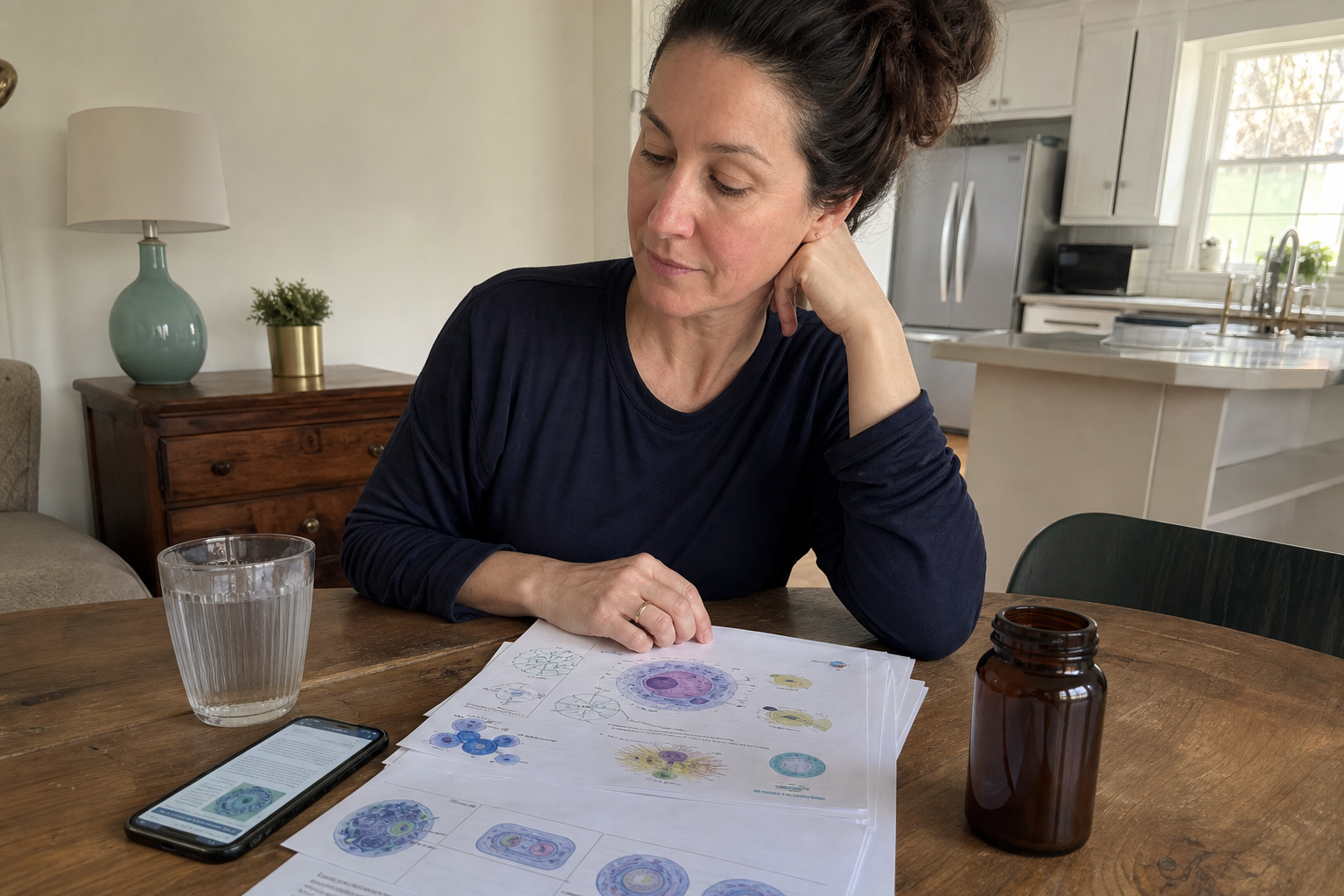
Sirtuins are seven related human proteins with different locations, substrates, and biological roles. NAD+ is a required co-substrate for their catalytic reactions, but availability is only one part of the system. NMN is a precursor rather than a switch for sirtuin activity. Human studies support cautious statements about short-term NAD+ biomarkers and tolerability, not broad claims about slowing aging.
Content
- What are sirtuins?
- How does NAD+ relate to sirtuin activity?
- What do SIRT1 through SIRT7 do?
- How should the evidence be interpreted?
- What do human NMN studies show?
- What everyday habits support the same goal?
- What should you check in an NMN product?
- A practical decision framework
- Frequently Asked Questions
What are sirtuins?
Sirtuins are a family of seven proteins encoded by the human SIRT1 through SIRT7 genes. They belong to the class of enzymes that use NAD+ as a co-substrate while removing selected acyl groups from proteins or carrying out related signaling reactions. This chemistry connects cellular nutrient status with processes such as chromatin organization, mitochondrial metabolism, stress signaling, and protein quality control. [1]
Calling them “longevity-linked genes” can blur the biology. A gene is an instruction; a sirtuin is the protein produced from it, and activity depends on location, substrates, NAD+, nicotinamide feedback, and other signals. The family members are not interchangeable, so research on one should not be extended automatically to all seven.
It is more accurate to use NAD+-dependent deacylases than to call all seven histone deacetylases. SIRT1, SIRT2, and SIRT3 have well-characterized deacetylase activity, while SIRT4, SIRT5, SIRT6, and SIRT7 show more specialized profiles. Several functions remain better established in laboratory systems than in people. [2]
How does NAD+ relate to sirtuin activity?
NAD+ is not simply fuel in a tank. It is a co-substrate consumed during sirtuin-catalyzed reactions, producing nicotinamide and other reaction products. For that reason, local NAD+ concentration can influence the potential for sirtuin activity. Yet the result depends on more than a blood measurement. NAD+ is distributed across tissues and cellular compartments, and the body also uses it for other enzymes, including PARPs and CD38-related pathways.
NMN sits in the NAD+ biosynthesis network. After ingestion, it may be converted through tissue-specific pathways that contribute to the NAD+ pool. That does not mean an NMN capsule travels unchanged to every cell or selectively binds SIRT1, SIRT3, or SIRT6. Transport, metabolism, tissue distribution, dose, baseline status, and study design all affect what can be observed. Readers who want the biochemical distinction between the molecules can compare NAD+ and NMN terminology before considering any supplement.
The useful interpretation is conditional: increasing NAD+ may remove one constraint on NAD+-dependent reactions, but it does not ensure a downstream response. Cellular signaling is a network, not a single switch.

A supplement routine is one part of the wider context that shapes an individual wellness decision.
What do SIRT1 through SIRT7 do?
This table is an orientation guide, not a list of supplement outcomes. It separates common cellular location from research focus. A laboratory finding does not mean that an over-the-counter supplement produces the same result in humans.
| Sirtuin | Common cellular location | What research explores | What this does not establish |
|---|---|---|---|
| SIRT1 | Nucleus and cytoplasm | Chromatin and transcriptional regulation, stress responses, and metabolic signaling | A universal switch for healthy aging |
| SIRT2 | Cytoplasm and nucleus | Cytoskeletal proteins, cell-cycle biology, and protein deacylation | A general brain or cancer intervention |
| SIRT3 | Mitochondria | Mitochondrial protein deacylation and metabolic enzyme regulation | A predictable increase in energy production |
| SIRT4 | Mitochondria | Metabolic enzyme regulation and amino-acid or lipid metabolism | A predictable change in insulin secretion |
| SIRT5 | Mitochondria | Desuccinylation, demalonylation, deglutarylation, and metabolic regulation | A generic “detox” effect |
| SIRT6 | Nucleus | Chromatin regulation, DNA-damage response, and long-chain fatty-acyl signaling | A supplement-driven change in chromosome length |
| SIRT7 | Nucleolus and nucleus | Ribosome biogenesis, chromatin biology, and cellular stress responses | A proven cardiovascular benefit from NMN |
This diversity is why “turning on all seven” is not a meaningful consumer endpoint. Some members are best understood through enzyme assays or cell and animal models, while others remain under investigation. Ask which claim was tested, in which tissue, and in which population.
How should the evidence be interpreted?
A strong explanation should show the distance between a molecular mechanism and a meaningful health outcome. The following evidence ladder can help readers, editors, and search engines distinguish what is plausible from what is demonstrated.
| Evidence level | Typical question | Practical meaning |
|---|---|---|
| Molecular mechanism | Can the enzyme use NAD+ in a defined reaction? | Shows biochemical plausibility, not a whole-person effect |
| Cell or animal model | Does changing the pathway alter a measured process? | Useful for hypotheses; translation to humans is uncertain |
| Human biomarker trial | Does an intervention change blood or tissue markers? | Shows a biological response; it may not predict how someone feels or functions |
| Human outcome trial | Does it improve a predefined outcome versus placebo? | Most relevant for decisions, but still depends on sample, duration, and replication |
This framework prevents a common leap: a change in NAD+ is treated as proof that every downstream pathway has improved. A careful article names the measured endpoint, the population, the duration, and the study limits.
What do human NMN studies show?
Human NMN research is growing, but it remains smaller and shorter than many longevity advertisements suggest. In a randomized, placebo-controlled study of 30 healthy adults, 250 mg daily for 12 weeks increased whole-blood NAD+ without obvious adverse effects during the study period. This supports a biomarker and short-term tolerability statement, not proof of a change in every sirtuin or in aging outcomes. See AIDEVI’s NMN research overview for a broader reading path. [3]
Another randomized trial enrolled 80 healthy middle-aged adults and compared 300, 600, and 900 mg daily for 60 days. Blood NAD+ increased across the study groups, and no safety signal was identified within that limited trial period. This does not create a universal serving recommendation. The participants were selected for a research question, the duration was short, and study funding or author affiliations should be considered when weighing the result. [4]
The most responsible summary is therefore narrow: NMN can raise measured NAD+ in some human study settings, while evidence for long-term functional outcomes remains incomplete. Results may differ with age, sex, baseline health, medication use, diet, activity, product quality, and the tissue being measured. A supplement decision should not be based on a single mechanism diagram or an isolated dosage number.
Readers comparing NMN with nicotinamide riboside can review NMN versus NR research questions. The useful comparison is not which ingredient has the most ambitious slogan; it is which human evidence, quality documentation, and personal safety context match the reader’s goal.
What everyday habits support the same goal?
NAD+ metabolism is connected to energy balance, activity, sleep-wake timing, and nutritional status. Foundational habits are relevant, but they do not produce a predictable sirtuin response in every person. A sustainable routine usually has more practical value than an aggressive “stack.”
- Move consistently: Combine aerobic activity, resistance training, and recovery at a level you can maintain. Exercise research is more useful when the routine, intensity, and population are clear.
- Protect sleep: A regular sleep schedule supports circadian and metabolic regulation. Sleep is not a substitute for a supplement, but it is an important baseline for interpreting energy or wellness changes.
- Build a nutrient-dense diet: Adequate protein, fiber, plants, and hydration support general health. There is no need to label ordinary foods as “sirtuin foods” or promise that one ingredient controls the pathway.
- Use fasting carefully: Time-restricted eating may fit some adults, but it is not appropriate for everyone. People with diabetes, a history of eating disorders, pregnancy, or medication-related meal requirements should ask a clinician first.

Consistent movement is a practical foundation for a healthy-aging routine.
For a practical overview of non-supplement approaches, see ways to support NAD+ naturally. Keep the language proportional: lifestyle can support healthy aging foundations, but it should not be presented as a certain molecular intervention.
What should you check in an NMN product?
If you decide to explore NMN, product quality is a more useful starting point than a promise about changing a specific protein. Check the ingredient name, amount per serving, lot identification, storage guidance, expiration information, and whether a recent certificate of analysis identifies the tested material. A COA is most useful when linked to the product lot and a clear testing method. The FDA’s dietary supplement guidance is also useful when separating product marketing from evidence.
- Read the label: Confirm whether the product contains NMN alone or a blend, and look for unnecessary proprietary wording that hides quantities.
- Review documentation: Use this NMN certificate-of-analysis guide to understand what a testing document can and cannot tell you.
- Keep research doses in context: A dose used in a clinical trial is a study parameter, not an automatic personal recommendation. Readers can use the NMN dosage evidence guide to see why age, formulation, duration, and clinician input matter.
- Ask about your context: Anyone who is pregnant, nursing, taking medication, preparing for surgery, or managing a medical condition should speak with a healthcare professional before starting a new supplement.

A transparent label and traceable testing record make product research easier to evaluate.
What is a sensible way to decide?
Use the following “Goal, Evidence, Context” filter before adding NMN to a routine. It keeps product discovery useful without turning a science article into a personal treatment plan.
| Decision point | A reasonable next step | Pause or ask first |
|---|---|---|
| Goal | You want to learn about NAD+ biology or support a general wellness routine | You expect a supplement to replace diagnosis, medical care, sleep, or nutrition |
| Evidence | You can identify the actual endpoint, study length, and population | The message relies only on animal results, a mechanism graphic, or a sweeping testimonial |
| Context | You have reviewed the label, batch documentation, and storage instructions | You are pregnant, nursing, using medication, managing a condition, or facing an upcoming procedure |
| Product fit | You prefer transparent ingredients and documentation; for example, review AIDEVI’s NMN product information as a label reference | The product makes disease, dramatic rejuvenation, or performance promises |
The goal is informed choice, not a promise that a pathway behaves identically in every person. Individual results may vary. If comparing products, the NMN buyer checklist offers a broader review of form, testing, and transparency.
Conclusion
Sirtuins are an important NAD+-dependent protein family, but they are not a single switch and they do not all perform the same reaction. Their location, substrates, regulatory signals, and tissue environment matter. NMN is biologically relevant because it can contribute to NAD+ biosynthesis; that mechanism is a reason to study the ingredient, not proof of a broad human outcome.
The clearest current human takeaway is narrower: selected NMN trials have reported higher blood NAD+ over short study periods, with no obvious safety signal within those study conditions. That finding should be separated from claims about long-term healthspan, cognition, mitochondrial performance, or genomic outcomes. A professional article earns trust by showing the evidence boundary, linking to quality information, and giving readers a conservative decision path.
For general wellness, start with consistent movement, adequate nutrition, regular sleep, and a review of personal contraindications. If NMN remains relevant, choose a transparent product and discuss it with a qualified healthcare professional when your health history or medication list makes the decision less straightforward.
Frequently Asked Questions
Are sirtuins genes or proteins?
The human SIRT1 through SIRT7 genes provide instructions for seven sirtuin proteins. In everyday health writing, “sirtuin genes” is often used loosely, but the biological activity being discussed is the activity of the encoded proteins.
Does NMN directly switch on sirtuins?
No direct consumer-level switch has been established. NMN is a precursor in NAD+ biosynthesis. If it changes NAD+ availability in a relevant tissue, that may alter the conditions for NAD+-dependent reactions, but the size and meaning of any downstream effect are context-dependent.
Are all seven sirtuins equally well understood?
No. SIRT1, SIRT2, and SIRT3 have been studied extensively, while the enzymology and physiological roles of SIRT4 and SIRT7 are less settled in comparison. SIRT5, SIRT6, and SIRT7 also illustrate why “deacylase” is a more useful umbrella term than treating every family member as the same type of deacetylase. [2]
Does a higher NAD+ result prove that aging has slowed?
No. A higher blood NAD+ result is a biomarker finding. It does not automatically show a change in lifespan, healthspan, physical function, cognition, or a specific sirtuin in every tissue. Those questions require appropriately designed human outcome studies.
Can I use NMN with medication or during pregnancy?
Do not assume compatibility from a general wellness article. If you are pregnant, nursing, taking medication, preparing for surgery, or managing a medical condition, ask a healthcare professional before starting NMN or any new supplement.
References
- [1] Kane, A. E., & Sinclair, D. A. (2018). Sirtuins and NAD+ in the Development and Treatment of Metabolic and Cardiovascular Diseases. Circulation Research review.
- [2] Zheng, W. & coauthors (2018). Mammalian Sirtuins SIRT4 and SIRT7. PubMed record.
- [3] Irie, J. & coauthors (2022). Randomized, placebo-controlled NMN study in healthy adults. PubMed record.
- [4] Yoshino, M. & coauthors (2022). Randomized NMN dose-ranging study in healthy middle-aged adults. PubMed record.
- [5] U.S. Food & Drug Administration. FDA 101: Dietary Supplements. Consumer guidance.
These statements have not been evaluated by the Food and Drug Administration. This product is not intended to diagnose, treat, cure, or prevent any disease.
