



AIDEVI Wellness Guide
nmn and Physiological and Metabolic Support in Older Adults
NMN may support healthy aging because it helps the body make NAD+, a coenzyme involved in cellular energy, metabolic signaling, and stress-response pathways. In older adults, early human studies suggest NMN can raise blood NAD+ markers and may influence measures related to walking, muscle function, and metabolic health. Still, NMN should be framed as wellness support, not as a treatment or a substitute for medical care.

- NMN is a precursor that supports the body's production of NAD+.
- NAD+ is involved in cellular energy metabolism, sirtuin activity, DNA repair signaling, and metabolic regulation.
- Human studies in older or middle-aged adults are encouraging but still limited in size, duration, and outcome scope.
- Older adults should discuss NMN with a healthcare professional, especially when taking medication or managing chronic conditions.
Content
A practical answer: NMN is best understood as a NAD+ support ingredient for healthy-aging routines. For older adults, the most realistic discussion includes cellular energy, physical function, metabolic markers, sleep quality, and safety monitoring. It should not be used as a shortcut around movement, protein intake, sleep, medical screening, or prescribed care.
Why does NAD+ matter more with age?
NAD+ is a coenzyme that helps cells convert nutrients into usable energy and supports several enzyme systems involved in cellular maintenance. Researchers often discuss NAD+ in relation to mitochondria, sirtuins, PARPs, DNA repair signaling, and stress-response pathways. Reviews of NAD+ biology describe age-related NAD+ decline as a recurring theme in geroscience, although the rate and meaning of that decline can vary by tissue, health status, and study method [1].
For older adults, this matters because cellular energy is tied to ordinary life: walking, climbing stairs, recovering after activity, maintaining muscle quality, and handling metabolic stress. NAD+ is not the only factor in these processes, but it is an important biochemical hub. That is why NMN, a NAD+ precursor, has become a focus of healthy-aging research. AIDEVI's guide to what NAD+ means for cellular energy gives the foundation, while why NAD+ declines with age explains the enzyme-level context.
The key phrase is “support,” not dramatic rejuvenation. Aging is multi-layered. Nutrition, hormones, inflammation, sleep, medication use, body composition, muscle mass, gut health, cardiovascular fitness, and social routines all influence how an older person feels. NMN belongs in the cellular-metabolism layer of that bigger picture.
What does human NMN research show in older adults?
Human NMN research is no longer limited to theory, but it is still early. A placebo-controlled, randomized, double-blind trial in healthy older men found that 250 mg of NMN per day for 6 or 12 weeks was well tolerated and increased blood NAD+ and NAD+ metabolite concentrations. The study also reported changes in selected muscle-function measures, including gait speed and grip-strength-related findings, while not presenting NMN as a broad anti-aging answer [2].
Another randomized, placebo-controlled study in older adults reported that 250 mg/day NMN for 12 weeks increased blood NAD+ metabolites. The primary stepping-test outcome was not significantly different between NMN and placebo, but secondary measures included shorter 4-meter walking time and sleep-quality findings after 12 weeks [3]. This is a good example of why careful wording matters: positive secondary signals are interesting, but they are not the same as a universal claim.
Metabolic research also matters. In a randomized clinical trial of postmenopausal women with prediabetes who were overweight or obese, NMN increased muscle insulin sensitivity and insulin signaling after 10 weeks [4]. This was not a general elderly-population study, and it should not be turned into a disease claim. It does show why researchers are interested in muscle, metabolism, and NAD+ precursor support. For a fuller discussion, AIDEVI's NMN and metabolic health science guide is a better next step.
Which physiological and metabolic areas are being studied?
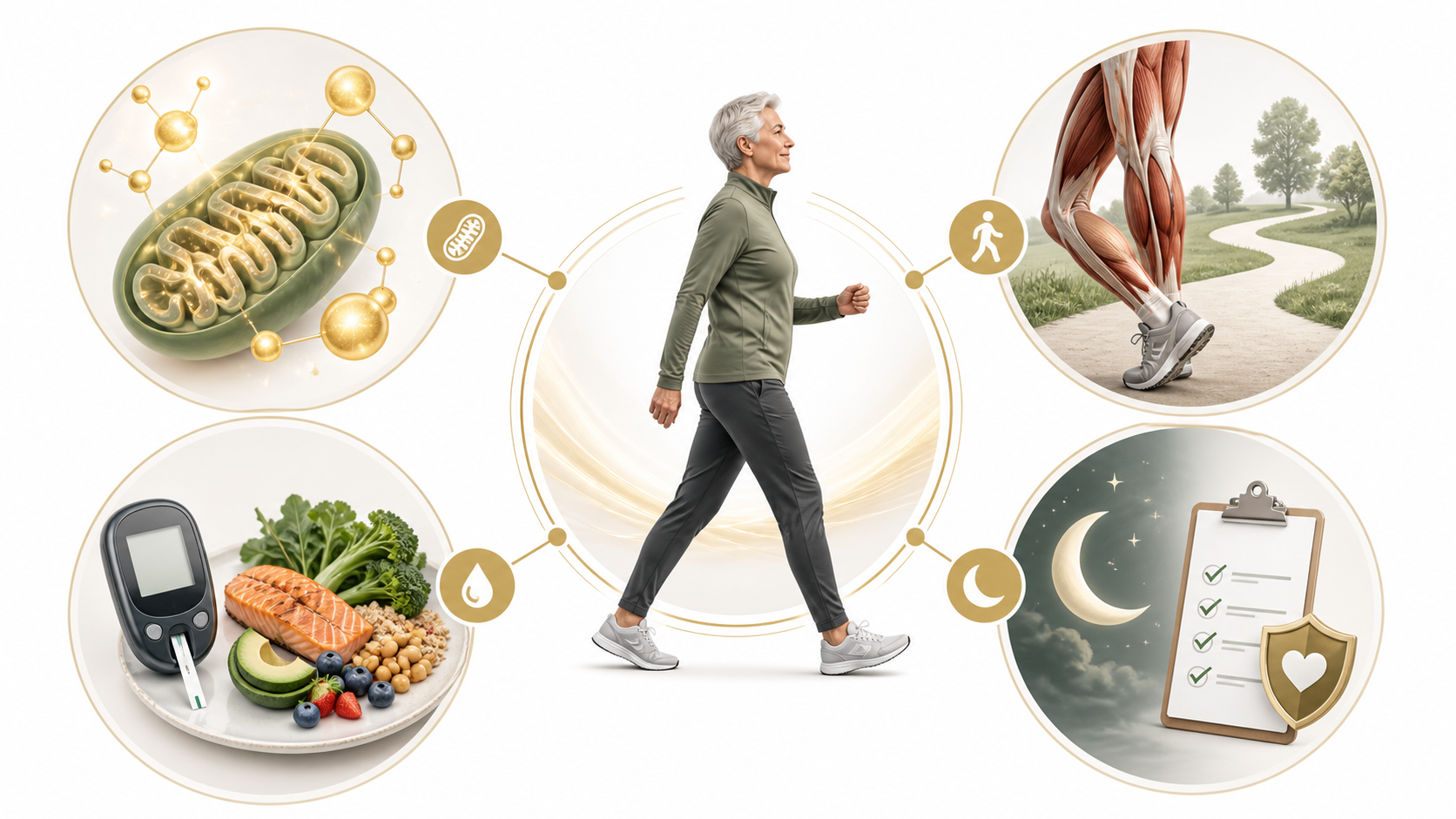
The strongest article structure for this topic is not a long list of promises. It is a pathway map. NMN research in older or middle-aged adults clusters around four areas: NAD+ status, physical function, metabolic signaling, and recovery-related quality of life. These areas overlap because skeletal muscle is both a movement organ and a metabolic organ.
| Area | Why it matters for older adults | Responsible wording |
|---|---|---|
| Cellular energy | Mitochondria use cellular pathways tied to NAD+ to help generate usable energy. | NMN helps support healthy NAD+ metabolism. |
| Physical function | Walking speed, muscle quality, and daily stamina shape independence. | NMN is being studied for healthy physical-function markers in older adults. |
| Metabolic wellness | Skeletal muscle helps handle glucose and metabolic flexibility. | NMN may support metabolic pathways already under normal wellness care. |
| Sleep and recovery | Sleep quality affects energy, glucose regulation, cognition, and resilience. | Sleep findings are emerging and should be tracked cautiously. |
If your main interest is physical energy, AIDEVI's article on cellular energy production and NMN supplementation explains the mitochondrial angle. If your question is whether NMN works in a broader sense, does NMN work? offers a balanced evidence review.
How should older adults build an NMN routine?
A good routine starts with the basics older bodies respond to consistently: adequate protein, resistance training, balance work, walking, hydration, regular sleep timing, and medical monitoring when appropriate. NMN should not be used to compensate for a low-protein diet, inactivity, poor sleep, or unmanaged health concerns. It is better viewed as one optional layer in a larger plan.
A practical framework is “Foundation, Fit, Follow-up.” Foundation means you already have food, movement, and sleep in place. Fit means the product form, timing, dose, and label are understandable. Follow-up means you track changes instead of relying on hope. For older adults, tracking should include energy pattern, digestion, sleep quality, walking comfort, exercise consistency, mood, and any unusual symptoms.
Dose conversations should stay conservative and personal. Human NMN trials have used different daily amounts, populations, and durations. That does not create one universal dose. Readers comparing routine design can review AIDEVI's NMN dosage by age guide, while low-energy patterns should be treated as educational context rather than self-diagnosis.
Sleep deserves special attention. One study in older adults reported secondary sleep-quality findings, but sleep is influenced by light exposure, caffeine, pain, medications, nighttime urination, stress, breathing issues, and circadian rhythm. NMN should not be the first explanation for sleep problems. AIDEVI's guide on NMN and sleep quality can help readers separate early research signals from practical sleep hygiene.
Who may consider NMN, and who should pause?
Older adults are not one group. A 62-year-old runner, a 75-year-old managing several prescriptions, and an 82-year-old recovering from a fall do not have the same supplement decision. Use the matrix below to keep the decision grounded.
| Best fit | Consider instead | Avoid or pause if |
|---|---|---|
| Healthy older adults interested in NAD+ metabolism and cellular-energy support. | Begin with protein, walking, strength training, and sleep if those are inconsistent. | You are using NMN instead of appropriate evaluation, medication review, or rehabilitation guidance. |
| Adults who want a simple, trackable supplement experiment after checking the label. | Compare NMN with NR or NAD+ formats if you are unsure about the pathway. | You take multiple medications or have liver, kidney, cancer, cardiovascular, or endocrine concerns without clinician input. |
| Women in midlife or later who are building a broader healthy-aging routine. | Address menopause, bone health, sleep, protein, and resistance training first. | You are pregnant, nursing, preparing for surgery, or experiencing new unexplained symptoms. |
For women-focused healthy aging, AIDEVI's women over 40 guide to NMN and ergothioneine gives a more targeted context. If you are comparing precursor formats before choosing, review the difference between NMN, NR, and NAD+ before stacking products.
Safety should remain front and center. The FDA explains that supplements can have risks, may interact with medicines, and should not replace prescribed care or a varied diet [5]. This is especially relevant for older adults, who are more likely to use multiple medications or manage more than one health condition.
What should older adults track after starting NMN?
Tracking should be simple enough to repeat. Before starting, write down your usual sleep schedule, morning energy, walking comfort, digestion, exercise frequency, and any current supplements or medications. After starting, review the same items weekly. A useful tracking note might include bedtime, wake time, appetite, stomach comfort, daily steps, resistance-training sessions, and whether you felt steady or tired during ordinary activities.
It is also important to separate a true supplement response from normal life noise. A good week of sleep, more protein, improved hydration, physical therapy, or a new walking habit can change energy and mobility even without NMN. The cleanest experiment changes one major variable at a time. If NMN is added during a broader routine reset, describe it as part of the full program, not as the sole reason for every change.
Older adults should also define a stop rule. If a supplement causes digestive discomfort, headaches, sleep disruption, unusual symptoms, or concern from a clinician or caregiver, pause and reassess. A quality healthy-aging routine should make daily life easier to manage, not create more uncertainty.
Set expectations around subtle support rather than dramatic change. The most meaningful improvements in later life often show up as steadier routines, better consistency, and fewer energy crashes, not overnight transformation.
Conclusion
NMN may support physiological and metabolic wellness in older adults by helping maintain NAD+ pathways involved in cellular energy, muscle function, metabolic signaling, and recovery. Human studies are encouraging, especially around blood NAD+ markers and selected functional or metabolic measures, but the evidence is still developing and should be interpreted carefully.
The best use of NMN is not as a promise of transformation. It is as a targeted supplement option within a larger healthy-aging plan: move daily, train muscles, eat enough protein, protect sleep, monitor health markers, and review supplements with a professional when the stakes are higher. Aging well is built from repeatable basics, with NMN serving only as one possible support layer.
Frequently Asked Questions
Can elderly adults take NMN?
Some older adults may consider NMN as part of a healthy-aging routine, but it should be discussed with a healthcare professional first, especially when medications or chronic conditions are involved.
Does NMN improve metabolism in older adults?
NMN is being studied for metabolic pathways, including NAD+ status and muscle insulin sensitivity in specific populations. It should be described as metabolic support research, not as a treatment claim.
Does NMN help physical function?
Some human studies in older adults have reported changes in walking or muscle-related measures, but results vary by study. Exercise, strength training, and balance work remain essential.
How long should older adults track NMN use?
A practical tracking window is often 8 to 12 weeks, matching many study durations. Track energy, sleep, digestion, movement consistency, and any side effects. Stop and seek advice if anything feels wrong.
What should older adults do before starting NMN?
Review medications, health conditions, supplement labels, and goals with a healthcare professional. Also make sure the basics are in place: adequate food, regular movement, sleep support, hydration, and routine medical care.
References
- [1] Rajman L, Chwalek K, Sinclair DA. Therapeutic Potential of NAD-Boosting Molecules: The In Vivo Evidence. https://pubmed.ncbi.nlm.nih.gov/29689125/
- [2] Igarashi M, et al. Chronic nicotinamide mononucleotide supplementation elevates blood NAD+ levels and alters muscle function in healthy older men. https://pubmed.ncbi.nlm.nih.gov/35927255/
- [3] Ingestion of beta-nicotinamide mononucleotide increased blood NAD levels, maintained walking speed, and improved sleep quality in older adults in a double-blind randomized, placebo-controlled study. https://pubmed.ncbi.nlm.nih.gov/38789831/
- [4] Yoshino M, et al. Nicotinamide mononucleotide increases muscle insulin sensitivity in prediabetic women. https://pubmed.ncbi.nlm.nih.gov/33888596/
- [5] U.S. Food and Drug Administration. FDA 101: Dietary Supplements. https://www.fda.gov/consumers/consumer-updates/fda-101-dietary-supplements
These statements have not been evaluated by the Food and Drug Administration. This product is not intended to diagnose, treat, cure, or prevent any disease. This article is for educational purposes only and is not medical advice. Consult a healthcare professional before starting any new supplement, especially if pregnant, nursing, taking medication, preparing for surgery, managing a medical condition, or caring for an older adult with complex health needs.
