



AIDEVI Science & Wellness Guide
How NAD Injections Compare to Other nmn Supplements
By AIDEVI Editorial Team | Last Updated: August 2026 | NAD+ & NMN Comparison
NAD+ injections and oral NMN supplements use different delivery routes, but current human research does not prove that injections produce faster or better long-term health outcomes. Intravenous NAD+ changes blood and metabolite levels during a supervised infusion, while oral NMN works as a precursor that the body processes into NAD-related compounds. The right comparison is not “which one is strongest?” but “which route has evidence for your goal, a safety profile you understand, and a routine you can use responsibly?”

An NAD+ infusion delivers NAD+ into the bloodstream under professional supervision, but a small human pilot showed that infused NAD+ was rapidly removed from plasma and metabolized rather than simply remaining available for cells. Oral NMN is a precursor; randomized human studies show that it can raise whole-blood NAD+ over weeks. Neither route has been proven to prevent aging-related disease or guarantee a noticeable energy boost.
Content
What is the real difference between NAD+ injections and oral NMN?
NAD+, or nicotinamide adenine dinucleotide, is a coenzyme involved in energy metabolism and many cellular reactions. NMN, or nicotinamide mononucleotide, is one precursor in the pathway used to make NAD+. That distinction matters: a route of administration does not automatically determine how much NAD+ reaches a target tissue or how long a biological effect lasts. It also does not determine whether a product is appropriate for a particular person.
An intravenous NAD+ infusion bypasses the gastrointestinal tract and introduces the compound into the circulation. It also requires a trained professional, sterile equipment, a suitable setting, and time for the infusion. Oral NMN capsules or powders must pass through digestion and absorption, then be processed through the body’s NAD metabolism. This can be more convenient, but the final tissue response depends on the formulation, dose, timing, baseline biology, and the person taking it.
Readers who want the biochemical background can explore AIDEVI’s guide to the differences between NAD+ and NMN and its NMN versus NAD+ bioavailability comparison. Those distinctions are useful for understanding the ingredients, but they should not be converted into promises about personal results.
What do human studies actually show?
The human evidence is still early and uneven. Direct infusion research has mainly measured short-term pharmacokinetics and tolerability. Oral NMN research has more randomized trials, but most are small, short, and focused on NAD-related markers or intermediate outcomes rather than disease prevention.
| Approach | What has been observed | What remains unknown |
|---|---|---|
| NAD+ IV infusion | In a small 6-hour human pilot, infused NAD+ and metabolites were measured over time. NAD+ was rapidly removed from plasma during the early infusion period [1]. | Whether infusion improves energy, cognition, aging, athletic performance, or clinical outcomes better than oral precursors. |
| Oral NMN | A randomized 12-week study in 30 healthy adults using 250 mg/day found higher whole-blood NAD+ and no obvious adverse effects during the study [2]. | Whether the biomarker change produces a meaningful, durable benefit in a broader population. |
| Oral NMN and vascular markers | A 12-week randomized study of 36 healthy middle-aged participants found that arterial stiffness tended to decrease, but the difference versus placebo was not statistically significant [3]. | A proven improvement in blood-vessel health or protection from cardiovascular disease. |
| Commercial NAD+ IV versus NR IV | A 2026 retrospective real-world study reported different infusion tolerability patterns and variable exploratory metabolic findings [4]. | Causal effectiveness, long-term safety, and whether the findings apply outside that commercial setting. |
This comparison shows why “before and after” photos or testimonials are weak evidence. A person may report feeling different after an infusion, but that does not identify whether NAD+ changed inside cells, whether the effect came from hydration, expectation, rest, or another factor, or whether it will persist. The most reliable studies use a comparator, prespecify outcomes, and follow participants long enough to separate a temporary signal from a repeatable result.
It is also important to compare like with like. A supervised infusion protocol may use a pharmaceutical-grade preparation, a controlled rate, and clinical monitoring, whereas a retail capsule may differ in purity, stability, excipients, and labeling. Even two oral NMN products can produce different exposures. A fair buyer comparison therefore asks whether the study used the same ingredient form, serving amount, route, and outcome—not merely whether both products mention NAD+ on the label.
The oral NMN evidence should also be read carefully. Raising whole-blood NAD+ is a measurable pharmacologic effect, not a guarantee of better memory, stronger immunity, improved skin, or slower aging. AIDEVI’s article on NAD supplements and cellular health can provide broader ingredient context, while this comparison keeps the evidence boundary visible.
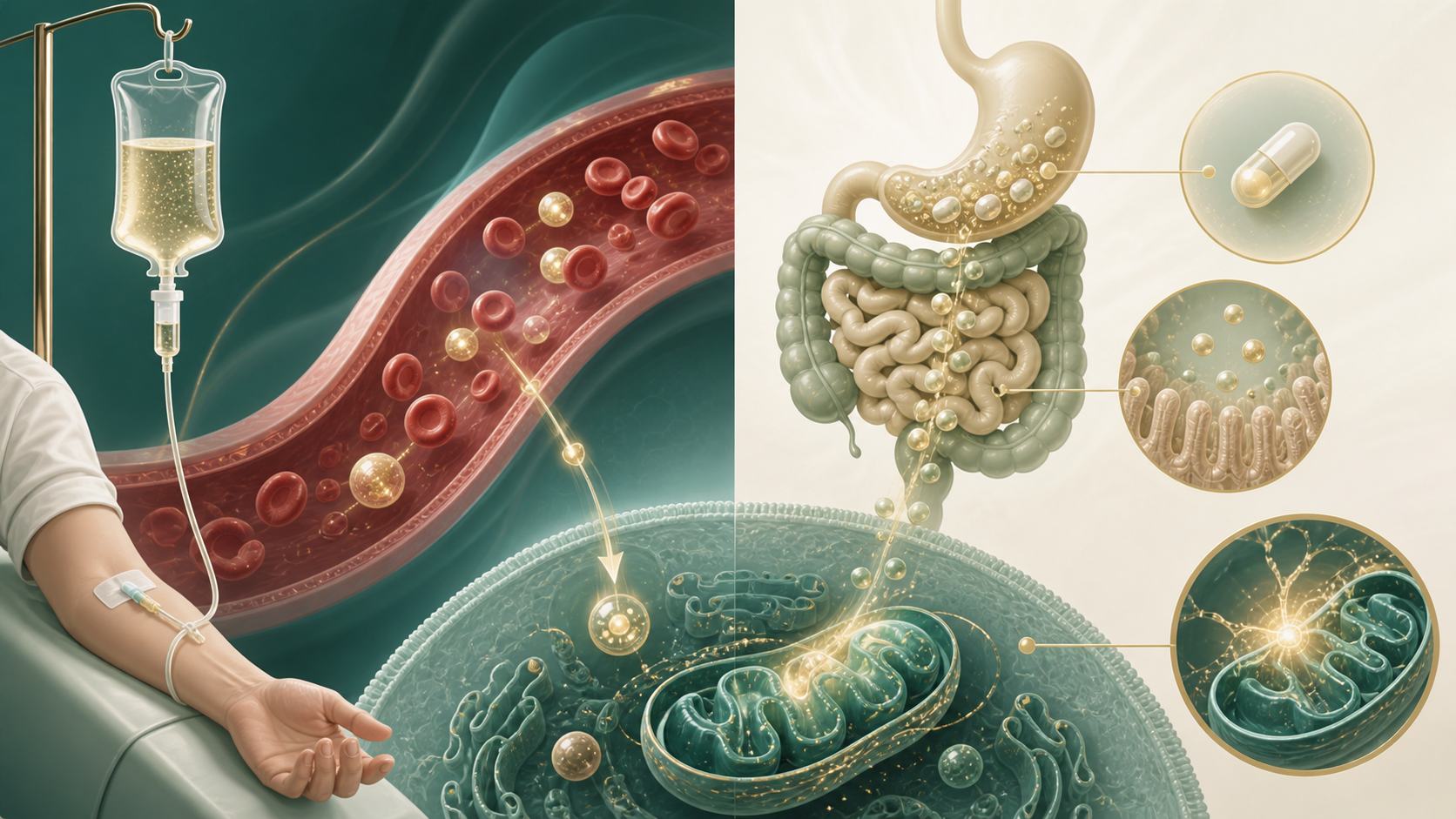
The route changes exposure and processing; it does not by itself prove greater cellular benefit. This illustration is conceptual, not a clinical measurement.
Does an injection work faster or reach cells better?
Does bypassing digestion guarantee a stronger effect?
No. Bypassing digestion can change how quickly a compound appears in the circulation, but it does not prove that more active NAD+ enters cells or that a person will feel a faster benefit. In the 2019 infusion pilot, plasma NAD+ did not simply remain elevated throughout the early infusion; the researchers observed rapid removal and downstream metabolite changes [1]. That result supports a more careful description: IV delivery changes pharmacokinetics, not necessarily health outcomes.
Does oral NMN work only slowly?
Oral NMN is not necessarily “inactive” because it is a precursor. Human trials show that repeated dosing can change whole-blood NAD+ over weeks, and some studies have explored metabolic or physical-function outcomes. However, the exact timing of a noticeable experience is not established, and individual absorption varies. The useful advantage of an oral product is usually routine simplicity, not a promise of a specific speed.
What about a direct NAD+ capsule?
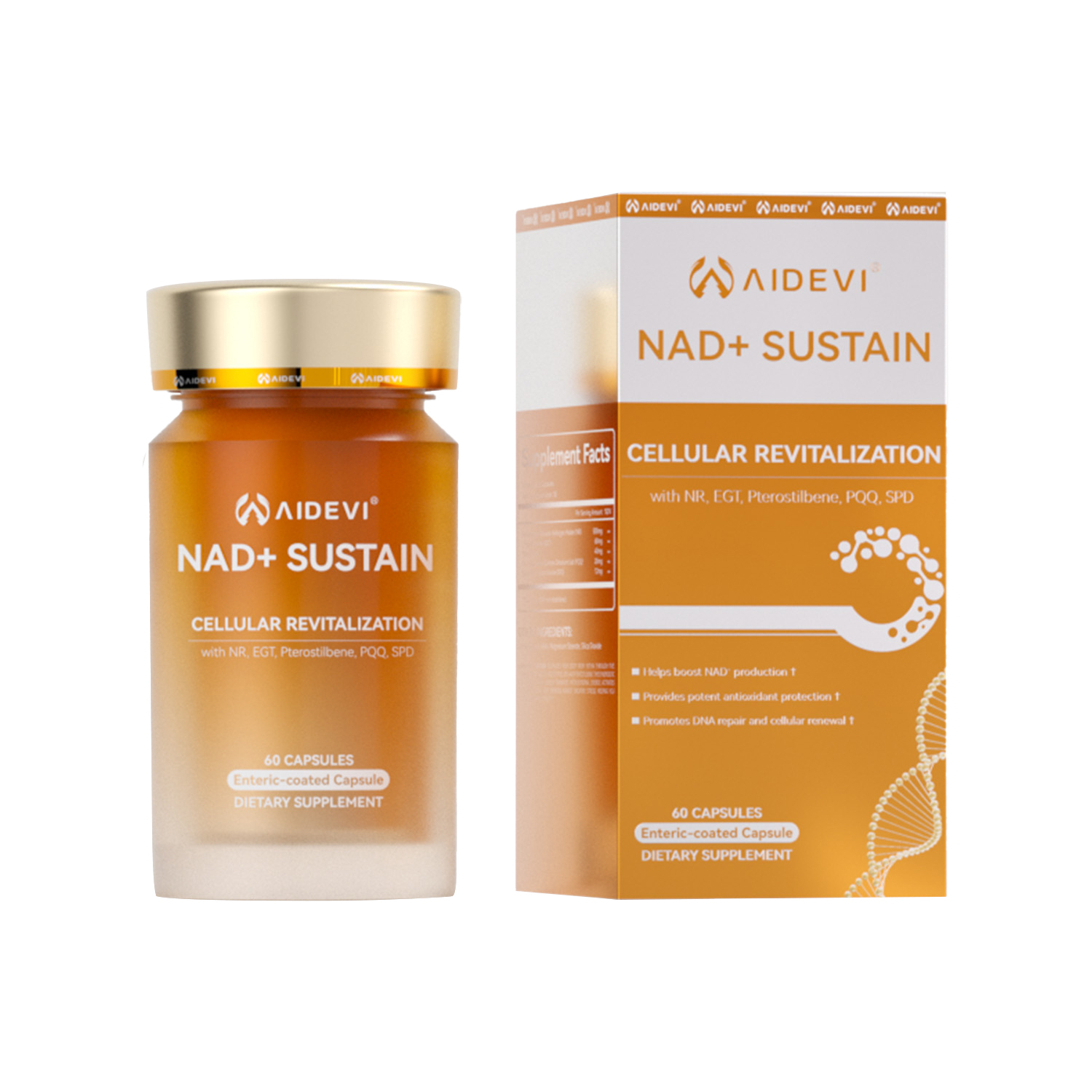
A direct NAD+ capsule should not automatically be treated as an oral equivalent of an IV infusion. The digestive tract, formulation, stability, excipients, and measured human bioavailability all matter. For example, the official AIDEVI product page for AIDEVI NAD+ 15000 lists 250 mg of direct NAD+ per capsule in a 30-capsule supply, alongside nicotinamide, TMG, and trans-resveratrol. Those are label details, not proof of a clinical outcome; compare the label with your own goals and clinician’s advice.
Which option fits different wellness goals?
A practical choice should account for the goal, evidence, setting, budget, and safety boundary. The following framework is intentionally conservative:
| Best fit | Consider instead | Avoid or pause if |
|---|---|---|
| You want a supervised procedure and have discussed the rationale, cost, and uncertainties with a qualified clinician. | A measured oral routine may be easier to maintain when the goal is general wellness rather than a clinical intervention. | You are seeking a guaranteed energy, anti-aging, or disease-related result from an infusion. |
| You prefer a daily oral precursor such as NMN and can track the label, serving size, routine, and tolerance. | Choose a product with transparent ingredients and human evidence relevant to the outcome you care about. | You are pregnant, nursing, preparing for surgery, managing a condition, or taking medication without professional review. |
| You are comparing convenience and want a non-procedural option that fits a consistent routine. | Review AIDEVI’s guide to NAD patches versus oral supplements and consider delivery claims critically. | The product does not clearly disclose ingredients, dose, manufacturer, or a way to report adverse reactions. |
Cost is part of the decision, but low cost should not be confused with low risk, and a higher price should not be confused with higher effectiveness. An infusion may include professional time, facility fees, travel, and repeat appointments. An oral supplement may be easier to use, but it still requires quality checks and realistic expectations. If absorption is your concern, AIDEVI’s guide to strategies for efficient NMN absorption is a useful starting point, not a substitute for product-specific evidence.

The most useful comparison tracks goal, evidence, routine, cost, and safety together rather than focusing on speed alone.
What safety questions should you ask?
The risks are not identical because the routes are not identical. An infusion involves a needle, sterile handling, a healthcare setting, infusion-related symptoms, and the possibility of a reaction during administration. A recent retrospective comparison of commercial NAD+ IV and NR IV reported gastrointestinal symptoms, increased heart rate, and chest pressure in some NAD+ IV recipients; the study was observational and cannot establish how common these experiences are across all settings [4].
Oral NMN avoids the procedure itself, but it is still biologically active and long-term evidence is limited. Short studies have generally reported favorable tolerability, yet a supplement can interact with a person’s broader health situation or make it harder to interpret laboratory changes. Ask about the exact formulation, dose, product testing, allergies, medication overlap, and what symptoms should prompt discontinuation or medical attention.
Do not use NAD+ injections or an oral NMN product as a replacement for prescribed treatment. Seek urgent medical care for chest pain or pressure, severe shortness of breath, fainting, sudden weakness, or another emergency symptom. A wellness procedure or supplement is not emergency care.
Conclusion
NAD+ injections offer a direct, supervised delivery route, while oral NMN supplements offer a precursor-based approach that can fit a daily routine. Human studies show pharmacokinetic and NAD-related changes with both strategies, but they do not establish that injections deliver superior cellular benefits or faster long-term health improvements. Choose based on a defined goal, relevant evidence, transparent labeling, practical consistency, and professional safety guidance—not on the promise of an instant before-and-after transformation.
Frequently Asked Questions
Are NAD+ injections better than NMN supplements?
No clear human evidence shows that NAD+ injections are broadly better. They change delivery and exposure, while oral NMN has its own human data on blood NAD+ and short-term tolerability. The best fit depends on the goal and safety context.
Do NAD+ injections provide instant energy?
Some people report an immediate subjective change, but controlled evidence does not establish a guaranteed energy effect. A small infusion study measured metabolite changes, not a proven instant improvement in energy or performance.
Does oral NMN raise NAD+ levels?
In a small randomized 12-week study, 250 mg/day of oral NMN increased whole-blood NAD+ in healthy adults. That biomarker result does not guarantee the same response for every product, dose, tissue, or person.
Is a direct NAD+ capsule the same as an NAD+ IV?
No. An IV route bypasses the digestive tract, while an oral capsule must be digested and absorbed. A direct NAD+ label also does not prove that the capsule produces the same blood or tissue exposure as an infusion.
Should I ask a doctor before using either option?
Yes, especially if you take medication, have a medical condition, are pregnant or nursing, or are considering an infusion. Bring the exact product label or proposed infusion details so the professional can review the situation accurately.
References
- [1] Grant R, et al. A Pilot Study Investigating Changes in the Human Plasma and Urine NAD+ Metabolome During a 6 Hour Intravenous Infusion of NAD+. Frontiers in Aging Neuroscience, 2019.
- [2] Okabe K, et al. Oral Administration of Nicotinamide Mononucleotide Is Safe and Efficiently Increases Blood NAD+ Levels in Healthy Subjects. Frontiers in Nutrition, 2022.
- [3] Igarashi M, et al. Nicotinamide adenine dinucleotide metabolism and arterial stiffness after long-term nicotinamide mononucleotide supplementation. GeroScience, 2023.
- [4] Reyna B, et al. Intravenous infusion of nicotinamide adenine dinucleotide (NAD+) versus nicotinamide riboside (NR): a retrospective tolerability pilot study in a real-world setting. 2026.
- [5] Fukamizu A, et al. Safety evaluation of β-nicotinamide mononucleotide oral administration in healthy adult men and women. Scientific Reports, 2022.
Individual results may vary. Consult a healthcare professional before starting any new supplement or infusion, especially if pregnant, nursing, taking medication, preparing for surgery, or managing a medical condition. These statements have not been evaluated by the Food and Drug Administration. This product is not intended to diagnose, treat, cure, or prevent any disease.
