



AIDEVI Healthy Aging Guide
How to Maintain Youthful Vitality Through nmn and a Healthy Lifestyle?
Updated August 20, 2026 · A practical, evidence-aware guide to NMN, daily habits, and healthy aging
Youthful vitality is better understood as a long-term pattern of energy, strength, mobility, sleep, metabolic health, and resilience—not as a number on a supplement label. NMN may help raise NAD+ availability in some human studies, but it has not been proven to reverse aging or extend human lifespan. The strongest strategy is to build a durable lifestyle around exercise, restorative sleep, nourishing food, stress management, and appropriate medical care, then consider NMN as an optional research-informed supplement rather than a replacement for those foundations.

Youthful vitality is represented here as active, sustainable well-being—not a promise to reverse biological aging.
The practical answer
Use a “Protect, Build, Support, Track” framework: protect sleep and recovery, build strength and aerobic capacity, support nutrition and cellular health, and track real outcomes such as walking ability, waist measurement, blood pressure, mood, and energy. NMN fits only in the support category, and its human benefits remain under investigation.
Content
- What does youthful vitality mean in practice?
- What is NMN supposed to do?
- What do human NMN studies actually show?
- How can exercise work alongside NMN?
- Which food and sleep habits matter most?
- How can you build a realistic daily routine?
- What safety boundaries should you keep?
- Frequently asked questions
What does youthful vitality mean in practice?
“Youthful” is often used to describe how capable and engaged a person feels, but it is not a single clinical endpoint. A more useful definition includes the ability to move comfortably, maintain muscle, recover from ordinary activity, sleep consistently, think clearly, and keep everyday health markers in a favorable range. Those outcomes are influenced by age, genetics, medical history, sleep, nutrition, physical activity, stress, alcohol, tobacco, and social connection.
This definition changes the goal. Instead of asking whether one supplement can make a person younger, ask whether a routine helps preserve function over time. Can you climb stairs, carry groceries, train, work, and enjoy your day without disproportionate fatigue? Are your strength, balance, blood pressure, glucose, lipids, and sleep moving in a healthy direction? These questions are more actionable than trying to infer biological age from a single blood marker.
AIDEVI’s broader guide to longevity, lifestyle, diet, and NMN supplementation can be used as a companion framework. The common thread is consistency: a supplement may be easy to add, but the behaviors that shape health span are repeated thousands of times.
What is NMN supposed to do?
Nicotinamide mononucleotide, or NMN, is a molecule involved in the body’s pathway for making nicotinamide adenine dinucleotide, better known as NAD+. NAD+ participates in redox reactions, cellular energy metabolism, and signaling processes. It is also used by enzymes such as sirtuins, PARPs, and CD38, which connect NAD+ biology with stress responses, DNA maintenance, inflammation, and metabolism.
That is the rationale behind NMN research: supplying a precursor might help cells maintain NAD+ availability when production and consumption are out of balance. But a plausible pathway is not the same as a proven anti-aging outcome. Researchers still need to determine which tissues change, whether a blood change reflects the relevant tissue, which people benefit, and whether a measurable change improves a meaningful health outcome.
For a plain-language explanation of cellular energy and NMN, see AIDEVI’s related guide.
Even the idea that NAD+ declines with age needs careful wording. Reviews describe age-related NAD+ changes in several organisms and tissues, while noting important gaps in human measurement. A 2026 analysis of whole-blood NAD+ across multiple human cohorts reported that whole-blood levels remained relatively stable with age and lifestyle interventions, challenging the use of blood NAD+ as a simple universal aging clock [2]. In other words, NAD+ biology is important, but “low NAD+” should not be assumed from age alone.
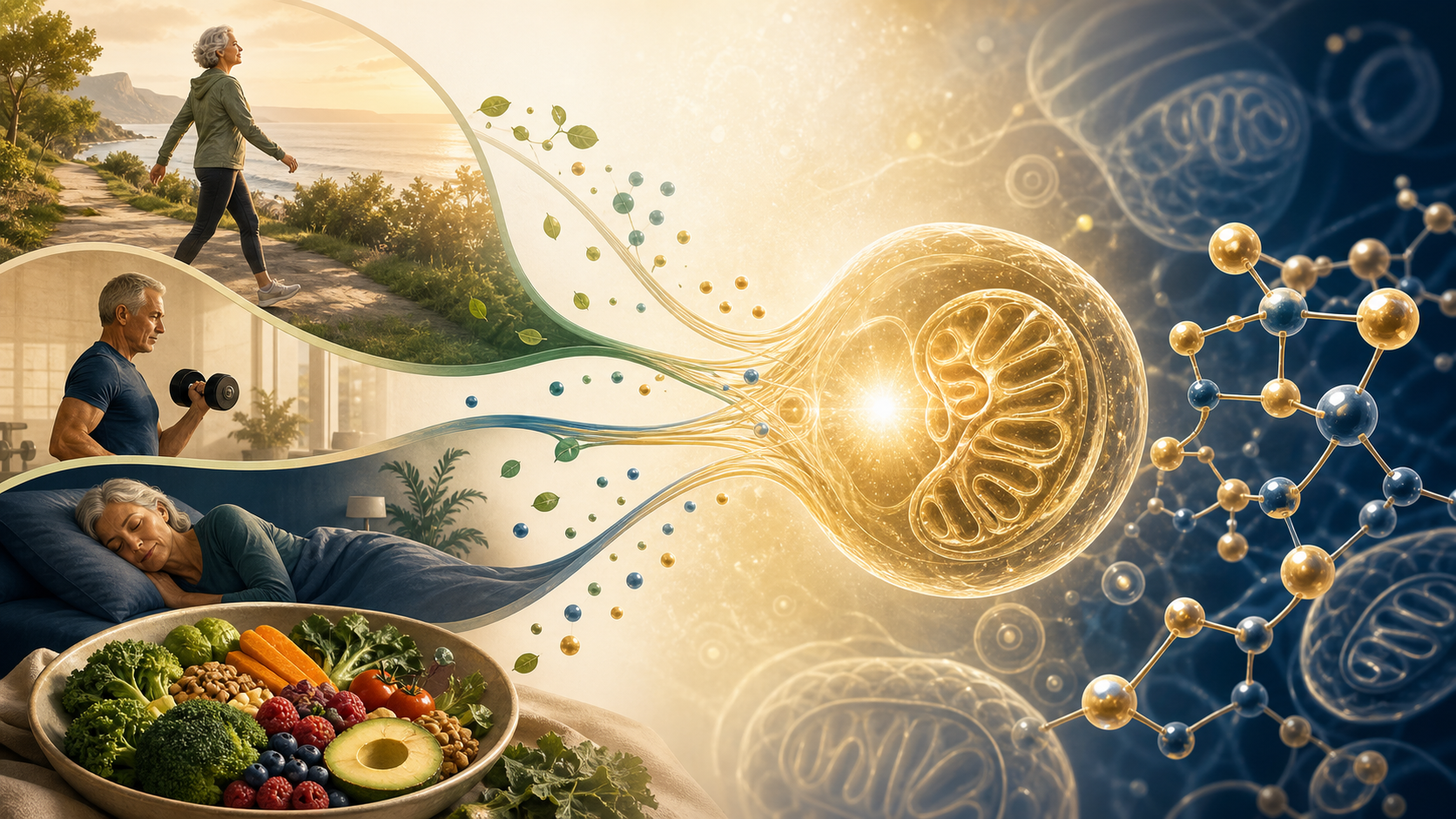
A conceptual illustration of how daily behaviors and cellular energy research can be considered together. It is not a clinical pathway or dosage chart.
What do human NMN studies actually show?
Human NMN research is growing, but it is still small compared with the size of the anti-aging claims made online. A critical review of NAD+ biology and precursor trials describes promising changes in blood NAD+ and selected physiological measures, while emphasizing that many questions about clinical benefit, tissue targeting, dose, and long-term safety remain unresolved [1].
| Human study | Reported result | How to interpret it |
|---|---|---|
| Postmenopausal women with prediabetes; 250 mg/day for 10 weeks | Improved muscle insulin sensitivity and related signaling in the study population [3] | Interesting metabolic evidence in a specific clinical group—not proof of general anti-aging effects |
| Healthy recreational runners; 300, 600, or 1,200 mg/day for 6 weeks with training | Some ventilatory-threshold and oxygen-utilization measures improved more in selected NMN groups [4] | A short exercise-performance study; it does not establish lifespan, appearance, or disease prevention |
| Healthy adults aged 20–65; 1,250 mg/day for up to 4 weeks | No major changes beyond physiological variation and no severe adverse events were reported [5] | Short-term tolerability information, not evidence that a dose is optimal or safe for long-term use |
These findings support continued research, not a blanket promise. The studies use different populations, products, durations, doses, and outcomes. Some include training programs or participants with metabolic risk, so the results cannot be transferred automatically to every healthy adult. They also do not prove that NMN reverses wrinkles, restores youth, extends lifespan, or prevents a disease.
For a current overview of how researchers are studying NMN alongside antioxidant and healthy-aging questions, see AIDEVI’s guide to healthy aging and the antioxidant properties discussed around NMN. Read it as background for decision-making, not as a substitute for a clinical consultation.
How can exercise work alongside NMN?
Exercise has a much stronger evidence base for preserving physical function than any NMN longevity claim. Aerobic activity challenges the cardiovascular system, resistance training helps maintain muscle and bone, and balance or mobility work supports independence. Exercise also changes energy demand, which is why researchers are interested in how NAD+ metabolism may interact with training.
The runner trial above is relevant because NMN was tested together with a structured training program, not in place of it. That distinction matters: the study does not tell us how much of the result came from training, how well it applies to sedentary adults, or whether the same dose is useful for a different goal. Do not turn an exercise-study dose into a universal recommendation.
A practical weekly template is to build toward at least 150 minutes of moderate aerobic activity, add two strength sessions that cover major movement patterns, and include short balance or mobility sessions. Start below that level if needed and progress gradually. If you have chest pain, unexplained breathlessness, dizziness, a recent injury, or a significant medical condition, ask a healthcare professional how to exercise safely.
Which food and sleep habits matter most?
A healthy aging diet does not need to be a supplement stack. Center meals on vegetables and fruit, legumes, whole grains, nuts, seeds, olive oil, and adequate protein. Include fish or another suitable protein source when it fits your dietary pattern. Limit heavily processed foods, excess alcohol, and a consistently high intake of added sugar and sodium. This approach supports the health factors that determine vitality—cardiovascular fitness, body composition, glucose regulation, and recovery—without requiring a claim about a single molecule.
Food contains small amounts of compounds related to NAD+ metabolism, but the exact amount varies by food, variety, preparation, and measurement method. It is not useful to promise that a specific vegetable supplies a clinical NMN dose. Eat a diverse diet for its overall nutrient pattern, not as a replacement for a studied supplement amount.
Sleep is equally important. Most adults need a regular opportunity for roughly seven to nine hours, although individual needs vary. Keep a consistent sleep and wake time, use daylight and movement during the day, reduce late caffeine and alcohol, and make the bedroom comfortable and dark. If you have persistent insomnia, loud snoring, or marked daytime sleepiness, investigate the cause rather than trying to cover the symptom with NMN.
AIDEVI’s guide to sleep, mental health, and healthy aging can help connect recovery habits with the broader vitality conversation.

A consistent evening routine can support recovery, sleep, and the sustainable habits that matter most for vitality.
How can you build a realistic daily routine?
Use the following “Protect, Build, Support, Track” framework. It keeps NMN in proportion and gives you a way to evaluate whether your routine is helping.
| Pillar | Action | What to track |
|---|---|---|
| Protect | Sleep, recovery days, sun protection, and sensible alcohol limits | Sleep duration, morning energy, soreness, and mood |
| Build | Progressive strength, aerobic movement, balance, and mobility | Walking pace, repetitions, loads, balance, and recovery |
| Support | Protein-rich meals, plant diversity, hydration, and—if appropriate—NMN | Hunger, digestion, adherence, and any supplement side effects |
| Track | Review progress monthly instead of chasing daily fluctuations | Clinician-reviewed blood pressure, waist, glucose or lipids when relevant |
If you choose to try NMN, make the experiment conservative: change one variable at a time, use the product label, avoid stacking multiple NAD+ precursors without professional guidance, and record the reason you started. There is no universally established “anti-aging dose by age,” no requirement to take NMN before a workout, and no human evidence that a higher dose guarantees more vitality. Morning use is a common preference, but timing should be guided by tolerance and routine rather than a promised circadian effect.
Readers who want to explore how NMN research intersects with gut, liver, circulation, and microbiota questions can continue with AIDEVI’s latest NMN research overview. The same principle applies: treat promising mechanisms as reasons to learn, not reasons to skip foundational care.
What safety boundaries should you keep?
Short-term human studies have generally reported acceptable tolerability, including a randomized study of 1,250 mg/day for up to four weeks in healthy adults aged 20–65 [5]. That result should not be read as a long-term safety guarantee. Trials are small and brief compared with the decades-long time horizon implied by “longevity.” Product quality, formulation, health status, medication use, and individual response also matter.
Speak with a healthcare professional before starting NMN if you are pregnant or breastfeeding, under 18, preparing for surgery, taking prescription medication, or managing a medical condition. Stop and seek advice if you develop concerning symptoms. Do not use NMN to delay evaluation of unexplained fatigue, weight change, weakness, sleep problems, mood changes, chest symptoms, or abnormal laboratory results.
Conclusion
NMN is a credible subject of healthy-aging research because NAD+ participates in energy metabolism and cellular signaling. Early human trials suggest that NMN can alter blood NAD+ or selected physiological outcomes in particular groups, but the evidence does not support calling it a proven anti-aging treatment or a way to restore youth.
The most reliable vitality plan is still a system: protect sleep and recovery, build strength and aerobic capacity, eat mostly minimally processed foods, manage stress and exposure risks, keep preventive care current, and track function over time. If NMN belongs in your routine, let it be a measured, optional support within that system—not the system itself.
Frequently Asked Questions
Can NMN make me look younger?
There is no reliable human evidence that NMN reverses visible aging or guarantees a younger appearance. Skin, sleep, sun exposure, nutrition, smoking, stress, and genetics all influence appearance. Use NMN claims about youthfulness cautiously.
Does NMN extend human lifespan?
No. Lifespan extension is not an established outcome of NMN supplementation in humans. Animal and cellular findings can guide research, but they cannot be used as a human longevity guarantee.
What is the best NMN dose for healthy aging?
There is no universally established dose for healthy aging, and clinical trials have used different doses, populations, and durations. Do not treat an age-based internet chart as medical guidance. Follow the product label and ask a qualified professional if you have health conditions or take medication.
Should I take NMN before exercise?
One short runner study evaluated NMN alongside training, but it does not establish a universal pre-workout timing rule. Prioritize hydration, food, sleep, progressive training, and safety. Timing should be based on tolerance and consistency, not a promise of boosted performance.
Can I get enough NMN from food?
Foods may contain small amounts of NMN or related precursors, but food measurements vary and no standard “food dose” has been established for healthy aging. Choose whole foods for their overall nutrient pattern rather than trying to calculate a therapeutic NMN amount from a single ingredient.
What should I do if I feel tired despite taking NMN?
Do not simply increase the dose. Review sleep, training load, meals, caffeine, alcohol, mood, and medications, and seek medical advice if fatigue is persistent, severe, or accompanied by other symptoms. NMN should not be used to mask an underlying problem.
References
- Bhasin S, et al. Nicotinamide adenine dinucleotide in aging biology: potential applications and many unknowns. PubMed.
- Human whole-blood NAD+ levels do not vary with age or lifestyle interventions. PubMed.
- Yoshino M, et al. Nicotinamide mononucleotide increases muscle insulin sensitivity in prediabetic women. PubMed.
- Liao B, et al. Nicotinamide mononucleotide supplementation enhances aerobic capacity in amateur runners. PubMed.
- Fukamizu Y, et al. Safety evaluation of beta-nicotinamide mononucleotide oral administration in healthy adult men and women. PubMed.
FDA Disclaimer: These statements have not been evaluated by the Food and Drug Administration. This content is for educational purposes only and is not intended to diagnose, treat, cure, or prevent any disease. Consult your healthcare professional before starting any dietary supplement.
