



AIDEVI Mushroom Supplement Evidence Guide
Cordyceps Sinensis Benefits: What Human Research Shows About Energy, Exercise, and Safety
Updated September 7, 2026 · A practical guide to Cordyceps species, human evidence, supplement labels, and safety boundaries
Cordyceps supplements are widely promoted for energy, endurance, immunity, recovery, and healthy aging. Human research is more specific and less conclusive: some small trials suggest possible effects on exercise capacity or sleep, while other studies show no clear improvement. The result depends on the exact species, preparation, dose, population, and outcome being measured. Cordyceps should be treated as an optional wellness ingredient, not a proven treatment for cancer, diabetes, heart disease, kidney disease, or infection.

A high-altitude outdoor scene that reflects Cordyceps’ traditional origin and the modern interest in endurance. The image does not represent a guaranteed performance benefit.
What to know first
- Cordyceps sinensis, Cordyceps militaris, and cultivated Cs-4 mycelium are not interchangeable ingredients.
- Exercise evidence is mixed and usually comes from small, short studies using different preparations.
- Most immune, blood sugar, heart, kidney, liver, anti-aging, and anticancer findings are laboratory or animal research rather than established human outcomes.
- Label identity, extract type, batch testing, medication interactions, and realistic expectations matter more than a dramatic benefit list.
Content
- What is Cordyceps sinensis?
- How do Cordyceps species and forms differ?
- Can Cordyceps improve energy or exercise performance?
- What about immunity, blood sugar, heart health, and aging?
- Can it support sleep or stress?
- How should you evaluate a Cordyceps supplement?
- What safety and interaction questions matter?
- Frequently asked questions
What is Cordyceps sinensis?
Cordyceps sinensis is the older common name for the fungus now generally referred to as Ophiocordyceps sinensis. In the wild, it is associated with insect larvae in high-altitude regions of the Tibetan Plateau and Himalayas. Traditional preparations used the fungus-and-larva material in soups, teas, or other formulas. Because wild material is scarce and expensive, modern supplements more often use cultivated mycelium, fermentation products, or a different Cordyceps species.
Cordyceps contains several groups of compounds, including nucleosides, polysaccharides, sterols, and other fungal metabolites. Cordycepin and adenosine are often discussed in research, but a marker compound is not the same as a clinically proven dose. The chemical profile can change with species, growing conditions, extraction, and whether the product contains fruiting body, mycelium, or a grain substrate.
This is why the label matters before the benefit list. A study on a standardized Cordyceps militaris extract cannot automatically validate a Cordyceps sinensis powder, a Cs-4 product, or a multi-mushroom blend.
How do Cordyceps species and forms differ?
“Cordyceps” is a broad market term, not one uniform formula. Natural Ophiocordyceps sinensis is difficult to obtain. Cordyceps militaris is cultivated more easily and is studied for compounds such as cordycepin. Cs-4 usually refers to a cultivated mycelial preparation associated with C. sinensis research. A bottle may also contain myceliated grain, a fermentation broth, a fruiting-body extract, or a blend of several mushrooms.
These forms may be reasonable food or supplement ingredients, but they should not be compared only by the number of milligrams on the front label. The extraction method, fungal material, standardization, and testing determine what the serving actually represents.
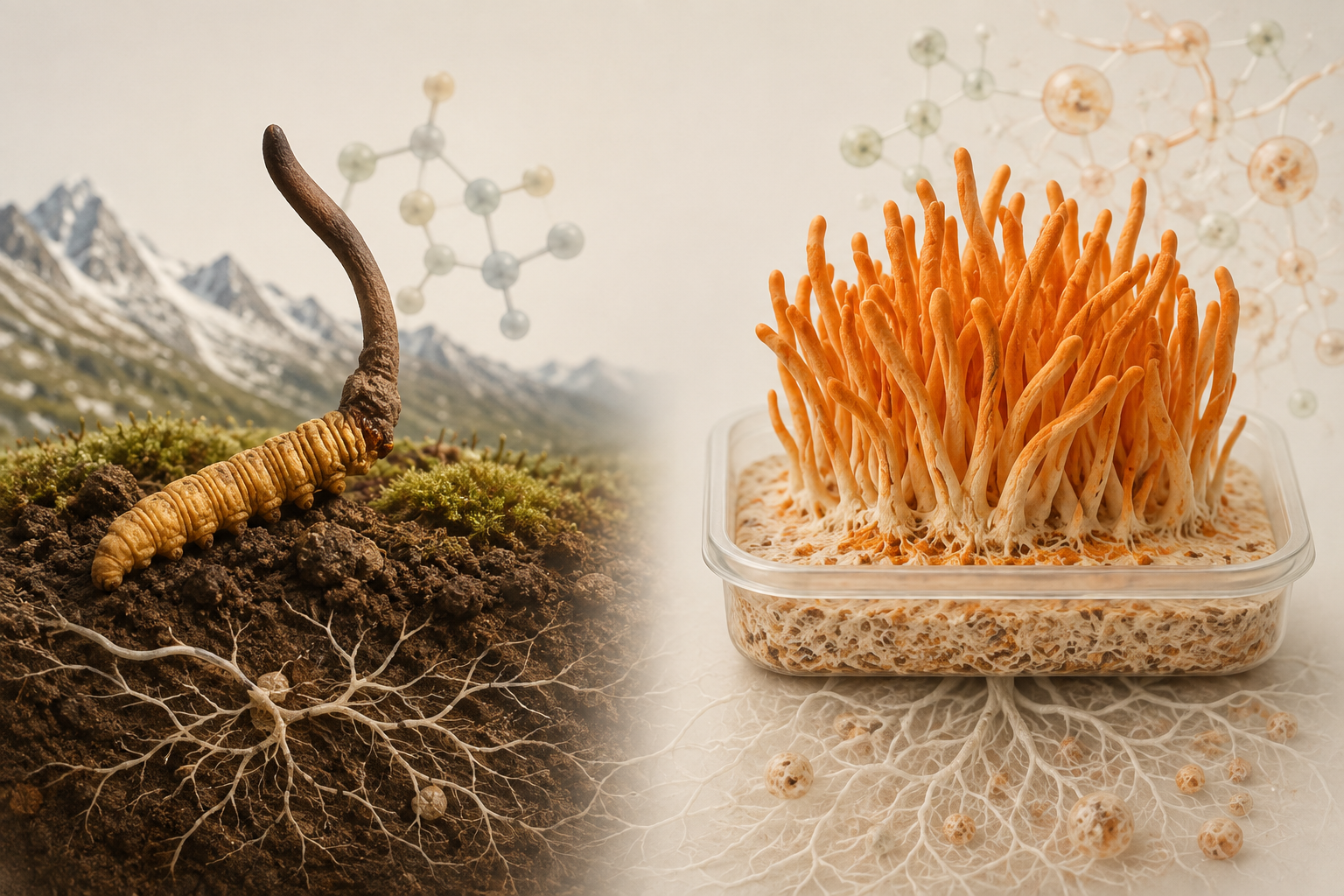
A text-free visual reminder that natural forms, cultivated fruiting bodies, mycelium, and fermentation products are different research materials.
Can Cordyceps improve energy or exercise performance?
Exercise is the most practical human research question, but the answer is not a simple yes. A small randomized trial in healthy older adults used a Cs-4 preparation for 12 weeks and reported improvements in metabolic and ventilatory thresholds, but not in VO2 max.[3] By contrast, an earlier trial in trained cyclists found that five weeks of Cs-4 did not improve VO2 peak, ventilatory threshold, or time-trial performance.
A recent review of human studies on C. militaris found only five intervention studies with 321 participants. The preparations, daily amounts, study lengths, and exercise tests varied substantially; some outcomes improved, while the overall certainty remained limited by small samples, mixed products, and inconsistent methods.[2] This is a more useful conclusion than “Cordyceps boosts ATP” or “Cordyceps makes you exercise longer.”
If your goal is training support, treat Cordyceps as an experiment with a measurable outcome, not a replacement for progressive training, adequate carbohydrate and protein intake, hydration, and sleep. Track the same workout conditions over several weeks and avoid changing multiple supplements at once.

A realistic post-exercise routine: performance claims are easier to evaluate when training conditions and recovery habits are tracked consistently.
What about immunity, blood sugar, heart health, and aging?
Cell and animal studies have explored Cordyceps polysaccharides, cordycepin, oxidative-stress markers, inflammatory pathways, glucose metabolism, lipids, and immune signaling. These studies can help researchers form hypotheses, but they do not show that an oral supplement prevents infections, lowers a person’s cholesterol, protects the heart, reverses aging, or treats diabetes.
The same boundary applies to cancer claims. Cordycepin and Cordyceps extracts have shown activity in laboratory models, including effects on cancer-cell growth. That is not evidence that Cordyceps treats cancer or makes chemotherapy safer. Anyone receiving cancer treatment should discuss all supplements with the oncology team and should not use a mushroom product as an alternative to prescribed care.
Kidney and liver claims also need restraint. A study in animals or a traditional-use reference cannot establish that a supplement repairs human organs. Cordyceps products may be unsuitable for some people because of interactions, allergies, product contamination, or an underlying condition. The responsible structure/function language is narrower: Cordyceps is being studied for cellular, metabolic, immune, and exercise-related pathways, while meaningful clinical outcomes remain condition-specific and incompletely established.
| Research area | What the evidence can support | What it cannot prove |
|---|---|---|
| Exercise | Possible support in selected small trials. | Guaranteed endurance, oxygen use, or faster recovery. |
| Immune and inflammatory pathways | Active research in cells, animals, and limited human settings. | Prevention or treatment of infection or autoimmune disease. |
| Blood sugar and lipids | Mechanistic and preclinical interest. | A substitute for diabetes or cholesterol medication. |
| Healthy aging and cancer | Laboratory hypotheses about cellular stress and growth pathways. | Longer life, cancer treatment, or disease prevention. |
Can Cordyceps support sleep or stress?
Sleep claims should be tied to the exact product studied. A 2025 randomized trial examined a Cordyceps sinensis fermentation broth in adults with primary insomnia and reported better sleep scores over 28 days.[4] That is an interesting signal, but it does not establish that every Cordyceps capsule, powder, or extract improves sleep. It also should not be used to market Cordyceps as a treatment for insomnia.
There is even less reason to promise that Cordyceps regulates serotonin, dopamine, or cortisol in a predictable way. If poor sleep, anxiety, low mood, or persistent fatigue is affecting daily life, evaluate the cause and use appropriate care. A supplement may be considered only after medication, pregnancy, bleeding risk, glucose management, and other health factors have been reviewed.
How should you evaluate a Cordyceps supplement?
Use a “species, substance, standardization, safety” check before comparing price or milligrams. First, confirm whether the label names Ophiocordyceps sinensis, C. militaris, Cs-4, mycelium, fruiting body, fermentation broth, or a blend. Next, check the extract ratio, serving size, other ingredients, and any stated marker compounds. A product that does not identify the fungal material is difficult to compare with a clinical trial.
Then look for lot or batch information, contaminant testing, and a current certificate of analysis when available. AIDEVI’s certificate-of-analysis guide covers the general logic of testing and documentation, even though it discusses another ingredient. The same quality questions apply here.
| Best fit | Consider instead | Avoid or pause if |
|---|---|---|
| An informed adult with a defined wellness goal and a transparent formula. | A food-first routine, training plan, sleep improvement, or clinical assessment may address the goal more directly. | The label hides the species, uses disease promises, or provides no meaningful quality information. |
| A short, trackable trial with one outcome such as training consistency. | Use the dose-by-age framework only as a reminder that dosage is context-specific, not as a Cordyceps dose recommendation. | You are changing several supplements at once or expecting a guaranteed result. |
For broader label-reading principles, see AIDEVI’s supplement-selection guide. It is not evidence that nmn and Cordyceps work the same way; it simply illustrates why identity, dose, testing, and intended use should be separated. Likewise, AIDEVI’s NAD+ versus NMN comparison is useful when readers are sorting different supplement categories, not when assigning Cordyceps a cellular-energy claim.
What safety and interaction questions matter?
Memorial Sloan Kettering Cancer Center notes that Cordyceps products have been studied for many traditional and preclinical uses, while human exercise findings are mixed. It also flags possible additive effects with insulin or other glucose-lowering medicines and possible bleeding risk with warfarin or other anticoagulant or antiplatelet medicines.[1]
Ask a clinician or pharmacist before use if you are pregnant or breastfeeding, have a bleeding disorder, take blood thinners, use diabetes medication, manage an autoimmune condition, have a mushroom allergy, have surgery planned, or are receiving cancer treatment. Stop and seek advice if you develop unusual bleeding, severe digestive symptoms, rash, breathing difficulty, dizziness, or signs of low blood sugar.
Do not assume that “natural” means risk-free. AIDEVI’s natural wellness habits guide is a useful reminder that food, movement, sleep, and stress management can support a long-term routine without making one supplement responsible for every health outcome.
Conclusion
Cordyceps sinensis is an interesting traditional fungus with active research in exercise, sleep, immune signaling, and cellular pathways. The strongest practical conclusion is modest: some standardized preparations may be worth studying for selected outcomes, but products and results are too different to promise universal energy, endurance, immunity, anti-aging, heart, kidney, liver, blood sugar, sexual-health, or cancer benefits.
Choose the species and preparation deliberately, read the full label, look for credible testing, track one realistic goal, and review medication or medical-condition risks first. That approach creates a more useful supplement decision than copying a headline dose or repeating a long list of laboratory findings.
Frequently asked questions
Is Cordyceps sinensis the same as Cordyceps militaris?
No. They are different fungal materials with different cultivation methods and chemical profiles. A study on one species should not be treated as proof for another.
Does Cordyceps increase energy?
Some users and small studies report possible support for exercise capacity or fatigue, but results are mixed. It is not a guaranteed stimulant and should not replace sleep, nutrition, or medical evaluation of persistent fatigue.
Can Cordyceps treat cancer or diabetes?
No. Laboratory and animal findings may help guide research, but Cordyceps is not a proven treatment for cancer, diabetes, or another disease.
What dose of Cordyceps should I take?
There is no universal evidence-based dose for every Cordyceps form. Study amounts vary by species, extract, and outcome. Follow the product label and ask a healthcare professional if you take medication or have a medical condition.
Can Cordyceps interact with medication?
It may affect blood sugar or bleeding risk, especially with relevant medicines. Review Cordyceps with a pharmacist or clinician before combining it with insulin, glucose-lowering drugs, warfarin, aspirin, or other antiplatelet or anticoagulant medicines.
This article is for educational purposes only and is not medical advice. Dietary supplements are not approved by the FDA before they are sold to the public. These statements have not been evaluated by the Food and Drug Administration. This product is not intended to diagnose, treat, cure, or prevent any disease.
References
- Memorial Sloan Kettering Cancer Center. Cordyceps.
- Current Evidence of Ergogenic and Post-Exercise Recovery Effects of Dietary Supplementation with Cordyceps militaris in Humans. PubMed. 2026.
- Chen S, et al. Effect of Cs-4 Cordyceps sinensis on exercise performance in healthy older subjects. Journal of Alternative and Complementary Medicine. 2010.
- Zhao Y, et al. Effectiveness of fermentation broth of Cordyceps sinensis for primary insomnia. PubMed. 2025.
- Paterson RRM. Properties of Cordyceps sinensis: A review. PMC.
